
FC Twente Football Formation
 May 27, 2025


Starting Lineup
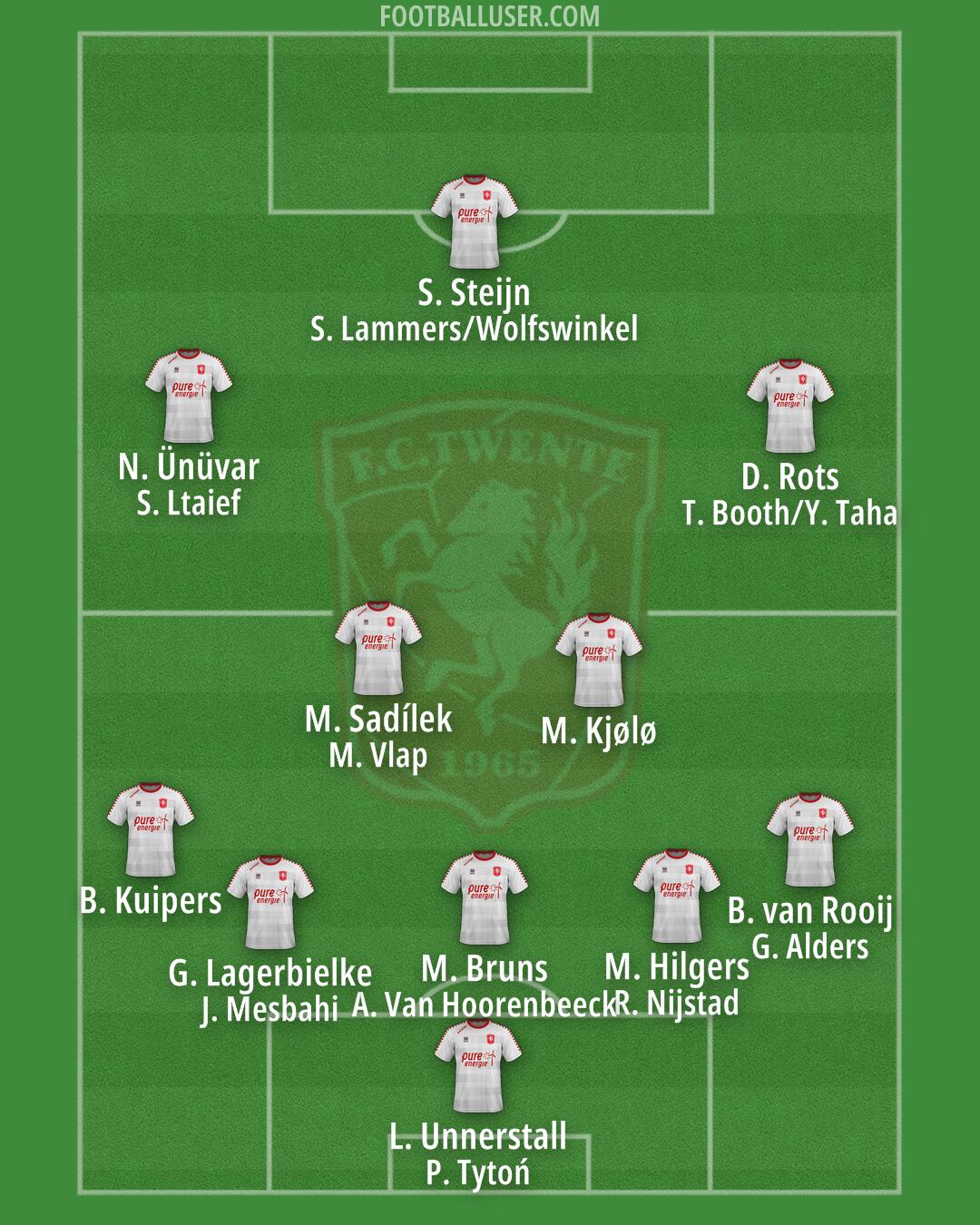
L. Unnerstall (P. Tytoń) · M. Hilgers (R. Nijstad) · M. Bruns (A. Van Hoorenbeeck) · G. Lagerbielke (J. Mesbahi) · B. Kuipers · B. van Rooij (G. Alders) · M. Sadílek (M. Vlap) · M. Kjølø · N. Ünüvar (S. Ltaief) · D. Rots (T. Booth/Y. Taha) · S. Steijn (S. Lammers/Wolfswinkel)FC Twente aims to control games through a high press and quick transitions using a 5-2-3 formation. This lineup is built to stay compact in a mid-block before winning the ball high up the pitch to catch opponents out of position. The system relies on intense work rates to squeeze the space and punish mistakes.
L. Unnerstall starts between the posts to command the area and kick start play. The defensive unit sits in a back five where M. Bruns acts as the central anchor to win the second ball. M. Hilgers plays as the right centre-back to cover space and provide aerial strength, while G. Lagerbielke occupies the left centre-back slot to step up and intercept passes. On the flanks, B. van Rooij works as an attacking wing back to provide width on the right, and B. Kuipers operates as an attacking wing back on the left to push high and support the attack.
A double pivot in midfield provides the engine for FC Twente. M. Sadílek works to press aggressively to win the ball high, while M. Kjølø acts as the carrier to drive forward with the ball once possession is regained. These two midfielders connect the defensive line to the front three, with Sadílek often dropping to help the back five while Kjølø looks to progress through the thirds. Their job is to win the ball back quickly and immediately find the attackers in space.
The attacking unit utilizes three attackers across the front to stretch the defence. S. Steijn operates as a pressing centre-forward to pin the last defender and hold up the ball for others. On the wings, N. Ünüvar and D. Rots act as inverted wingers who cut inside to create central overloads. This movement creates space for the wing backs to overlap the winger and deliver crosses. The forwards work to press the opposition back line, looking to trigger a press that leads to direct runs in behind.
This formation offers specific tactical advantages including the ability to press high in coordinated waves. The back five provides compactness when defending, making it difficult for opponents to find gaps between the lines. By using wide wing backs, the team can create wide overloads to bypass a narrow defensive block.
The 5-2-3 formation provides a solid platform for high intensity pressing and rapid counter attacks. It is best suited for games against teams that struggle to play out from the back or leave space behind their defensive line.