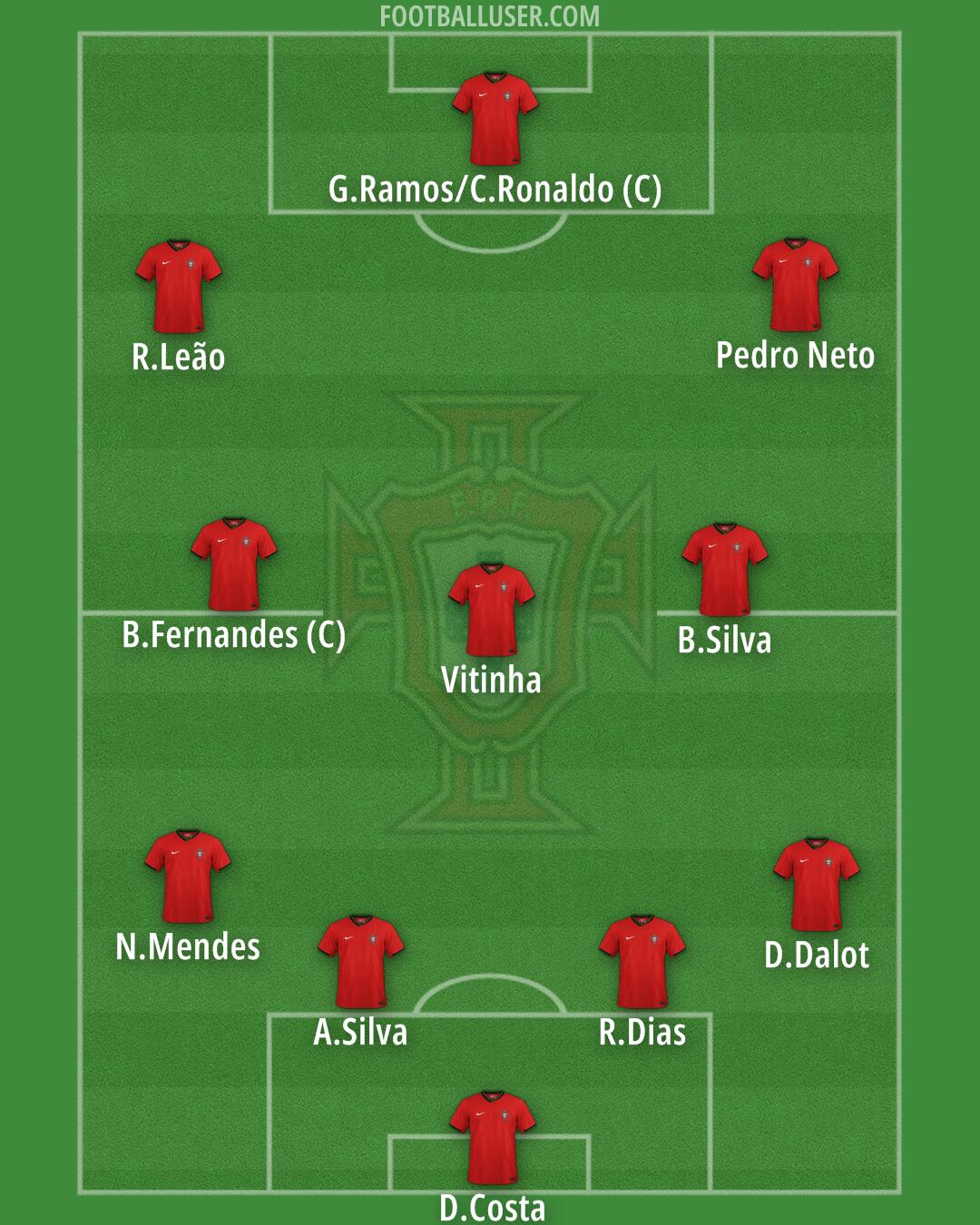

Portugal National Football Team Formation
 May 30, 2025
 bosan
bosan


Starting Lineup
D.Costa · N.Mendes · A.Silva · R.Dias · Vitinha · B.Fernandes (C) · B.Silva · R.Leão · Pedro Neto · G.Ramos/C.Ronaldo (C) · D.DalotPortugal focuses on high pressing and quick transitions through a 4-3-3 formation. The lineup is built to win the ball high up the pitch and use technical players to control the tempo. By playing with a high line and aggressive wide players, the team seeks to stretch the opposition and create space in the central areas.
Diogo Costa plays between the posts to command the area and start play from the back. The defense functions as a flat back four where Ruben Dias acts as the dominant presence in the air and a leader in the line. Alongside him, Antonio Silva provides cover and reads the game to intercept passes. Nuno Mendes acts as an attacking left back to provide width, while Diogo Dalot operates on the right to either overlap or tuck inside.
The midfield works as a three-man unit with a focus on ball retention and movement. Vitinha operates as a carrier who drives forward with the ball to break the lines of the opposition. Bruno Fernandes, who is the captain, plays as the creative engine to play through the lines and find runners. Alongside him, Bernardo Silva connects the defensive and attacking lines, using his dribbling style to keep possession in tight spaces and recycle the ball when needed.
In the attacking third, Portugal uses three attackers to pin the last defender. Rafael Leão plays as an inverted winger on the left to cut inside and create goal threats, while Pedro Neto stays wide on the right to stretch the defence. Goncalo Ramos or Cristiano Ronaldo leads the line as a central striker to find the feet of the attackers or make runs in behind. This frontline presses from the front to force a long ball and create turnovers.
This formation offers significant advantages through its ability to press high in coordinated waves. The team can create wide overloads when Nuno Mendes and Rafael Leão combine to isolate the opposition full back. Portugal also benefits from the speed of transition, using the technical quality of the midfield to find the wingers as they break quickly.
The tactical identity of Portugal relies on aggressive pressing and technical ball progression. This formation is best suited for matches where the team needs to dominate possession and pin the opponent in their own half.