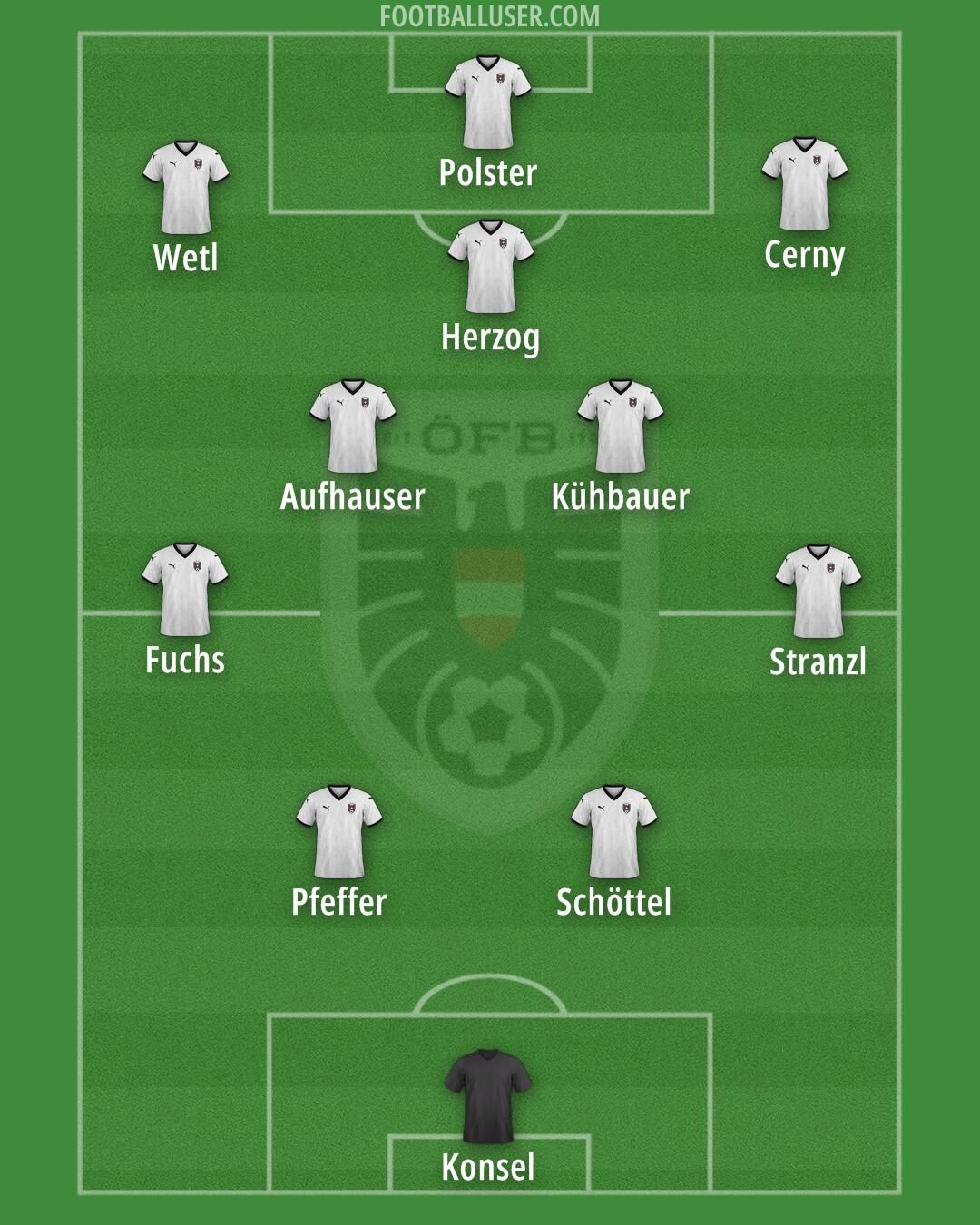

Austria National Football Team Formation
 May 31, 2025


Starting Lineup
Polster · Cerny · Herzog · Kühbauer · Aufhauser · Wetl · Pfeffer · Schöttel · Konsel · Stranzl · FuchsAustria focuses on heavy central occupation and overwhelming the middle with a 2-5-3 formation. This lineup aims to control the center of the pitch through sheer numbers, creating a heavy presence that makes it difficult for opponents to build play through the middle. The team looks to dominate the ball and squeeze the space in the center to force play into less dangerous areas.
Konsel stays between the posts to manage the defensive line. The back line consists of a narrow pair of central defenders, Schöttel and Pfeffer, who must maintain a high line to keep the team compact. Because there are only two defenders, Schöttel and Pfeffer need to be prepared to cover large areas of space and win the second ball when the high press is bypassed. They must step up quickly to catch attackers offside and act as the last line of defense before the goalkeeper.
The midfield is the engine room of the Austria lineup, utilizing a five man unit to control the tempo. Stranzl and Fuchs operate as a double pivot to shield the two defenders, with Stranzl acting to break up play and Fuchs to recycle possession. Ahead of them, Kühbauer and Aufhauser operate in the half spaces to link the play and drive the ball forward. Herzog plays as an attacking ten, sitting in the hole to find pockets of space and provide the final pass to the forwards.
In the attacking phase, the team employs three attackers to stretch the defense. Polster acts as the focal point, holding up the ball to bring others into play. Wetl and Cerny play as wide wingers, with Wetl pulling wide to provide width and Cerny looking to cut inside to attack the goal. This trio works to press the opposition back line from the front, making runs in behind to exploit any gaps left by a retreating defense.
One major tactical advantage is the numerical superiority in the middle of the pitch, which allows the team to dominate possession and control the game. The coordination of the five midfielders creates a compact block that is very difficult to pass through. Additionally, the ability to use the wide wingers to stretch the defense allows the central players to find more space to operate.
This 2-5-3 formation is designed to dominate games through central control and intense pressure. It is best suited for matches against teams that struggle to bypass a crowded midfield.