
Germany National Football Team Formation
 June 1, 2025


Starting Lineup
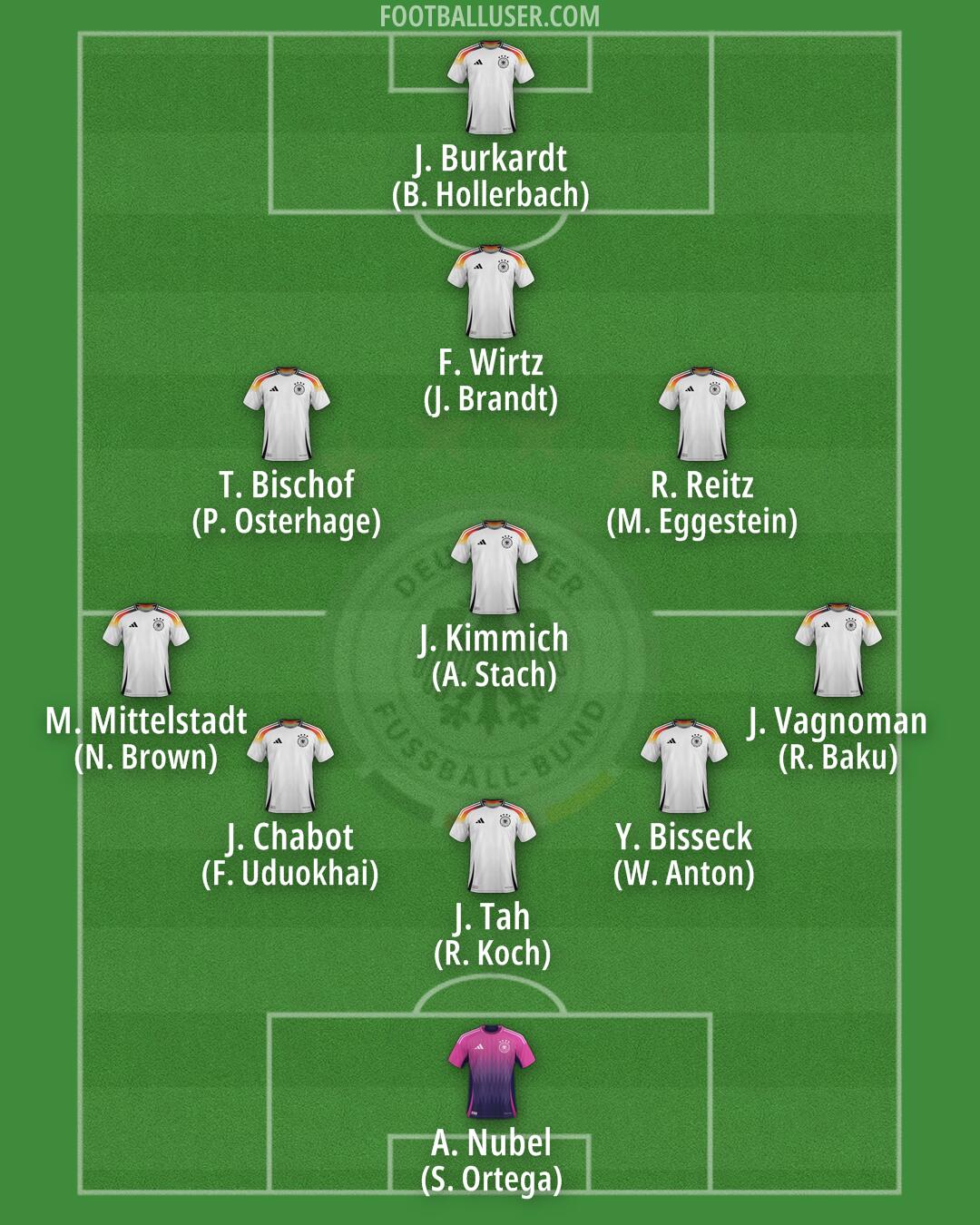
A. Nubel (S. Ortega) · J. Vagnoman (R. Baku) · M. Mittelstadt (N. Brown) · Y. Bisseck (W. Anton) · J. Tah (R. Koch) · J. Kimmich (A. Stach) · R. Reitz (M. Eggestein) · T. Bischof (P. Osterhage) · F. Wirtz (J. Brandt) · J. Chabot (F. Uduokhai) · J. Burkardt (B. Hollerbach)Germany focuses on a hard to beat defensive identity through a 5-4-1 formation. This lineup is built to sit deep and absorb pressure before looking to strike on the break. The intention for Germany is to remain compact and deny space in the middle of the pitch.
A. Nubel starts between the posts to command the area. The defensive unit operates as a back five to provide extra cover against central runs. Y. Bisseck and J. Chabot act as the central defenders, while J. Tah provides additional depth to the line. On the flanks, J. Vagnoman and M. Mittelstadt play as attacking wing backs to provide width in transition. The defensive line stays narrow to force the opposition wide.
A four man midfield sits in front of the back five to control the central zones. J. Kimmich plays as a single pivot to shield the defence and recycle possession. R. Reitz and T. Bischof occupy the central midfield roles to win the second ball and support the pivot. F. Wirtz operates as an attacking ten behind the striker to connect the lines. He uses his passing range and dribbling to drive the team forward once the ball is won.
The attacking system relies on J. Burkardt as a lone striker. He works to hold up the ball and pin the last defender to create space for others. When the team wins the ball, F. Wirtz looks to find him or drive into the half spaces. The wing backs, J. Vagnoman and M. Mittelstadt, push high to provide crosses and width. This movement forces the opposition back line to stretch, creating runs in behind for the midfielders to exploit.
This formation offers a high level of compactness when defending in a low block. It creates numerical superiority in the defensive third to stop central breakthroughs. The team can also use the speed of transition to catch opponents out when the wing backs sprint forward.
This 5-4-1 formation is designed for a team that wants to frustrate superior opponents by denying space. It is best suited for matches where the team needs to defend a lead or face a heavy attacking side.