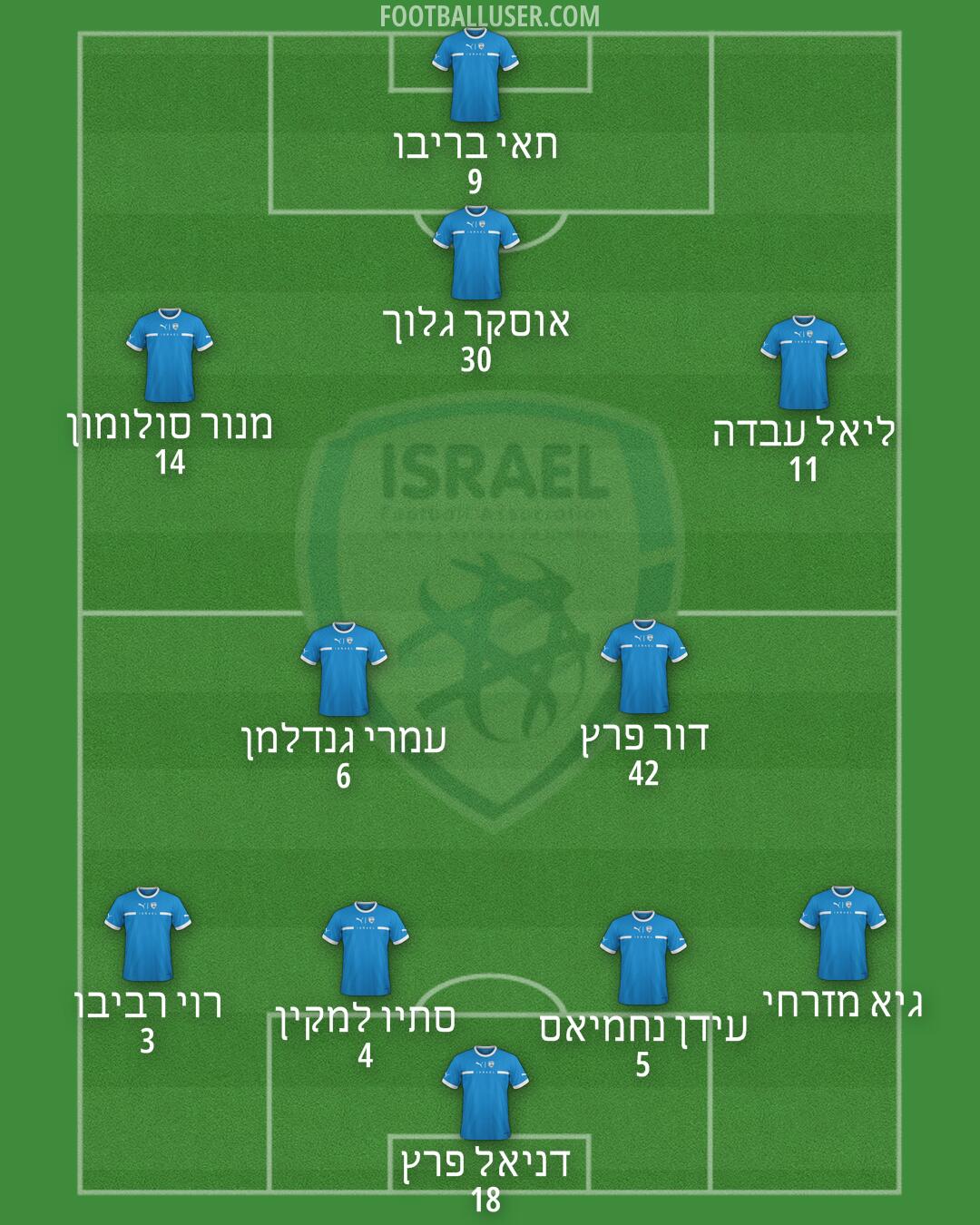

Israel National Football Team Formation
 June 1, 2025


Starting Lineup
דניאל פרץ (18) · גיא מזרחי · עידן נחמיאס (5) · סתיו למקין (4) · רוי רביבו (3) · דור פרץ (42) · עמרי גנדלמן (6) · ליאל עבדה (11) · אוסקר גלוך (30) · מנור סולומון (14) · תאי בריבו (9)Israel focuses on a heavy vertical game with a 4-2-4 formation. This lineup aims to overwhelm the opposition by committing many players forward to exploit space in the final third. The goal is to use high intensity to win the ball and strike quickly before the defense can settle.
In goal, דניאל פרץ acts as the first line of defense. The back four remains relatively flat when the team sits in a mid-block, with גיא מזרחי and רוי רביבו acting as full backs. עידן נחמיאס and סתיו למקין operate as the central defensive pair, tasked with holding the line and winning headers. While the full backs look to push up during attacking phases, the two central defenders must stay deep to cover for any long balls played behind them.
The midfield relies on a double pivot to link the defense to the front four. עמרי גנדלמן and דור פרץ work to control the center of the pitch. One player often stays deeper to shield the defense while the other attempts to carry the ball forward. They must work hard to intercept passes and recycle possession to find the attackers. This pairing is vital for preventing counter attacks when the team commits so many players into the attacking zone.
Attacking with four players allows Israel to stretch the defence significantly. מנור סולומון and ליאל עבדה operate as wide wingers who look to cut inside and create chances. In the center, אוסקר גלוך and תאי בריבו work as a strike partnership. אוסקר גלוך uses his passing range and dribbling to pull defenders out of position, while תאי בריבו looks to find space in the box. The front four press the opposition back line to force a long ball and win it back high up the pitch.
A major advantage of this 4-2-4 is the ability to create wide overloads and isolate wingers in one on one situations. By pushing the wingers high, the team forces the opposition full backs to stay deep, which creates more space for the midfield to operate. The numerical superiority in the box during crosses also makes the team very dangerous in the final third.
This formation is built for teams that want to play with high risk and high reward. It is best suited for games where the team needs to score goals against a side that plays a deep defensive block.