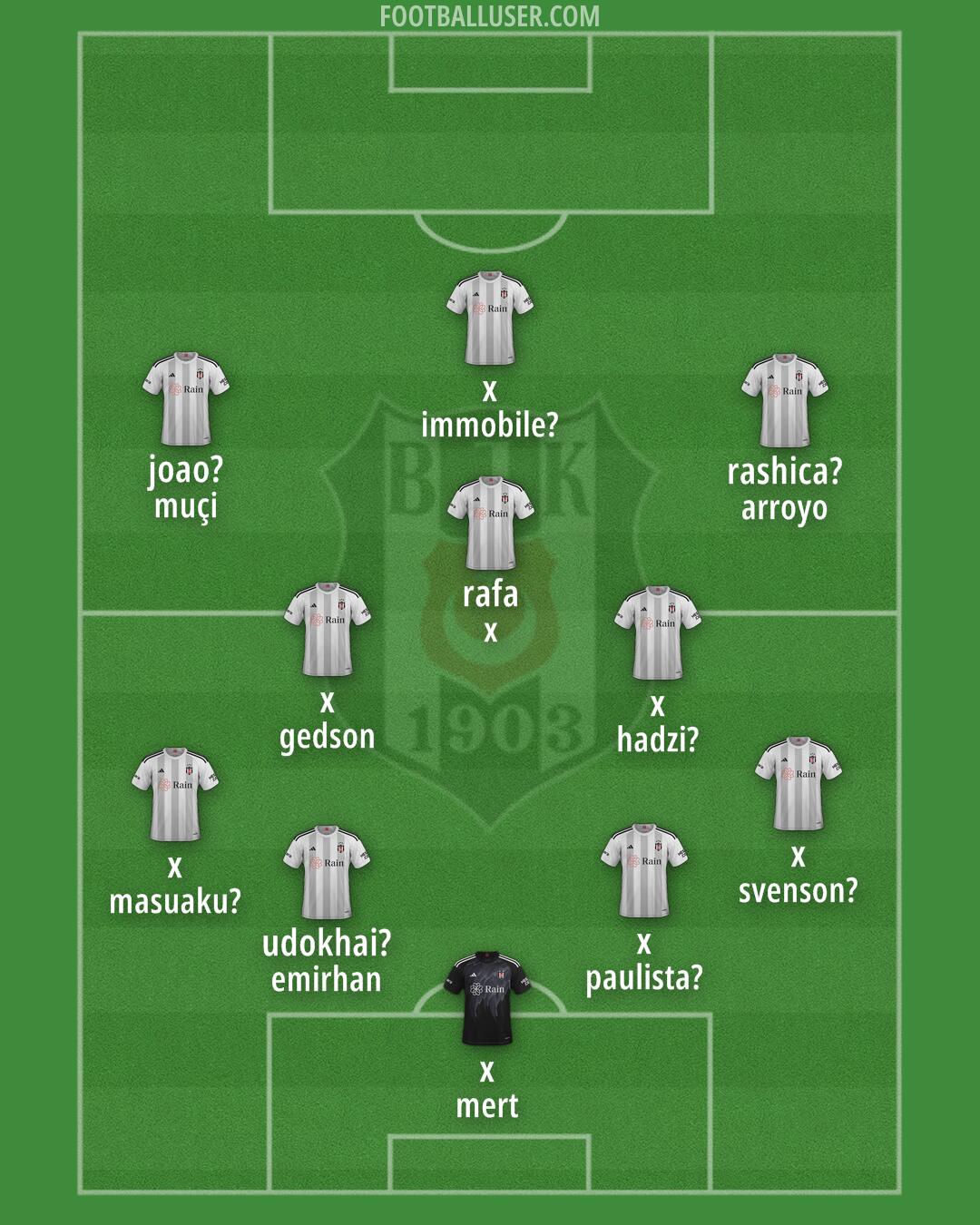

Besiktas Football Formation
 June 1, 2025


Starting Lineup
x (mert) · x (paulista?) · udokhai? (emirhan) · x (masuaku?) · x (svenson?) · x (gedson) · x (hadzi?) · rashica? (arroyo) · rafa (x) · joao? (muçi) · x (immobile?)Besiktas focuses on a high press and rapid transitions using a 4-3-3 formation. This lineup aims to win the ball high up the pitch and move the play forward quickly to catch opponents off guard. The tactical intent is to control the game through aggressive pressing and direct attacking movements that stretch the opposition.
Between the posts, x acts as the last line of defense. The defensive unit sits in a flat back four with udokhai? acting as a left centre-back. The central defenders must defend zonally and stay connected to avoid gaps. The wide defenders are tasked with providing width and must track back to cover the flanks when the team loses possession. This defensive unit works together to squeeze the space and maintain a high line to support the press.
The midfield consists of a three-man midfield with a carrier and a creative spark. The two central midfielders work to win the second ball and connect the defensive line to the attack. Rafa operates as an attacking ten behind the striker, looking to play through the lines and find pockets of space. This group must press in a mid-block to prevent the opposition from playing out from the back, while the midfielders also help to recycle possession when the tempo needs to slow down.
In the attacking third, Besiktas employs three attackers to pin the last defender. Joao? and Rashica? operate as inverted wingers who cut inside to create goalscoring chances. Rashica? uses his pace to threaten runs in behind, while Joao? looks to combine in tight spaces. The lone striker serves as a focal point to hold up the ball and lay it off to the oncoming midfielders. The front three press from the front to force a long ball from the opposition.
One major advantage of this Besiktas formation is the ability to press high in coordinated waves, making it difficult for opponents to build play. The team also benefits from the speed of transition when the wingers hit in behind on the transition. By using inverted wingers, the team creates overloads in the central areas, allowing the midfielders to arrive late into the box and exploit the space created by the wide players.
This 4-3-3 formation is built to dominate games through aggressive pressing and quick verticality. It is best suited for matches against teams that struggle to play out from the back or those that leave space behind their defensive line.