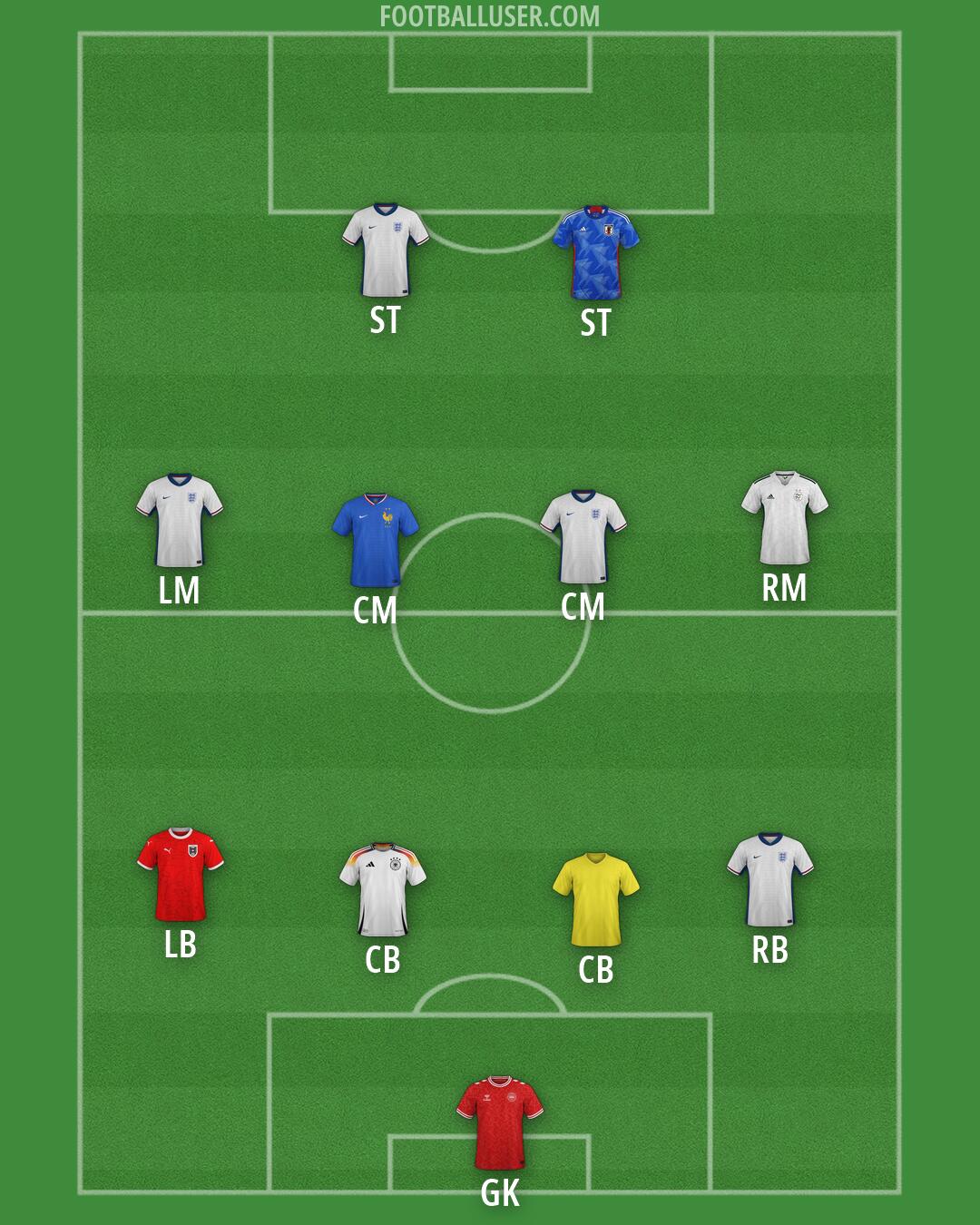
Custom Team Football Formation
 June 3, 2025


Starting Lineup
GK (Denmark) · RB (England) · CB (South Africa) · CB (Germany) · LB (Austria) · RM (Algeria) · CM (England) · CM (France) · LM (England) · ST (Japan) · ST (England)A heavy emphasis on a direct and vertical style of play defines this team as they operate in a 4-4-2 formation. The goal is to use the width of the pitch to stretch the opposition and strike quickly when opportunities arise. This lineup is built to win second balls and exploit gaps in the opponent defensive line through rapid transitions.
In goal, GK acts as the last line of defense to sweep up any long balls played over the top. The defensive unit functions as a flat back four, with RB and LB tasked with maintaining the width and tracking back to cover the flanks. CB and CB sit deep to hold the line, focusing on winning headers and clearing the lines when under pressure. This back four works together to maintain a compact shape, ensuring they do not leave space between the wide defenders and the central pair.
The midfield operates in two banks of four to control the central areas. LCM and RCM act as the engine room, with one player often dropping deep to shield the defense while the other seeks to carry the ball forward into the half spaces. LM and RM provide the necessary width, staying high to pin the opposition full backs and look to whip it in toward the box. The midfield unit is designed to press in a mid-block, forcing the opponent to play long and then looking to intercept the ball to start a counter.
Up front, the team utilizes two strikers in a partnership to create constant movement. LS and RS work in tandem, often playing off each other to pull defenders out of position. One striker may act as a target man to hold up the ball, while the other looks to run in behind the defense to receive through balls. This duo presses from the front, constantly bothering the opposition centre backs to prevent them from playing out from the back. Their movement creates many chances for cutbacks and knock it in behind scenarios.
The main tactical advantages of this 4-4-2 include the ability to create wide overloads when the full backs join the LM and RM in attack. There is also a significant strength in the speed of transition, as the team can move from a defensive block to an attacking threat in seconds. This formation allows for high levels of compactness when defending, making it very difficult for opponents to find space between the lines.
This formation provides a reliable way to play a direct and physical brand of football. It is best suited for matches against teams that play a high line and can be punished on the break.