Custom Team Football Formation
 June 4, 2025


Starting Lineup
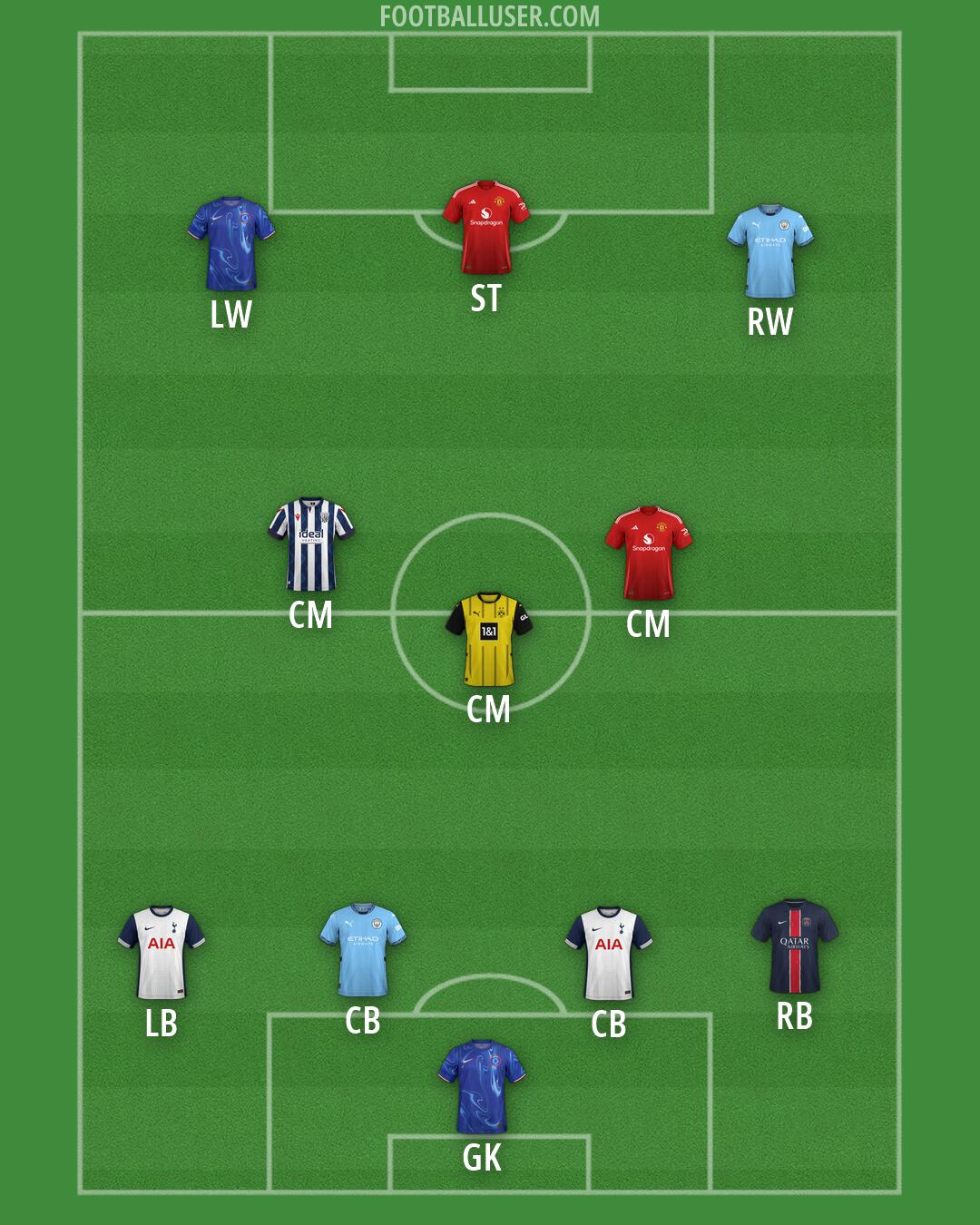
GK (Chelsea) · RB (PSG) · CB (Tottenham) · LB (Tottenham) · CB (Man City) · CM (West Brom) · CM (Borussia Dortmund) · CM (Man Utd) · RW (Man City) · ST (Man Utd) · LW (Chelsea)This team aims to control the game through high pressing and quick ball movement, operating within a 4-3-3 formation. The goal is to win the ball back high up the pitch and use the wide areas to stretch the opposition. This lineup relies on aggressive pressing and rapid transitions to catch opponents out of position.
The goalkeeper sits behind a flat back four to maintain a compact defensive block. LB and RB act as full backs who provide width, often pushing up to overlap the wingers. The central defenders, CB and CB, work as a unit to hold the line and defend zonally. While one might step up to intercept a pass, the other stays back to cover the space behind, ensuring the team can play out from the back safely.
The midfield operates as a three-man midfield with a single pivot. CM acts as the defensive shield, sitting in front of the back four to deny the pivot and pick up runners. The two other midfielders, LCM and RCM, operate in the half-spaces to connect the defensive and attacking lines. They are tasked to carry the ball forward, press in a mid-block, and arrive late into the box to support the attack.
In the final third, the team utilizes three attackers across the front. LW and RW act as inverted wingers who cut inside to create space for the full backs, while ST serves as a pressing centre-forward to trigger the press from the front. The attack is built on quick combinations and movement to pull wide, creating gaps in the middle for LCM or RCM to exploit. They look to split the defence with a through ball or find the feet of the striker to maintain pressure.
One major strength is the ability to press high in coordinated waves, forcing a long ball from the opposition. The formation also creates wide overloads when the full backs push up to join the wingers. This makes it difficult for opponents to defend the flanks, as they must constantly track back to deal with the extra numbers.
This 4-3-3 formation is built for aggressive, high-intensity football that seeks to dominate territory. It is best suited for matches against teams that struggle to play out from the back or fail to handle intense pressure.