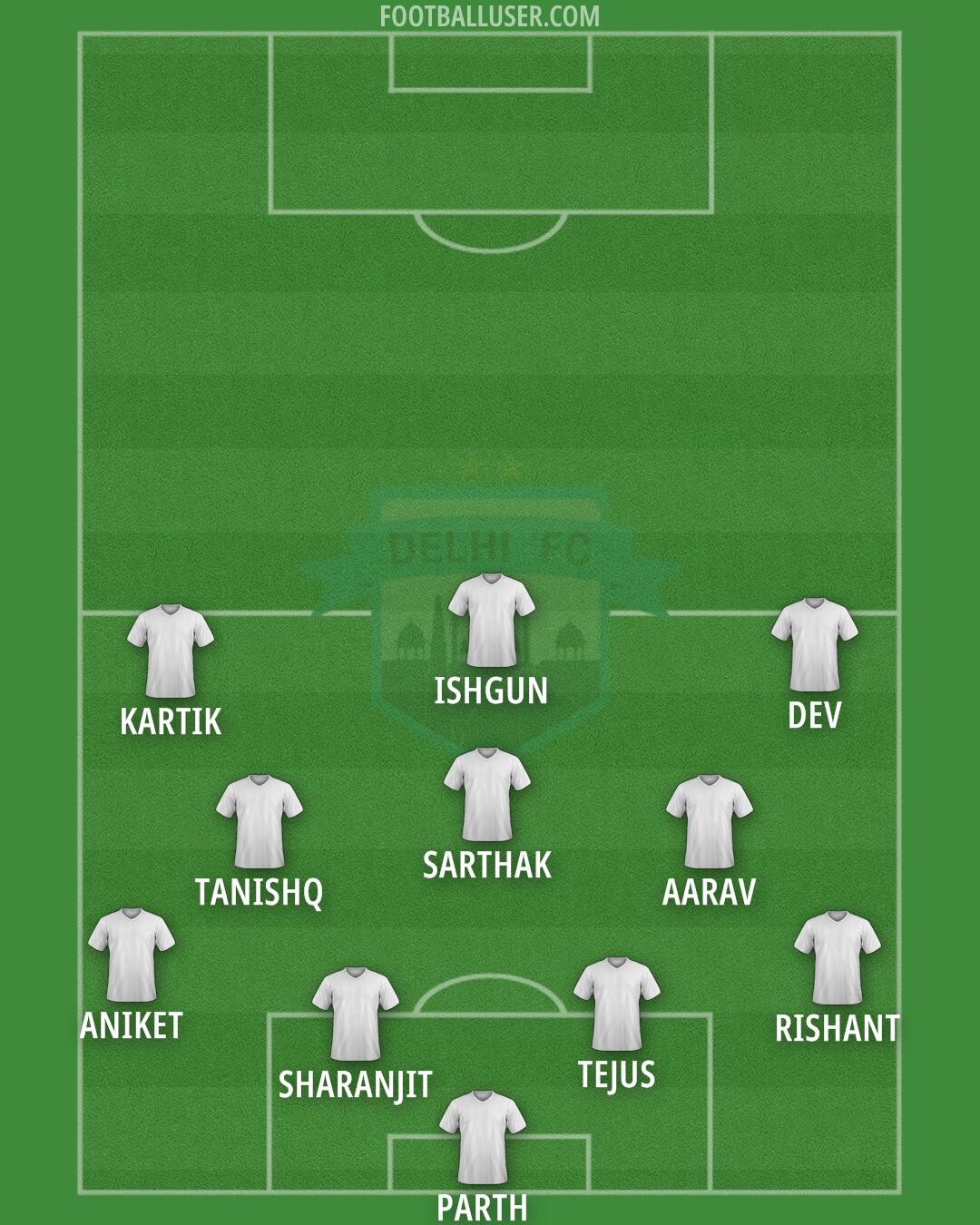

Delhi FC Football Formation
 June 5, 2025


Starting Lineup
ISHGUN · PARTH · SHARANJIT · TEJUS · ANIKET · RISHANT · SARTHAK · TANISHQ · DEV · KARTIK · AARAVDelhi FC plays with a clear intent to dominate through a high press and quick transitions using a 4-3-3 formation. This lineup aims to control the game by squeezing the space in the opponent half and winning the ball back high up the pitch. The team seeks to use their verticality to catch the opposition before they can settle.
In the defensive unit, PARTH guards the goal. The back line operates as a flat back four where ANIKET acts as the left back and RISHANT plays as the right back. Both full backs are tasked to push forward and provide width. SHARANJIT and TEJUS form the central pair, with the left side covered by SHARANJIT and the right by TEJUS. They work together to defend zonally, with one often stepping up to intercept while the other covers the space behind.
The midfield is a three man unit that connects the defence to the attack. SARTHAK sits in the center to protect the back four and recycle possession. On either side, TANISHQ and AARAV operate in the half spaces. TANISHQ plays as the left central midfielder to drive forward with the ball, while AARAV works as the right central midfielder to help win the second ball. This group works to compress the midfield and deny the turn to opposition players.
Moving into the attacking third, Delhi FC uses three attackers to stretch the defence. ISHGUN leads the line as a lone striker, looking to hold up the ball or run in behind. KARTIK operates on the left wing and DEV on the right wing. While KARTIK prefers to cut inside to create chances, DEV stays wider to whip it in. This combination allows the team to create space and use the width provided by the wingers to pull wide defenders out of position.
A major strength of this Delhi FC formation is the ability to press high in coordinated waves. By using TANISHQ, AARAV, and SARTHAK to squeeze the space, the team can often win the ball in dangerous areas. Another advantage is the ability to create wide overloads when ANIKET and RISHANT overlap the winger. This creates constant pressure on the opposition flanks and allows for quick cutbacks.
This 4-3-3 formation is built for a team that wants to control the tempo through aggressive pressing and rapid ball movement. It is best suited for matches against teams that play a high defensive line and struggle to defend transitions.