Man City Football Formation
 June 5, 2025


Starting Lineup
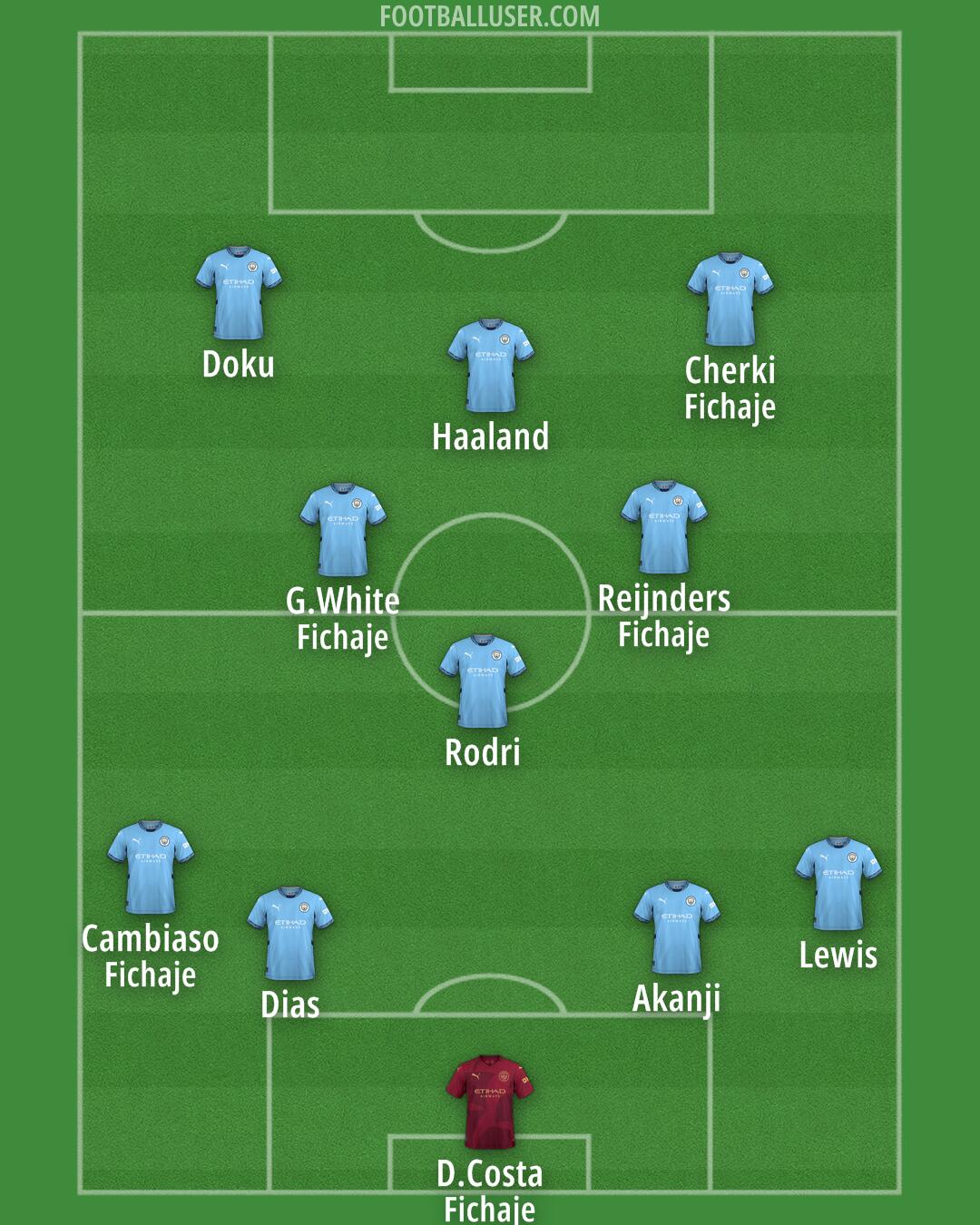
D.Costa (Fichaje) · Cambiaso (Fichaje) · Lewis · Dias · Akanji · Rodri · Reijnders (Fichaje) · G.White (Fichaje) · Haaland · Cherki (Fichaje) · DokuMan City aims to control games through heavy possession and high pressing, utilizing a 4-3-3 formation. This lineup focuses on dominating the ball and squeezing the pitch to force errors from the opposition. By keeping the ball in tight spaces and moving it quickly between players, the team looks to dictate the tempo from the back.
D.Costa starts between the posts to anchor the defense. The back line operates as a flat back four, where Lewis acts as the right back to provide width while Cambiaso operates on the left. In the center, Akanji and Dias form a strong pairing, with Dias often using his aerial strength and leadership to organize the unit. Akanji plays as a ball playing defender to help build play from the back, while the unit maintains a high line to keep the team compact.
The midfield functions with a single pivot to control the central zone. Rodri sits in front of the defense to shield the back four and recycle possession. Beside him, G.White and Reijnders operate as two central midfielders who connect the defensive and attacking lines. Reijnders drives forward with the ball to break the line, while G.White works to win the second ball and support the transition. This three man midfield allows the team to control the center of the pitch.
An attacking front three stretches the opposition defense. Doku and Cherki act as wide wingers, with Doku looking to take on defenders with his dribbling style and Cherki cutting inside to create chances. Haaland plays as a lone striker and a pressing centre-forward, using his physical presence to pin the last defender. The attackers work to win the ball high up the pitch and look to hit in behind on the transition, often using the width provided by the wingers to create space for Haaland to find the feet of the striker.
One major advantage for Man City is the ability to create wide overloads when the wingers and full backs combine. The midfield also offers numerical superiority in the center, making it difficult for opponents to bypass the central block. This coordination allows the team to press in waves and recover the ball quickly after losing it.
This 4-3-3 formation is built for sustained dominance and high intensity. It is best suited for matches against teams that sit deep and defend in a low block.