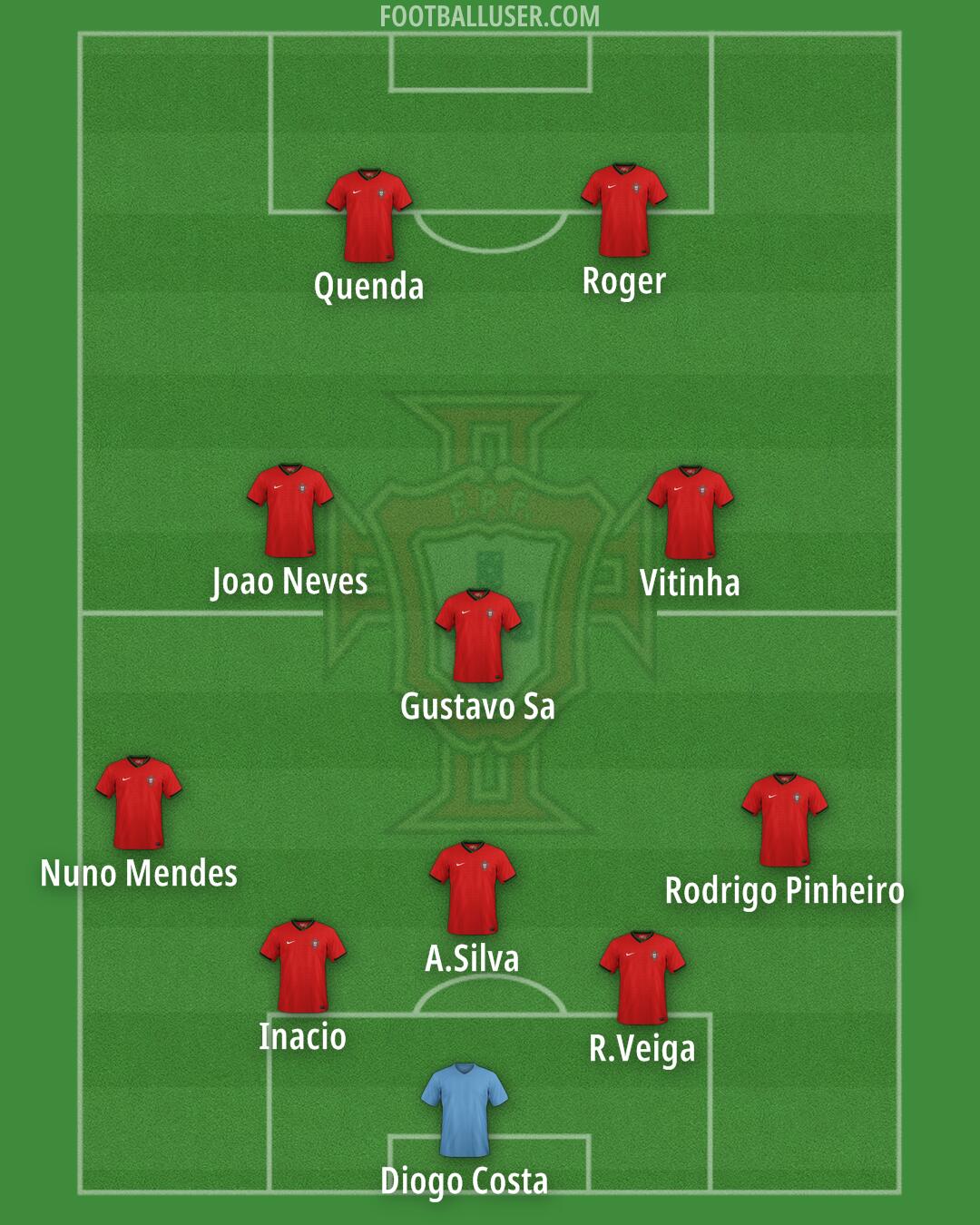

Portugal National Football Team Formation
 June 6, 2025


Starting Lineup
Quenda · Roger · Vitinha · Joao Neves · Gustavo Sa · Diogo Costa · Nuno Mendes · Inacio · A.Silva · R.Veiga · Rodrigo PinheiroPortugal relies on a solid defensive base to launch quick attacks using a 5-3-2. This formation is built to sit deep and absorb pressure before hitting teams on the break. The team looks to maintain a compact block when out of possession, making it difficult for opponents to find space. The goal is to stay solid and then use the pace of the forwards to exploit the opposition.
Diogo Costa starts in goal to command the area and organize the back line. The defensive unit functions with a back three of R.Veiga, A.Silva, and Inacio. R.Veiga and Inacio serve as wide centre-backs, providing cover and stepping into space to support the play, while A.Silva remains central to win the header and defend the zone. Inacio uses his ball playing ability to help move the ball out from the back. Rodrigo Pinheiro and Nuno Mendes operate as attacking wing backs. They are tasked to push high up the pitch to provide width, but they must also track back to maintain a narrow defensive block when the ball is lost.
The midfield works with a three-man unit to manage the center of the pitch. Gustavo Sa plays as a single pivot to shield the defence and protect the three centre-backs. Beside him, Vitinha and Joao Neves operate as the two central midfielders. Vitinha uses his passing range to switch play and find teammates, while Joao Neves uses his high pressing intensity to win the ball high up the pitch. This group connects the defensive and attacking lines by recycling possession and moving the ball through the thirds.
In the final third, Portugal uses two forwards in a partnership. Quenda and Roger lead the line, looking to find space between the defenders. They often look to run in behind the opposition back line to catch them out. The attack relies on the movement of the wing backs, as Rodrigo Pinheiro and Nuno Mendes overlap to stretch the defence. This creates space for Quenda and Roger to combine in tight spaces or for Vitinha to arrive late into the box. The team focuses on quick transitions to catch the opponent before they can reset.
One tactical advantage is the ability to create wide overloads. When the wing backs push forward, they can isolate the opposition wide players in one on one situations or double up on the flanks. Another strength is the numerical superiority in the defensive block, which makes the team very hard to play through. This compactness allows Portugal to squeeze the space in the middle and force a long ball from the opponent.
This 5-3-2 formation offers a very stable platform for a team that prefers to defend deep. It is best suited for facing teams that dominate possession and can be punished on the counter.