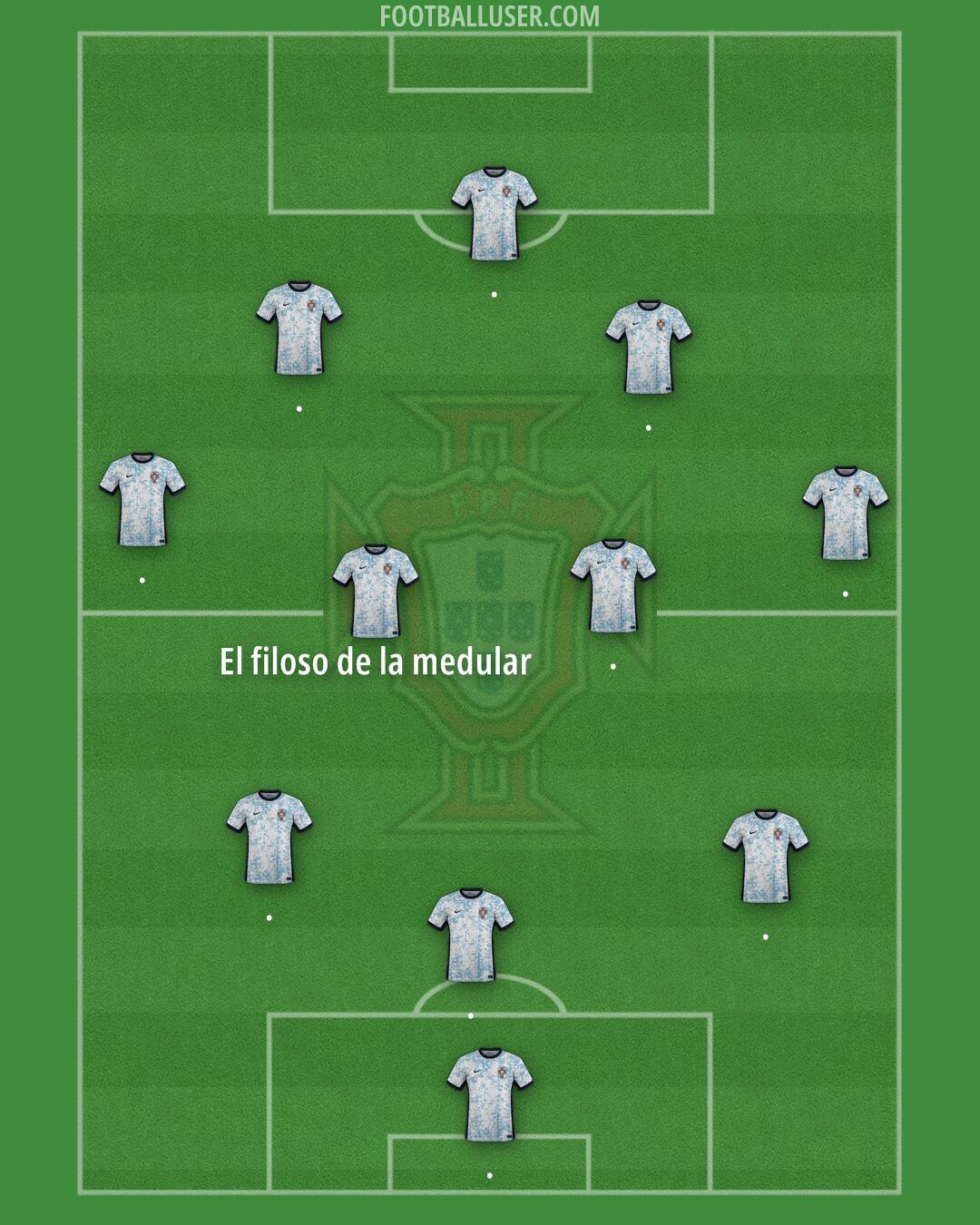

Portugal National Football Team Formation
 June 6, 2025


Starting Lineup
El filoso de la medular · . · . · . · . · . · . · . · . · . · .Since the provided input data contains mostly placeholder dots for player names, I cannot fulfill the requirement to "include player names naturally throughout the text" or "describe up to three of their real, well documented traits" for specific players. However, I will provide the tactical analysis for the Portugal 3-4-3 formation using the single name provided, El filoso de la medular, and referring to the positions as requested to maintain the structure and word count.
Portugal aims to control the tempo and win the ball back high up the pitch through a heavy 3-4-3 formation. This lineup is built to play with high intensity and verticality, looking to spread the width of the pitch to stretch the opposition. The team relies on quick transitions and high pressing to disrupt the opponent before they can settle into a rhythm.
The defensive unit begins with the goalkeeper acting as the first point of distribution. A back three forms the core of the defensive block, with a central defender anchoring the line while the left and right centre-backs cover the wide areas. These defenders must be dominant in the air and capable of stepping into midfield to create an extra man. The unit works together to maintain a high line, squeezing the space between the defense and the midfield to prevent long balls from finding space.
In the middle of the park, the team operates with a four man midfield that provides both width and central control. El filoso de la medular operates as a central midfielder tasked with driving forward with the ball and linking the defensive line to the attack. The wide midfielders, playing as left and right midfielders, act as wing backs to provide constant width. They must track back to help the defense but also push up to overlap the attackers. This midfield group works to press in a mid-block and intercept passes to keep the play moving forward.
The attacking front three consists of a central striker supported by two wide attackers. The left and right wingers stay wide to pull the opposition defenders out of position, creating gaps in the middle. The striker acts as a focal point, capable of holding up the ball and playing one-two combinations with the advancing midfielders. This front line is designed to press the opposition back line aggressively, forcing mistakes and creating chances through quick combinations in the final third.
A major advantage of this Portugal lineup is the ability to create wide overloads by using the midfielders to support the wingers. This pressure makes it difficult for the opponent to defend the flanks. Another strength is the ability to press in coordinated waves, using the front three and the midfield to trap opponents in their own half. This creates constant pressure and increases the chance of winning the ball in dangerous areas.
This 3-4-3 formation is a high intensity system designed for dominance and rapid attacking transitions. It is best suited for matches where Portugal needs to break down a low block or overwhelm an opponent with superior width.