
Peru National Football Team Formation
 June 10, 2025


Starting Lineup
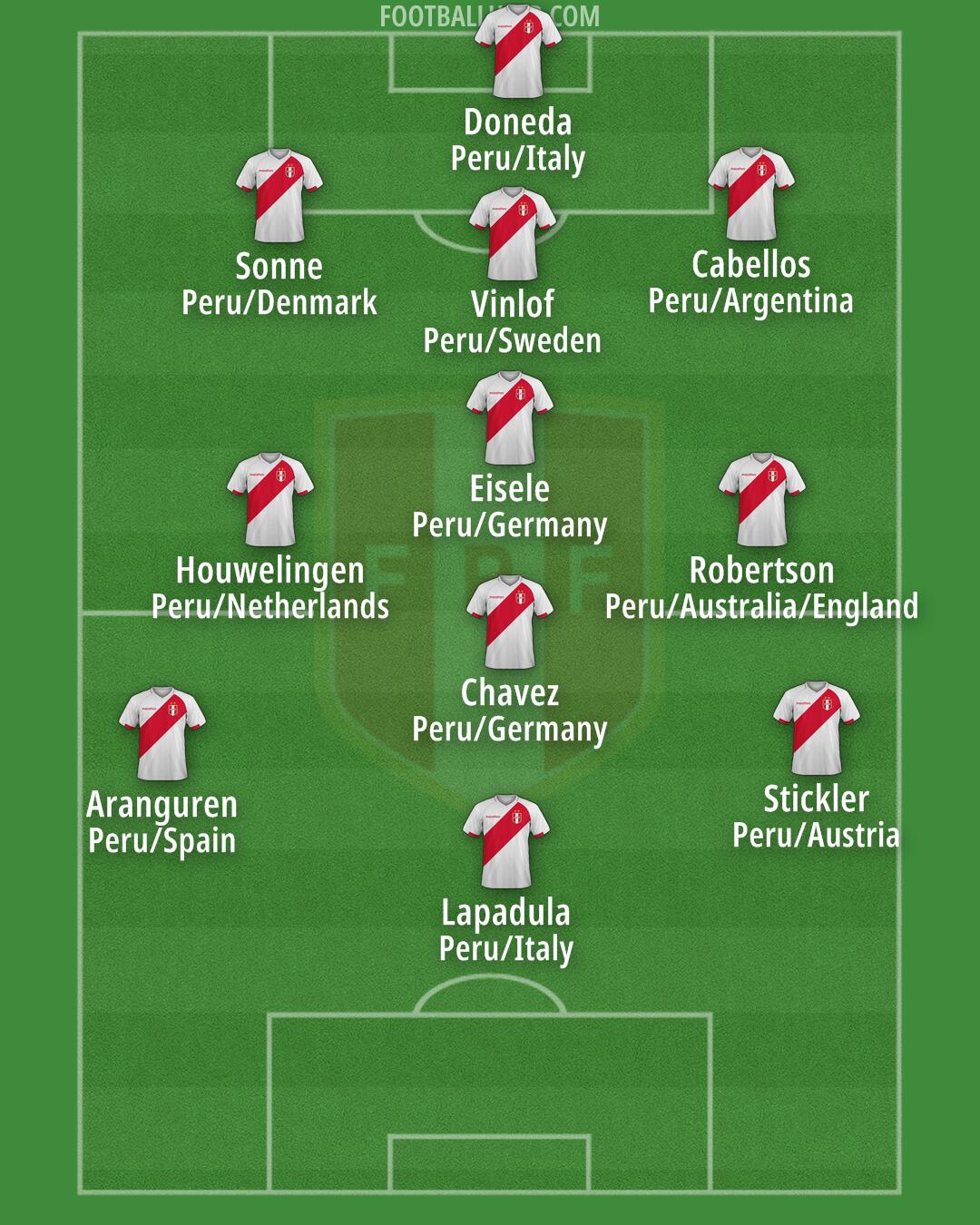
Lapadula (Peru/Italy) · Aranguren (Peru/Spain) · Stickler (Peru/Austria) · Chavez (Peru/Germany) · Robertson (Peru/Australia/England) · Houwelingen (Peru/Netherlands) · Eisele (Peru/Germany) · Sonne (Peru/Denmark) · Vinlof (Peru/Sweden) · Cabellos (Peru/Argentina) · Doneda (Peru/Italy)Peru relies on a high press and rapid vertical transitions within a 3-4-3 formation. This lineup is built to win the ball high up the pitch and hit the opponent before they can settle. By spreading the pitch wide, the team forces the opposition to stretch, creating gaps for runners to exploit through the middle.
Doneda starts between the posts to organize the defensive line. Behind the midfield, a back three provides a solid foundation, with Vinlof acting as the central figure to hold the line and command the area. Cabellos and Sonne operate as the wide centre-backs, responsible for covering the space when the midfield is bypassed and stepping up to squeeze the space between the lines. This unit functions to maintain a high line, using the offside trap to prevent long balls from getting behind.
The midfield functions as a central engine to control the tempo and disrupt play. Eisele sits as a single pivot to shield the defence and recycle possession when the team needs to reset. To his sides, Houwelingen and Robertson act as runners who drive forward with the ball to link the back three to the attack. Chavez operates in the hole as an attacking ten, looking to find pockets of space between the opponent's midfield and defence to play through the lines.
In the final third, Peru uses three attackers to pin the opposition back. Lapadula acts as a pressing centre-forward to harass the defenders and hold up the ball for incoming runners. Stickler and Aranguren play as wide wingers who hug the touchline to provide maximum width. These wide players look to isolate one on one defenders or cut inside to create shooting opportunities. The attack relies on quick combinations and runs in behind to punish mistakes in transition.
A major advantage for Peru is the ability to press high in coordinated waves, using the front three to trigger a press that the midfield can immediately join. This setup also creates numerical superiority in the wide areas when the wingers and wide centre-backs combine to overload the flanks. The presence of Chavez in the half-spaces makes it difficult for opponents to defend the central zone.
This 3-4-3 formation is designed to dominate teams that struggle to play out from the back under pressure. It is most effective when facing opponents that play a high line and can be caught on the break.