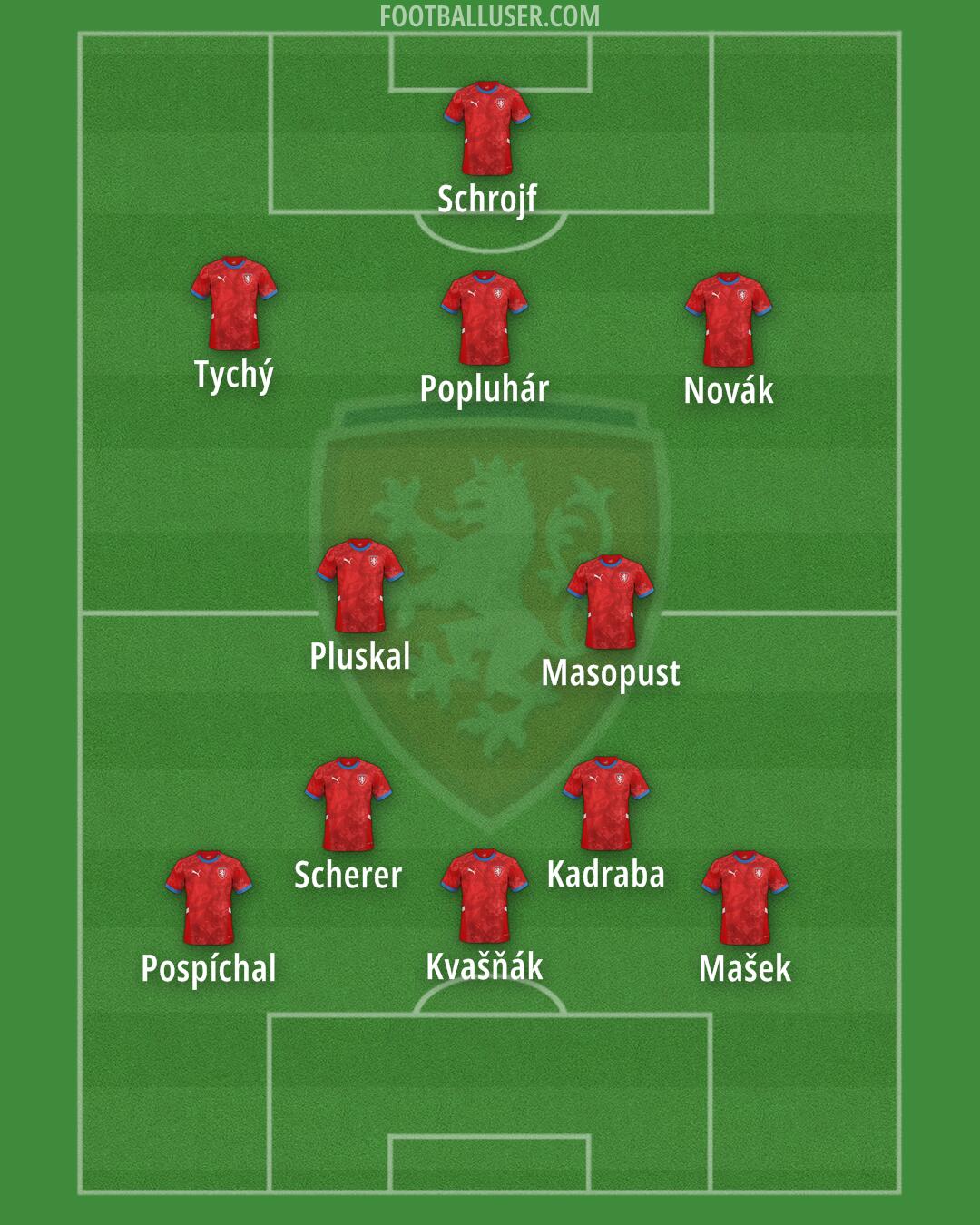

Czechia National Football Team Formation
 June 11, 2025


Starting Lineup
Schrojf · Tychý · Popluhár · Novák · Pluskal · Masopust · Pospíchal · Mašek · Kvašňák · Scherer · KadrabaCzechia plays a vertical style of football using a 3-4-3 formation. The team seeks to win the ball back high up the pitch and strike quickly before the opponent can settle. This lineup is built to exploit spaces behind the opposition defence through rapid passing and heavy movement.
Schrojf guards the goal within a back three that maintains a high line. Popluhár acts as the central defender to win the header and clear the lines, while Tychý and Novák operate as wide centre-backs. Tychý will step up to intercept passes and cover the space, whereas Novák stays ready to track back if the ball is switched. The defensive unit works to squeeze the space and defend zonally to prevent central penetration.
The midfield is controlled by a double pivot consisting of Pluskal and Masopust. Pluskal works to shield the defence and drop between the centre-backs to receive, while Masopust tries to win the second ball and carry the ball forward. Kadraba and Scherer occupy the half-spaces as two tens who link the midfield to the attack. His passing range allows Kadraba to find runners, while Scherer looks to arrive late into the box to score.
The attack features three players with Kvašňák leading the line as a pressing centre-forward. Mašek and Pospíchal act as inverted wingers who cut inside to create more central presence. While Mašek pulls wide to stretch the defence, Pospíchal looks to hit in behind on the transition. Kvašňák works to hold up the ball and lay it off for others to combine in tight spaces. This formation aims to isolate wide players in one on one situations.
A major strength for Czechia is the ability to press in coordinated waves from the front three and the two tens. The double pivot provides compactness when defending the middle, making it hard for opponents to play through the lines. Wide overloads occur when Kadraba and Scherer push up to support the wingers. This creates many chances to deliver early crosses or cut it back from the byline.
This formation is a high-intensity tool for teams that want to dominate the ball and win it back high up the pitch. It is best suited for facing opponents that struggle to play out from the back or leave space behind their defenders.