Man City Football Formation
 June 11, 2025


Starting Lineup
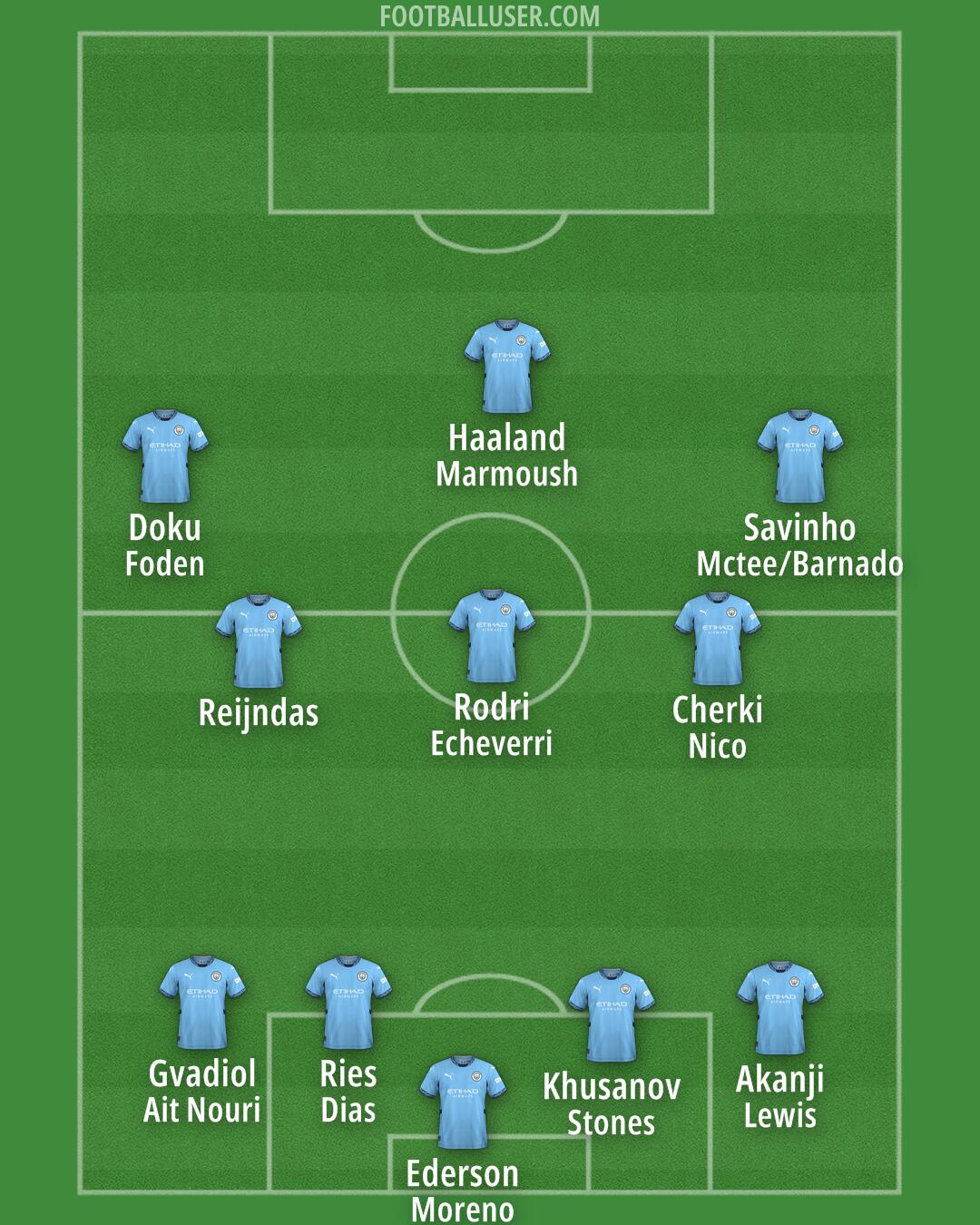
Ederson (Moreno) · Gvadiol (Ait Nouri) · Ries (Dias) · Khusanov (Stones) · Akanji (Lewis) · Reijndas · Rodri (Echeverri) · Cherki (Nico) · Doku (Foden) · Haaland (Marmoush) · Savinho (Mctee/Barnado)Manchester City seeks to control matches through heavy possession and high pressure within a 4-3-3 formation. This lineup aims to dominate the ball and squeeze the pitch to keep the opponent pinned in their own half. The goal is to use short passing to move the ball through the thirds and create chances in central areas.
Ederson plays between the posts as the primary distributor to play out from the back. The defensive unit operates with a flat back four that can push high to squeeze the space. Akanji acts as a right back who can overlap or tuck inside, while Gvadiol plays on the left to provide cover. Khusanov and Ries function as the central defenders, with Ries acting as a ball playing defender to start attacks. This back line must stay compact to prevent runners from getting behind.
The midfield works through a three man midfield with a single pivot. Rodri sits in the center to shield the defence and recycle possession when the team needs to reset. Cherki operates in the half space to connect the lines and link the defence to the attack. Reijndas acts as the carrier to drive forward with the ball and move it into the final third. This trio works together to win the second ball and maintain control of the middle of the pitch.
An attacking trio leads the press from the front. Haaland acts as a pressing centre forward to pin the last defender and hold up the ball for others. On the flanks, Doku and Savinho act as inverted wingers who cut inside to create goal scoring opportunities. Doku uses his dribbling style to beat defenders one on one, while Savinho looks to create space. The team builds the attack by using the wide players to stretch the defence before playing through the lines to Haaland.
Manchester City gains a major advantage through numerical superiority in midfield, allowing them to control the tempo. The ability to press high in coordinated waves forces the opposition into mistakes near their own goal. Using the width provided by the wingers allows the team to isolate wide players in one on one situations to break the lines.
This 4-3-3 formation is built for teams that want to dominate territory and dictate the rhythm of the game. It is most effective against opponents that sit in a low block and struggle to deal with constant ball movement.