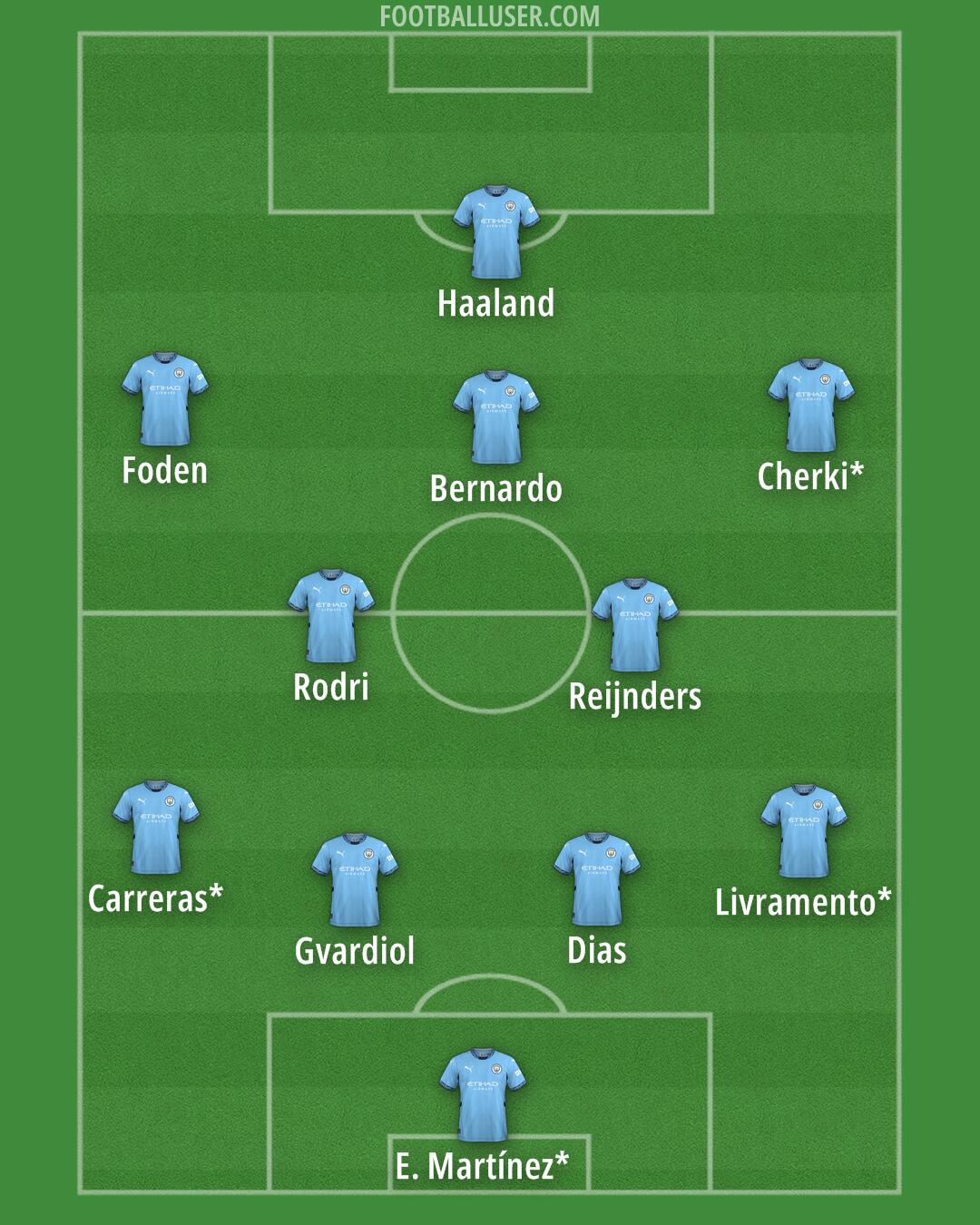
Man City Football Formation
 June 14, 2025


Starting Lineup
E. Martínez* · Dias · Gvardiol · Livramento* · Carreras* · Rodri · Bernardo · Reijnders · Foden · Cherki* · HaalandMan City plays with a heavy attacking intent, utilizing a 4-2-4 formation. This lineup is built to press high and attack with extreme verticality to overwhelm the opposition. The primary goal is to win the ball back high up the pitch and quickly move it into the final third to catch the opponent out of position. This formation relies on constant movement to pull the opposition out of their defensive block and create space for the attackers to exploit.
E. Martínez, the captain, stays between the posts to help play out from the back. The defense functions as a flat back four with Carreras and Livramento, both captains, acting as the wide defenders. Gvardiol and Dias occupy the center of the defense to hold the line. Dias is dominant in the air and helps to clear the lines when the ball is played long, while Gvardiol works to cover space and step up to intercept passes. The whole unit must stay compact to prevent being caught on the break.
The midfield utilizes a double pivot to connect the defensive unit and the attacking line. Rodri sits deep to shield the defense and recycle possession, acting as a key link to move the ball forward. Reijnders acts as the carrier, driving with the ball to break the line of the opposition midfield. This pairing helps to squeeze the space in the center and stop the opposition from playing through the lines. They are essential in winning the second ball to keep the pressure on.
Up front, Man City deploys four attackers to stretch the defense. Cherki, the captain, and Foden act as inverted wingers who cut inside to create chances and pull the full backs out of position. Haaland serves as a powerful target man to finish moves, while Bernardo plays in the hole to find the feet of Haaland and link up play between the lines. The forwards press from the front to force a long ball and disrupt the build up.
This formation offers a massive advantage in the final third due to its heavy numbers. By using four attackers, the team creates wide overloads and forces the opposition defenders to sit deep and stay in position. The ability to press in coordinated waves means the team can win the ball back high up the pitch and strike quickly in transition. This creates many chances to exploit the space behind the defense.
This 4-2-4 lineup is built for high-intensity, vertical football. It is best suited for situations where the team needs to overwhelm a low block or punish an opponent through constant pressure and rapid attacking waves.