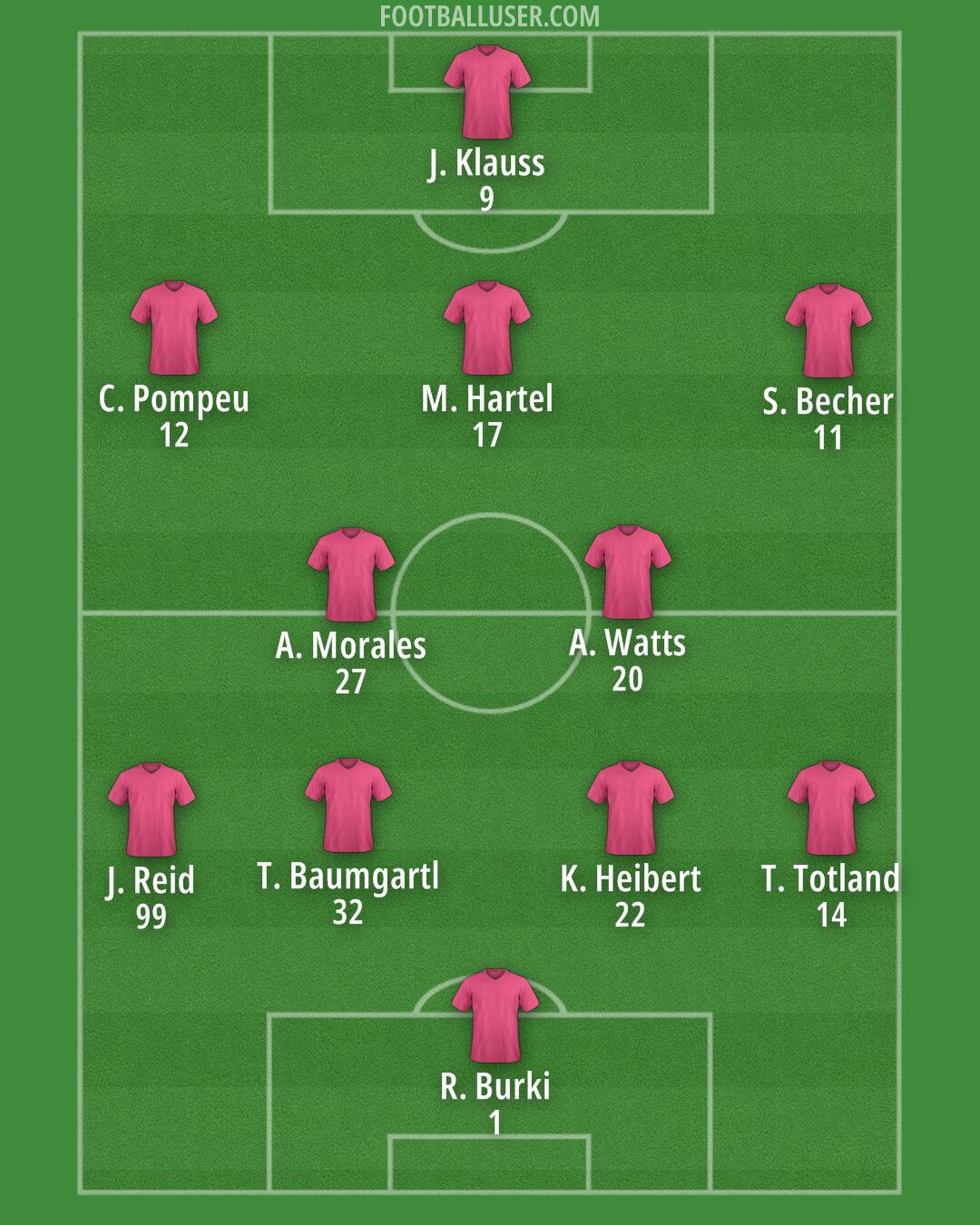
St. Louis CITY Soccer Formation
 June 14, 2025


Starting Lineup
R. Burki (1) · J. Reid (99) · T. Totland (14) · T. Baumgartl (32) · K. Heibert (22) · A. Morales (27) · A. Watts (20) · C. Pompeu (12) · M. Hartel (17) · S. Becher (11) · J. Klauss (9)St. Louis CITY relies on a defensive identity built to frustrate opponents through a compact 5-4-1. This formation is designed to sit deep and absorb pressure before looking to hit the opposition in transition. The lineup prioritizes density in central areas to make it difficult for other teams to play through the middle.
J. Klauss stays between the posts to anchor the defense. The back line operates as a narrow defensive block with three central defenders. A. Morales acts as the right centre-back, while A. Watts covers the left side, leaving M. Hartel to hold the center. S. Becher plays as the left wing back to provide width and track back when needed, whereas C. Pompeu acts as the right wing back to cover the entire flank. These defenders work as a single unit to squeeze the space and force the ball wide.
The midfield consists of a flat four that works to compress the midfield area. T. Baumgartl and K. Heibert form the central pairing to shield the defense and win the second ball. T. Totland and J. Reid operate on the flanks to mark the opposition wide players and help the wing backs. These four players shift together to block passing lanes and ensure the team stays compact when defending in a mid-block.
R. Burki acts as the lone striker and is tasked to hold up the ball to allow the midfield to move up the pitch. He must fight against the opposition centre-backs and try to win the second ball to start attacks. The wide players, T. Totland and J. Reid, look to push forward and provide outlets during transitions. The team builds attacks by finding the feet of the striker or using the width provided by C. Pompeu and S. Becher to stretch the defense.
This formation offers several tactical advantages for St. Louis CITY. It provides immense compactness when defending, making it very hard to break through the central zone. The team can also utilize the speed of transition once the ball is won back in the middle. This allows the wing backs to carry the ball forward quickly and create numbers in the final third.
The 5-4-1 is a reliable way to play when the team needs to protect a lead or face a much stronger opponent. It is best suited for matches where the goal is to deny space and counter at pace.