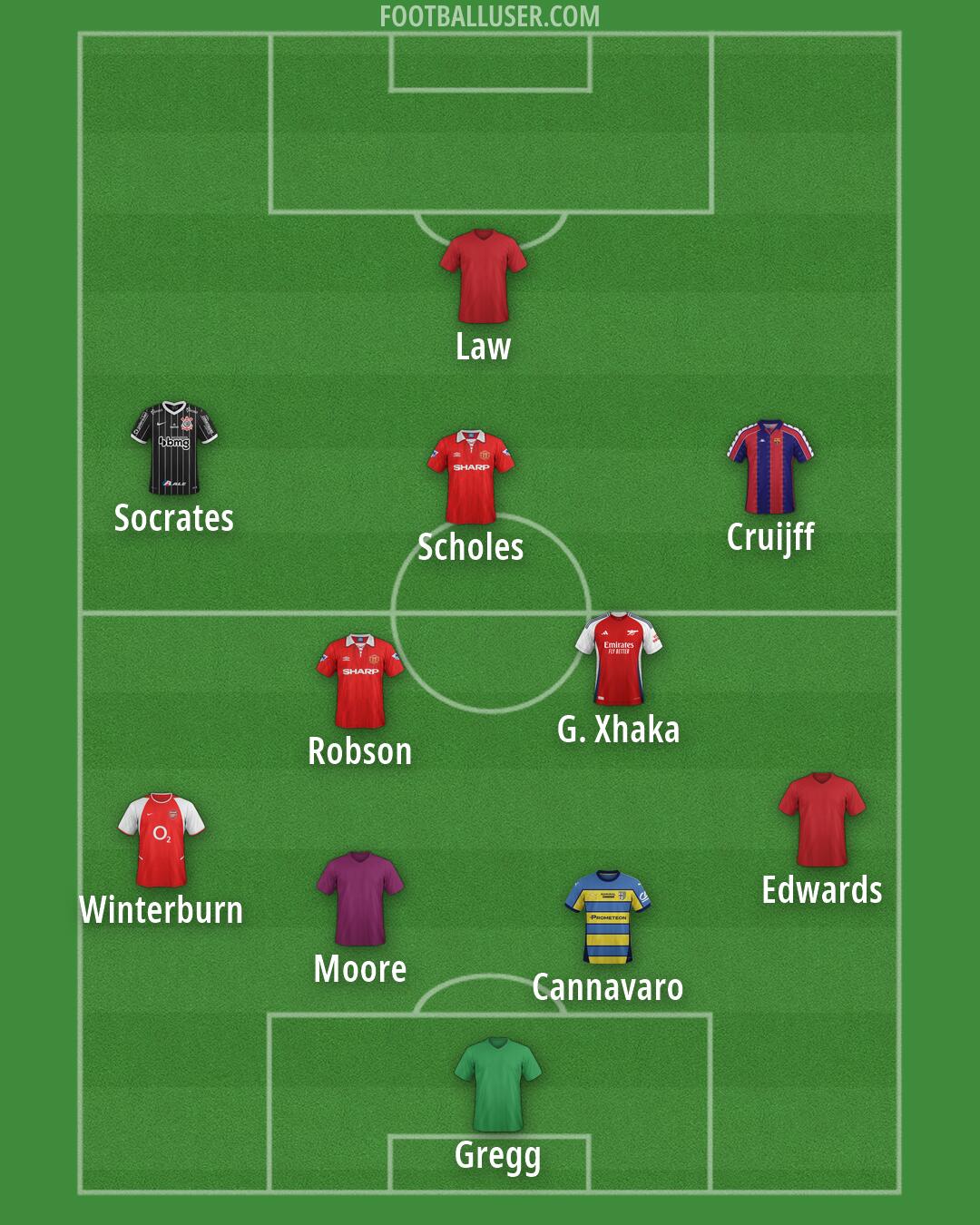
Custom Team Football Formation
 June 15, 2025


Starting Lineup
Law (Man Utd) · Scholes (Man Utd) · Robson (Man Utd) · G. Xhaka (Arsenal) · Winterburn (Arsenal) · Moore (West Ham) · Gregg (Man Utd) · Cannavaro (Parma) · Cruijff (Barcelona) · Socrates (Corinthians) · Edwards (Man Utd)A heavy focus on direct attacking play and high-intensity pressure defines this lineup in a 4-2-4. This formation is built to overwhelm opponents in the final third and score goals quickly through heavy numbers up the pitch. By committing four players to the front line, the team aims to force mistakes and exploit space in the opposition defensive line.
Gregg sits between the posts to oversee the defensive unit. The back four functions as a flat defensive block where Cannavaro acts as a ball playing defender to help start attacks. Moore covers the central area, while Winterburn and Edwards provide width from the flanks. Winterburn is expected to overlap to provide crosses, while Edwards must track back to prevent counters when the team pushes forward. The defenders work together to hold the line and prevent runners from getting behind.
The midfield relies on a double pivot to maintain control and shield the back four. Robson and G. Xhaka work in the central zone to connect the defence to the attack. G. Xhaka is known for his passing range and ability to disrupt play, making him vital for winning the second ball. Robson drives forward with the ball to support the front four, while also dropping deep to receive from the defenders. This pairing must be disciplined to prevent being bypassed in the middle of the pitch.
The attack is extremely aggressive with four players positioned high up the pitch. Law and Scholes operate as a central partnership, where Law acts as a powerful presence and Scholes looks to arrive late into the box. Socrates and Cruijff occupy the wide areas, but they are not traditional wingers. Socrates plays as an inverted winger to cut inside and create, while Cruijff uses his dribbling style and vision to manipulate the opposition. This front line is designed to create combinations in tight spaces and hit the opposition in behind on the transition.
This formation offers massive numerical superiority in the attacking third. The ability to press from the front in coordinated waves can force a long ball from the opponent. By having four attackers, the team can isolate wide players in one on one situations and create chaos in the box. The speed of transition is a major advantage when the team wins the ball high up the pitch.
This 4-2-4 lineup is a high risk, high reward system centered on goal scoring. It is best suited for matches where the team needs to break down a low block or overwhelm a less physical opponent.