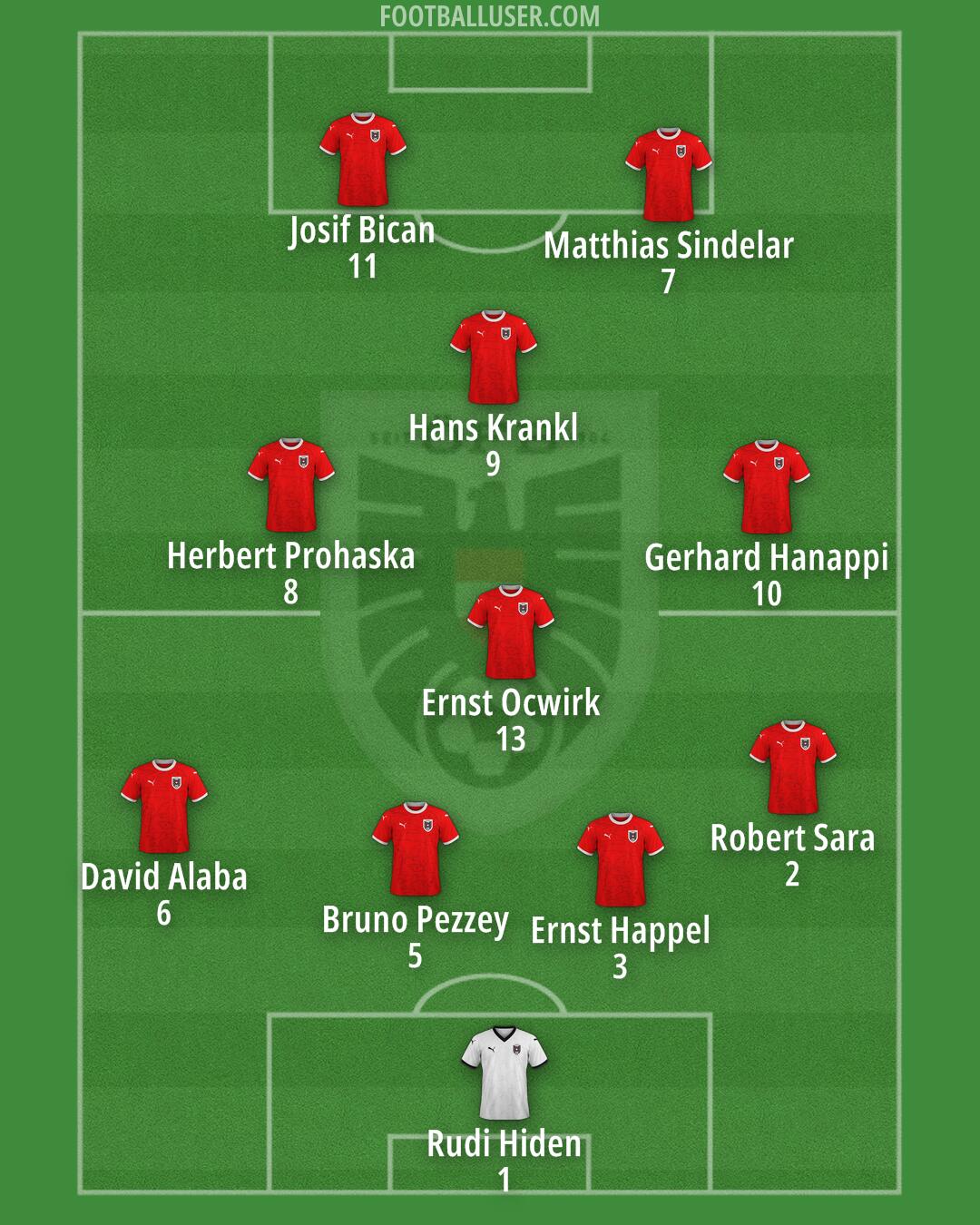

Austria National Football Team Formation
 June 16, 2025


Starting Lineup
David Alaba (6) · Josif Bican (11) · Matthias Sindelar (7) · Rudi Hiden (1) · Bruno Pezzey (5) · Robert Sara (2) · Herbert Prohaska (8) · Gerhard Hanappi (10) · Ernst Ocwirk (13) · Ernst Happel (3) · Hans Krankl (9)Austria focuses on a solid defensive base and rapid transitions using a 5-3-2 formation. This lineup is built to absorb pressure before hitting the opposition with direct verticality. The team looks to control the middle ground and exploit the space behind the opponent's back line when they commit too many bodies forward.
Rudi Hiden guards the goal as the last line of defense. The defensive unit operates with a back three consisting of Ernst Ocwirk as the central leader, flanked by Ernst Happel on the right and Bruno Pezzey on the left. Ernst Ocwirk acts as the main organizer to command the line. Robert Sara and David Alaba play as attacking wing backs to provide width and support the transition. They are expected to push high up the pitch to stretch the opponent. The central trio works to keep the space tight and win the second ball in the middle third.
A three man midfield provides the engine for Austria. Gerhard Hanappi and Herbert Prohaska occupy the central roles to control the tempo and recycle possession. Gerhard Hanappi works to cover ground and win the ball, while Herbert Prohaska looks to play through the lines with his passing range. Hans Krankl plays as an attacking ten behind the two forwards to connect the midfield and attack. He seeks to find pockets of space between the lines to receive the ball and turn towards goal.
The attack relies on a partnership of two forwards. Josif Bican and Matthias Sindelar operate as the main goal threats. Josif Bican uses his finishing ability to lead the line, while Matthias Sindelar works to find space and link play with the midfielders. The team uses the width provided by Robert Sara and David Alaba to deliver crosses into the box. They look to move the ball quickly to catch the defense out of position, using runs in behind to exploit high lines.
One major strength is the ability to defend in a compact shape while remaining dangerous on the break. The wing backs allow the team to transition from a five man defense to an attacking force with great speed. Another advantage is the numerical superiority in the central areas when Hans Krankl drops deep to assist the midfield. This creates problems for opposition pivots trying to track runners.
This 5-3-2 formation provides a balance between defensive stability and attacking directness. It is best suited for games against dominant sides where Austria needs to absorb pressure and strike on the counter.