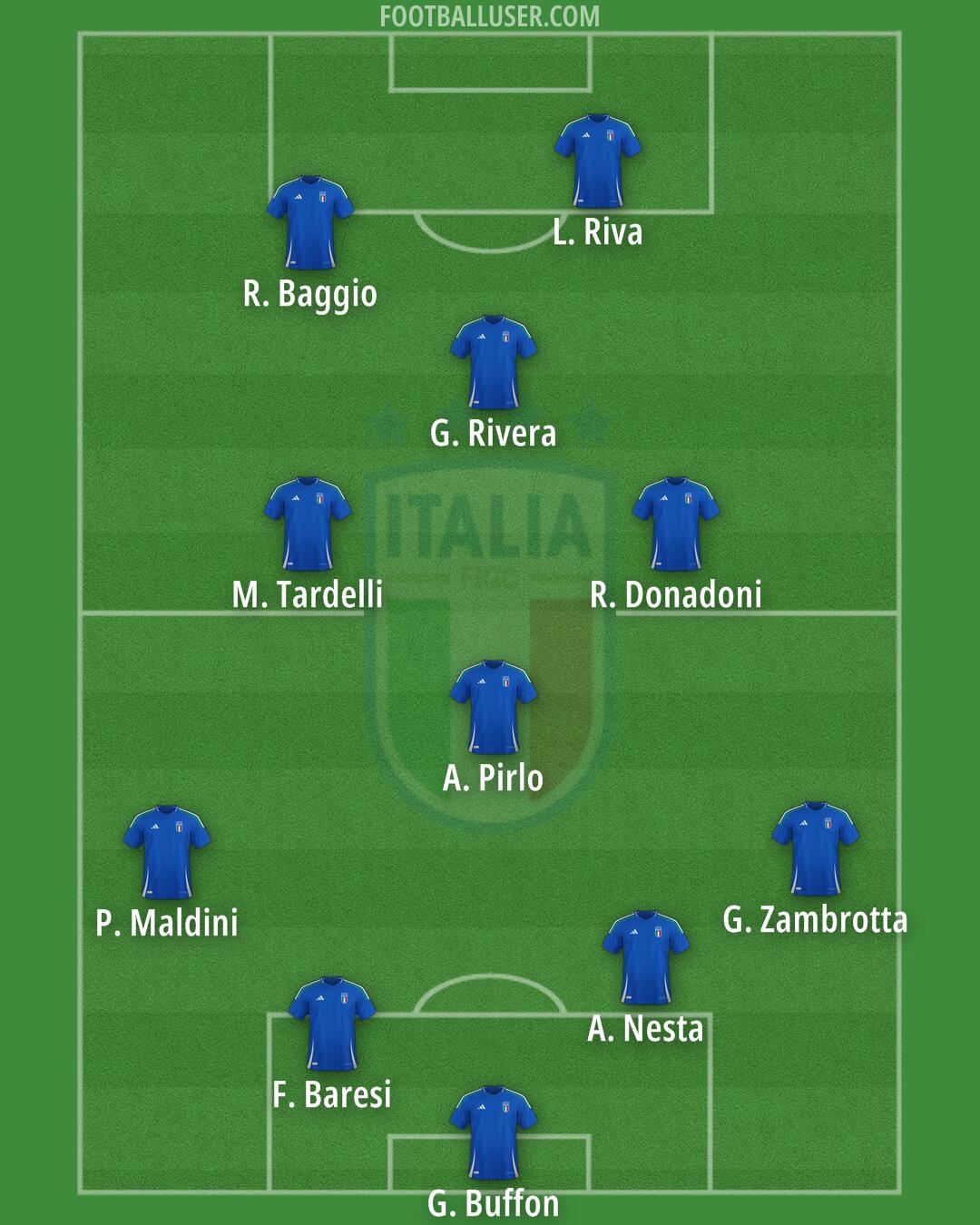

Italy National Football Team Formation
 June 17, 2025


Starting Lineup
G. Buffon · A. Nesta · F. Baresi · G. Zambrotta · P. Maldini · A. Pirlo · R. Donadoni · M. Tardelli · G. Rivera · R. Baggio · L. RivaThis Italy lineup focuses on defensive solidity and rapid transitions through a 5-3-2 formation. The team aims to sit deep and absorb pressure before using vertical passing to catch opponents out of position. This setup is built to remain extremely hard to beat while relying on individual quality to break through the lines.
Gianluigi Buffon guards the goal, acting as a sweeper behind the defensive unit. The back line consists of a back three with Alessandro Nesta and Franco Baresi acting as central defenders. Alessandro Nesta is dominant in the air and reads the game well, while Franco Baresi manages the line and covers spaces. Andrea Pirlo plays as a ball playing defender who can step into midfield to help progress the ball. The wide defenders, Paolo Maldini and Gianluca Zambrotta, act as attacking wing backs. Maldini can slide into a left back role to defend, while Zambrotta pushes up to provide width.
The midfield functions as a three man midfield with a carrier and a creative hub. Gennaro Donadoni and Marco Tardelli work in the engine room to win the second ball and press in a mid-block. Marco Tardelli provides high pressing intensity to disrupt the opposition. They connect the defense to the attack, allowing Roberto Baggio to operate in the hole. Gianni Rivera acts as the attacking ten behind the strikers, looking to play through the lines with his exceptional passing range. This midfield unit works to compress the space between the lines and prevent the opposition from playing between the units.
In the attacking phase, the team uses two forwards in a partnership. Roberto Baggio operates as a second striker in the hole, dropping deep to link with the midfield. Luigi Riva acts as the primary striker, looking to find the feet of the striker or run in behind. The attack uses the width provided by Maldini and Zambrotta to stretch the defence. When Italy win the ball, they look to hit in behind on the transition, using the combination of Baggio and Riva to exploit gaps.
Italy benefits from extreme compactness when defending a low block. The formation offers the ability to shift between a back five and a back three easily depending on whether the wing backs push high. This creates numerical superiority in the central areas and makes it difficult for opponents to find space between the lines. The speed of transition from a deep block to an attacking shape is a major advantage.
This Italy formation provides a reliable defensive foundation that is difficult to break down. It is best suited for matches against teams that dominate possession and require a disciplined unit to exploit on the break.