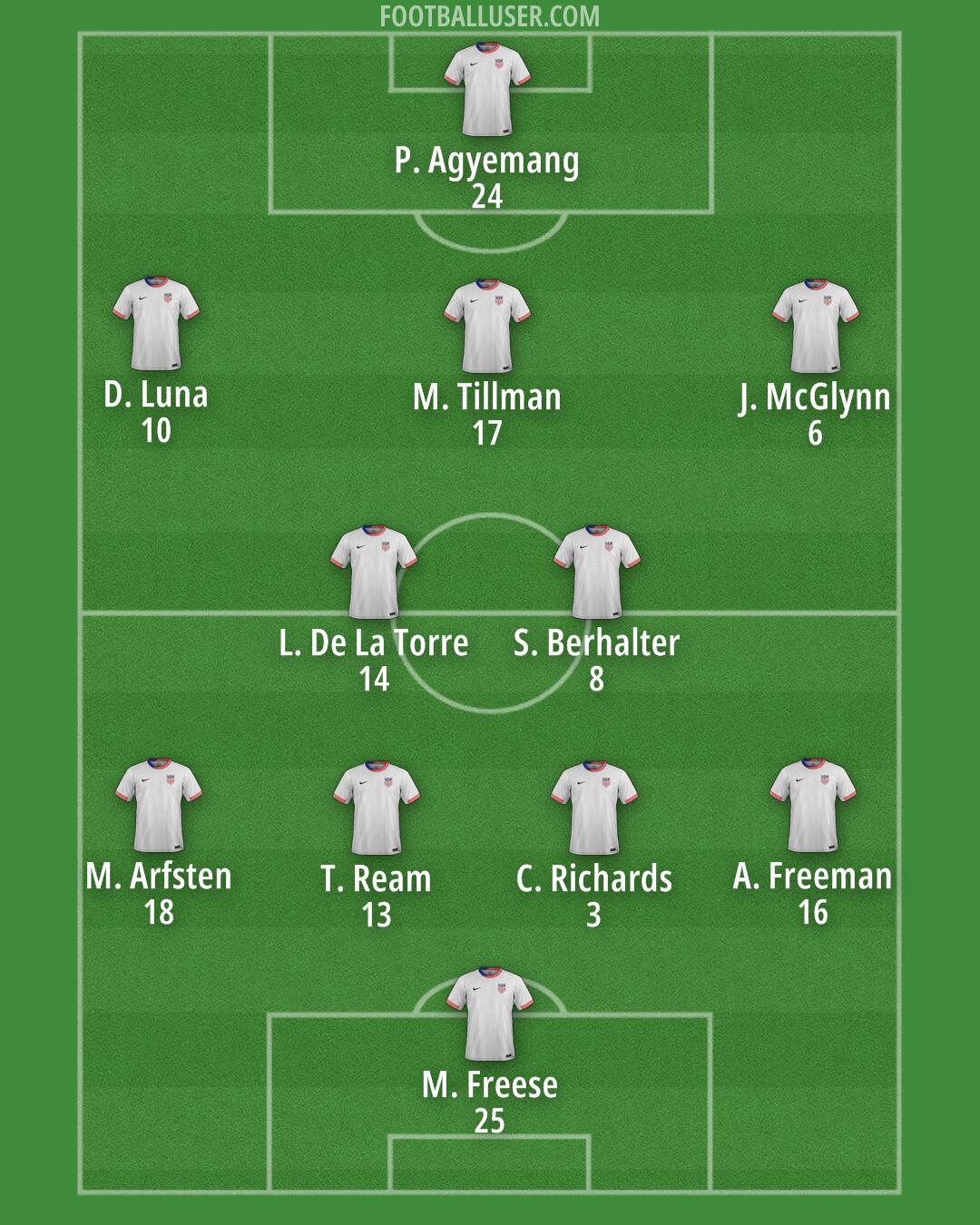
United States National Soccer Team Formation
 June 20, 2025


Starting Lineup
M. Freese (25) · M. Arfsten (18) · A. Freeman (16) · T. Ream (13) · C. Richards (3) · L. De La Torre (14) · S. Berhalter (8) · D. Luna (10) · M. Tillman (17) · J. McGlynn (6) · P. Agyemang (24)United States relies on a defensive identity built to frustrate opponents through a compact 5-4-1. This formation is designed to sit deep and absorb pressure before looking to hit in behind on the transition. The team looks to stay hard to beat and limits the space available to the opposition in the final third.
P. Agyemang guards the goal within a five man defensive line. The back line functions as a narrow defensive block with S. Berhalter and L. De La Torre acting as the central pair to win the header and clear the lines. M. Tillman provides extra cover in the middle to protect the area. On the flanks, D. Luna and J. McGlynn operate as attacking wing backs who must track back to support the central defenders. This unit works together to squeeze the space and maintain a solid block when the ball is on the opposite side.
The midfield is organized as a flat four intended to close passing lanes. C. Richards and T. Ream occupy the central roles to shield the defense and win the second ball. Richards works to protect the zone in front of the center backs while Ream looks to carry the ball forward and link the lines. On the edges, M. Arfsten and A. Freeman provide width and are tasked to press in a mid-block. This group works to compress the midfield and ensure the team remains difficult to play through.
United States utilizes a lone striker in M. Freese to lead the line. He acts as a pressing centre-forward to disrupt the opposition build up from the back. The attack relies on the width provided by D. Luna and J. McGlynn to provide crosses into the box. When the team wins the ball, the intention is to go direct or use the wide players to stretch the defence. M. Freese must hold up the ball to allow the midfielders to move up the pitch.
This lineup offers several tactical advantages. The team can achieve compactness when defending by sitting in a low block. They can also create wide overloads when the wing backs push high to support M. Arfsten and A. Freeman. This allows United States to shift between a back five and a back three during certain phases of play.
The 5-4-1 formation creates a very solid defensive unit that is difficult to break down. It is best suited for matches against high possession teams where United States can defend deep and counter at pace.