Custom Team Football Formation
 June 21, 2025


Starting Lineup
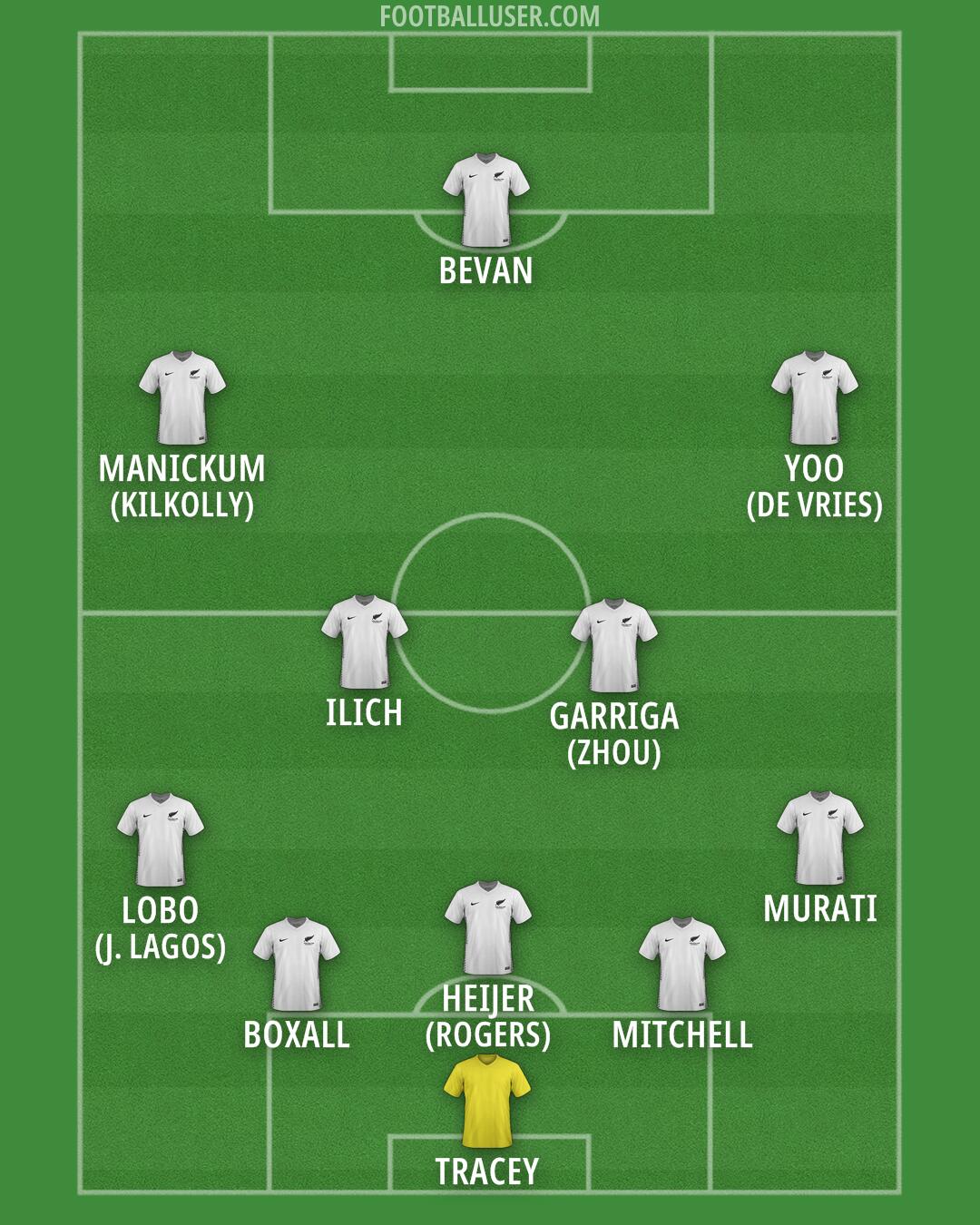
TRACEY (Boca) · MURATI (New Zealand) · MITCHELL (New Zealand) · HEIJER (ROGERS) (New Zealand) · BOXALL (New Zealand) · LOBO (J. LAGOS) (New Zealand) · YOO (DE VRIES) (New Zealand) · GARRIGA (ZHOU) (New Zealand) · ILICH (New Zealand) · MANICKUM (KILKOLLY) (New Zealand) · BEVAN (New Zealand)Focusing on rapid transitions and defensive stability, this team utilizes a 5-2-3 formation. The lineup is built to absorb pressure and hit opponents in behind when they leave space. By keeping a compact unit, they can quickly switch play to exploit the flanks.
Tracey sits between the posts to organize the back line. The defensive unit functions as a back five with HEIJER acting as the central anchor to clear the lines and command the area. To his sides, BOXALL and MITCHELL provide depth, with BOXALL acting as the left centre back and MITCHELL playing as the right centre back. LOBO and MURATI operate as attacking wing backs, tasked to push high up the pitch to provide width and overlap the wingers. This formation allows the defenders to hold a deep block or step up to squeeze the space when needed.
The midfield consists of a two man engine room. GARRIGA and ILICH act as the central duo, tasked to protect the centre of the pitch and win the second ball. GARRIGA works to shield the defence while ILICH seeks to carry the ball forward to connect the lines. They must press in a mid-block to force a long ball from the opposition. This pairing is vital to ensure the team does not get bypassed easily in the middle third.
In the final third, the attack relies on three players to stretch the defence. BEVAN acts as the lone striker, tasked to hold up the ball and find the feet of his teammates. MANICKUM and YOO operate as wide wingers, with MANICKUM on the left and YOO on the right. They look to cut inside to create central overloads or pull wide to receive crosses from the wing backs. The movement of LOBO and MURATI allows the wingers to occupy more central zones, creating chances to play through the lines.
A major strength of this lineup is the ability to create wide overloads when the wing backs join the attack. This numerical advantage forces the opposition to shift, leaving gaps for BEVAN to exploit. Additionally, the team is very strong at defending zonally with a narrow defensive block, making them hard to break down centrally. The speed of transition from a deep position to an attacking one allows them to catch opponents off guard.
This formation is designed for a counter attacking identity that prioritizes defensive solidity. It is best suited for matches against teams that dominate possession and leave their back line vulnerable to quick breaks.