Man City Football Formation
 June 23, 2025


Starting Lineup
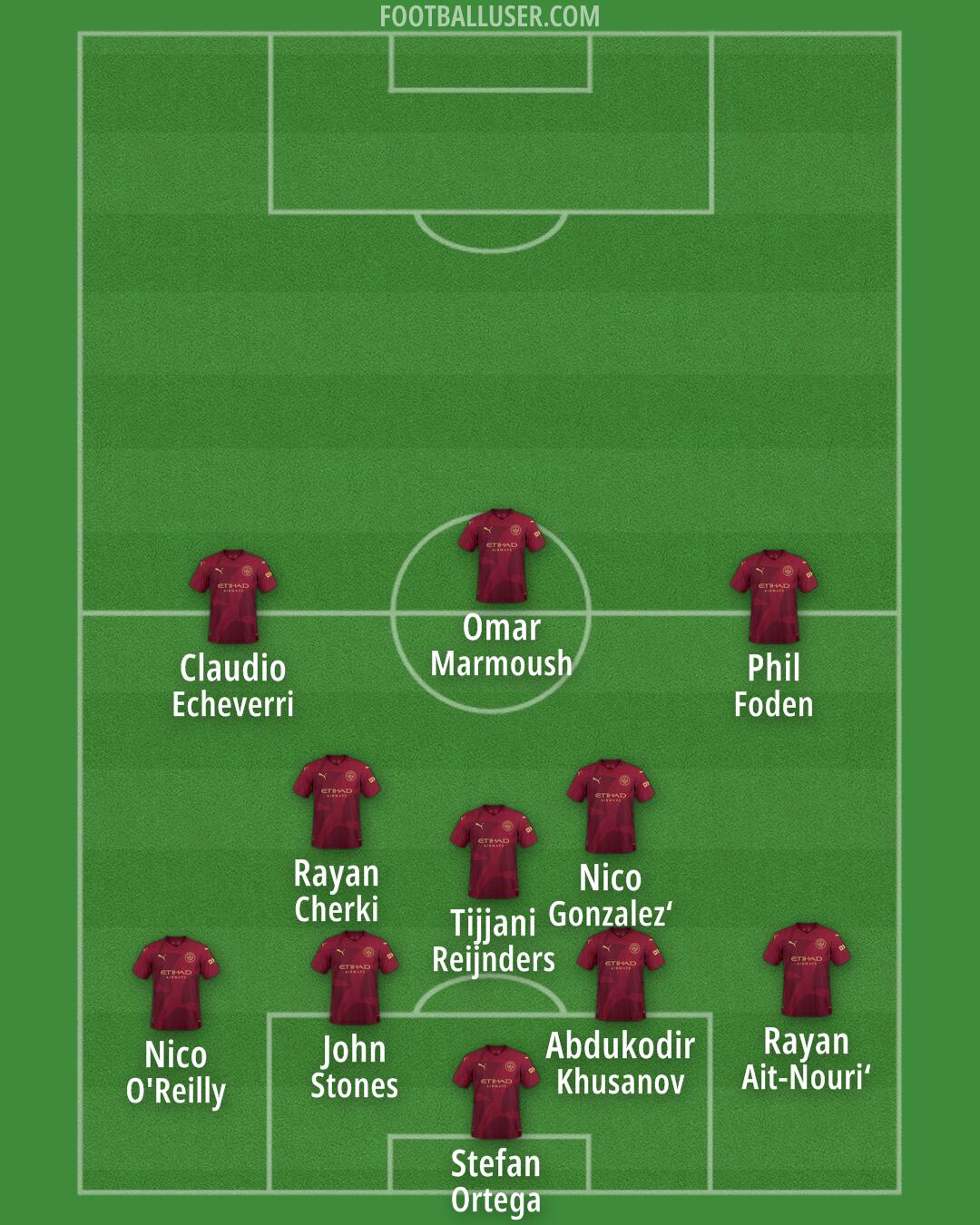
Omar (Marmoush) · Stefan (Ortega) · John (Stones) · Abdukodir (Khusanov) · Rayan (Cherki) · Nico (Gonzalez‘) · Claudio (Echeverri) · Phil (Foden) · Tijjani (Reijnders) · Rayan (Ait-Nouri‘) · Nico (O'Reilly)Man City looks to control the game through heavy possession in a 4-3-3 formation. This lineup is built to dominate the ball and pin the opponent in their own half. By keeping the ball and moving the opponent, they aim to create gaps in the defensive line. The team uses this setup to dictate the tempo and control the rhythm of every match.
Stefan stays between the posts to act as the first point of distribution. The defensive unit sits in a flat back four with John and Abdukodir acting as the central pair. John provides a presence in the air while Abdukodir covers the space behind when the line steps up. On the flanks, Nico and Rayan act as full backs to maintain a solid line. They must be careful to track back and prevent crosses while also looking to support the ball progression.
The midfield functions as a three man midfield with a strong presence in the center. Nico operates as a central figure to connect the defence and attack. Rayan and Tijjani work to control the middle, with Tijjani often looking to carry the ball forward. This trio works to recycle possession and ensures the team maintains control in the middle third. They must win the second ball and squeeze the space to prevent the opposition from playing through the lines.
In the attacking third, Man City uses three attackers to stretch the defence. Omar acts as the lone striker to hold up the ball and provide a focal point for the team. On the wings, Claudio and Phil provide width and threat. Claudio works to cut inside to create chances, while Phil uses his dribbling to beat his marker on the flank. The forwards press from the front to force a long ball and win it back high up the pitch.
One major advantage for Man City is their ability to create numerical superiority in the midfield. This allows them to control the game and keep the opposition on the back foot. They also benefit from wide overloads when the full backs push up to support the wingers. This movement forces the opponent to shift constantly, which eventually creates gaps for late runs into the box.
This 4-3-3 formation is designed for total control and high intensity. It is best suited for matches where the team needs to break down a low block through sustained pressure.