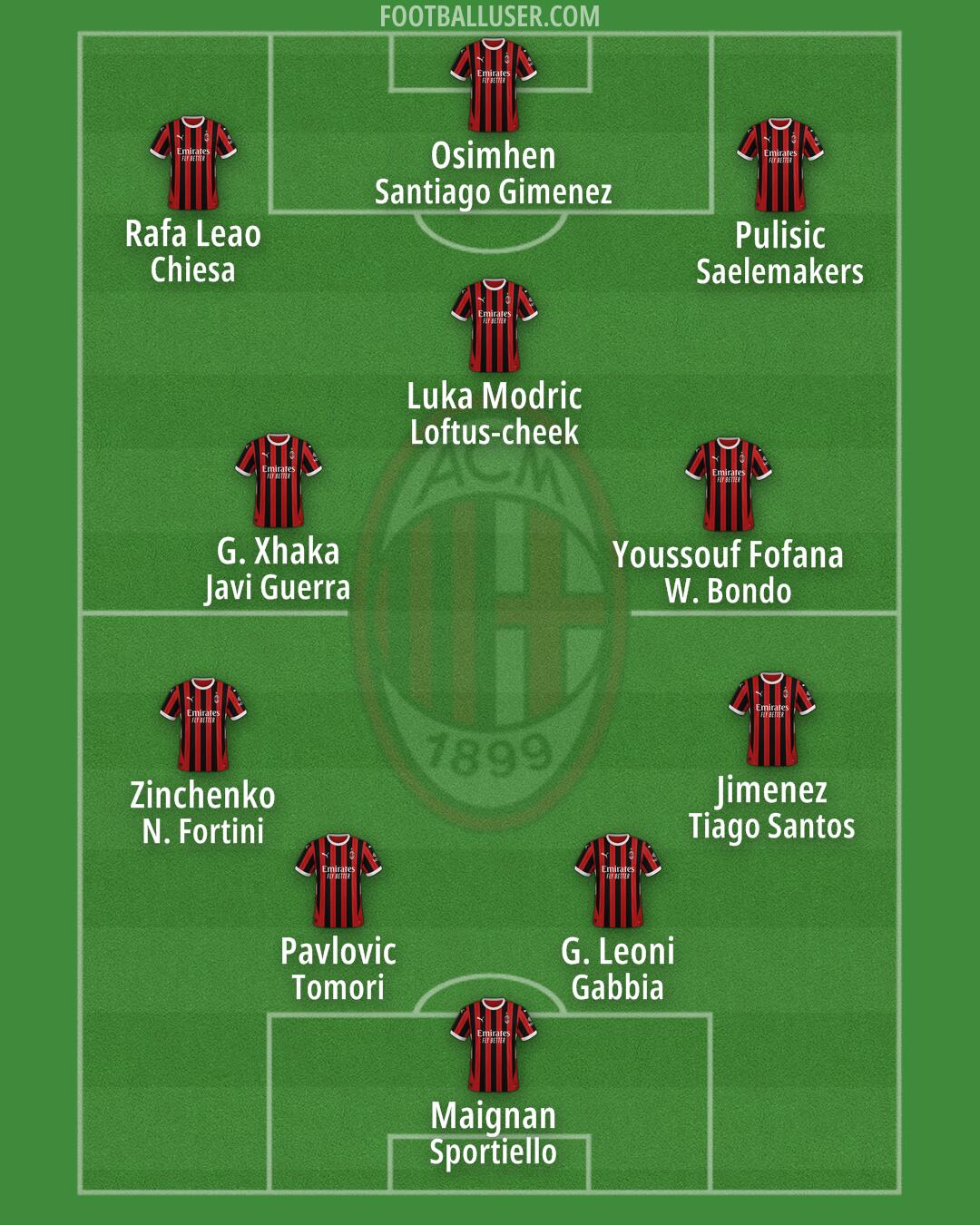

Milan Football Formation
 June 23, 2025


Starting Lineup
Osimhen (Santiago Gimenez) · Rafa Leao (Chiesa) · Pulisic (Saelemakers) · Luka Modric (Loftus-cheek) · Youssouf Fofana (W. Bondo) · G. Xhaka (Javi Guerra) · Jimenez (Tiago Santos) · Zinchenko (N. Fortini) · Maignan (Sportiello) · G. Leoni (Gabbia) · Pavlovic (Tomori)Milan utilizes a high press and vertical style within a 4-3-3. This formation is built to win the ball high up the pitch and attack quickly. The team focuses on direct play to catch opponents off guard and exploit space in the final third.
Maignan starts the build up from the goalkeeper position with his distribution and shot stopping. A flat back four forms the defensive unit. Zinchenko plays at left back and Jimenez at right back. Pavlovic and G. Leoni form the central pair. This duo provides aerial strength and covers the space behind as the line steps up. Players work together to maintain a compact defensive block when defending in a mid-block.
The midfield features a three-man unit with a clear division of labor. G. Xhaka acts as the deep-lying playmaker to shield the defence and use his passing range to switch play. Youssouf Fofana works as the carrier to drive the ball forward and carry it into the final third. Luka Modric plays as an attacking ten behind the striker to connect the lines. He uses his vision and control to play through the lines and provide key passes.
In the attacking phase, Milan uses three attackers across the front. Rafa Leao and Pulisic act as wide attackers who look to cut inside. The left winger uses his dribbling and pace to create mismatches on the flank. Osimhen leads the line as a pressing centre-forward to harass the opposition back line. The team looks to hit in behind on the transition, using the movement of the forwards to stretch the defence and create runs in behind.
One major advantage of this Milan lineup is the speed of transition once the ball is won. The midfield combination of G. Xhaka and Luka Modric allows the team to control the ball and recycle possession in tight spaces. Wide overloads are also created when the full backs push forward to support the wingers and pull the opposition wide.
This 4-3-3 relies on aggressive pressing and direct attacking movements to dominate games. It is ideally suited for games against teams that leave large gaps between their midfield and defence.