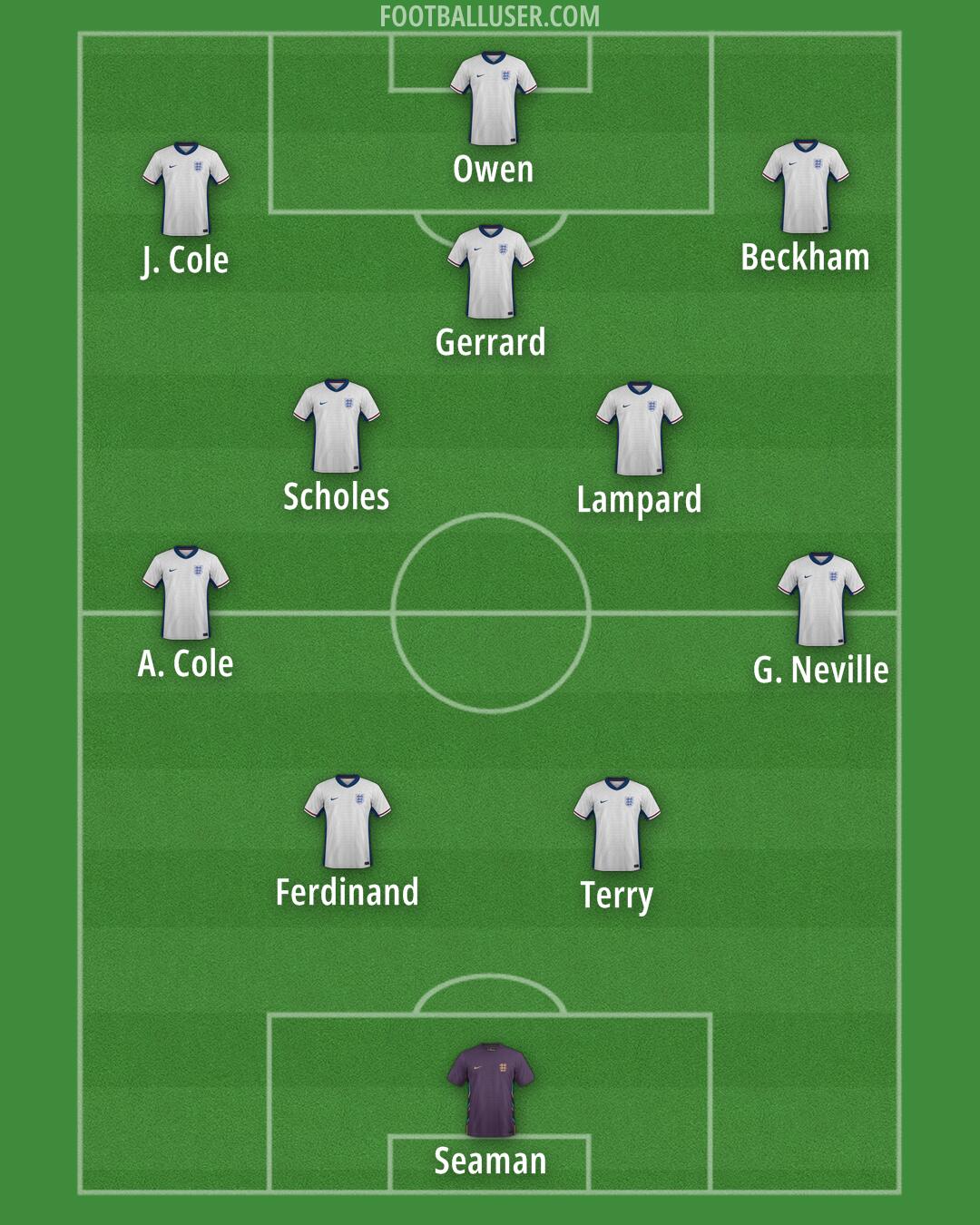
England National Football Team Formation
 June 24, 2025


Starting Lineup
J. Cole · Gerrard · Scholes · Lampard · Owen · Beckham · A. Cole · G. Neville · Ferdinand · Terry · SeamanFocusing on heavy verticality and aggressive attacking, England plays a 2-5-3 formation. This lineup aims to overwhelm the opposition by flooding the final third and using extreme width to stretch the defence. The goal is to win the ball back high up the pitch and transition immediately to exploit spaces behind the opponent's back line.
Seaman stands between the posts to command his area. Ahead of him, Terry and Ferdinand form a central duo that must play out from the back. As ball playing centre backs, they are tasked to carry the ball forward into the middle third or hit in behind the opposition defense with long passes. Because there are only two central defenders, they must stay narrow to cover the middle while communicating constantly to set the offside trap and prevent runners from getting behind them.
The midfield is a powerhouse designed to control the center and provide service. G. Neville and A. Cole operate as a double pivot to shield the two defenders. G. Neville provides defensive stability, while A. Cole can push up to support the left side. Lampard and Scholes play as inverted eights, with Scholes looking to recycle possession and Lampard looking to arrive late into the box. Gerrard plays as an attacking ten behind the striker, acting as the main connection between the lines and pressing aggressively to win the ball back high up the pitch.
In the final third, the team utilizes three attackers to pin the last defender. Owen acts as a pressing centre-forward, using his pace to run in behind and stretch the opposition. J. Cole plays as an inverted winger on the left, cutting inside to create chaos in the half-spaces. On the right, Beckham provides width and is famous for his elite set piece delivery and crossing range. Beckham will often look to whip it in or deliver early crosses to find the feet of the striker.
This formation offers significant numerical superiority in the central areas due to the five-man midfield. It also creates wide overloads because the midfielders can push high to support the wingers. When winning the ball, the speed of transition is immense, allowing the team to catch opponents out of position before they can set a compact shape.
England relies on this heavy offensive lineup to dominate possession and punish teams in transition. It is a high-risk system best suited for games where the team needs to break down a deep low block through sheer attacking volume.