Everton Football Formation
 June 25, 2025


Starting Lineup
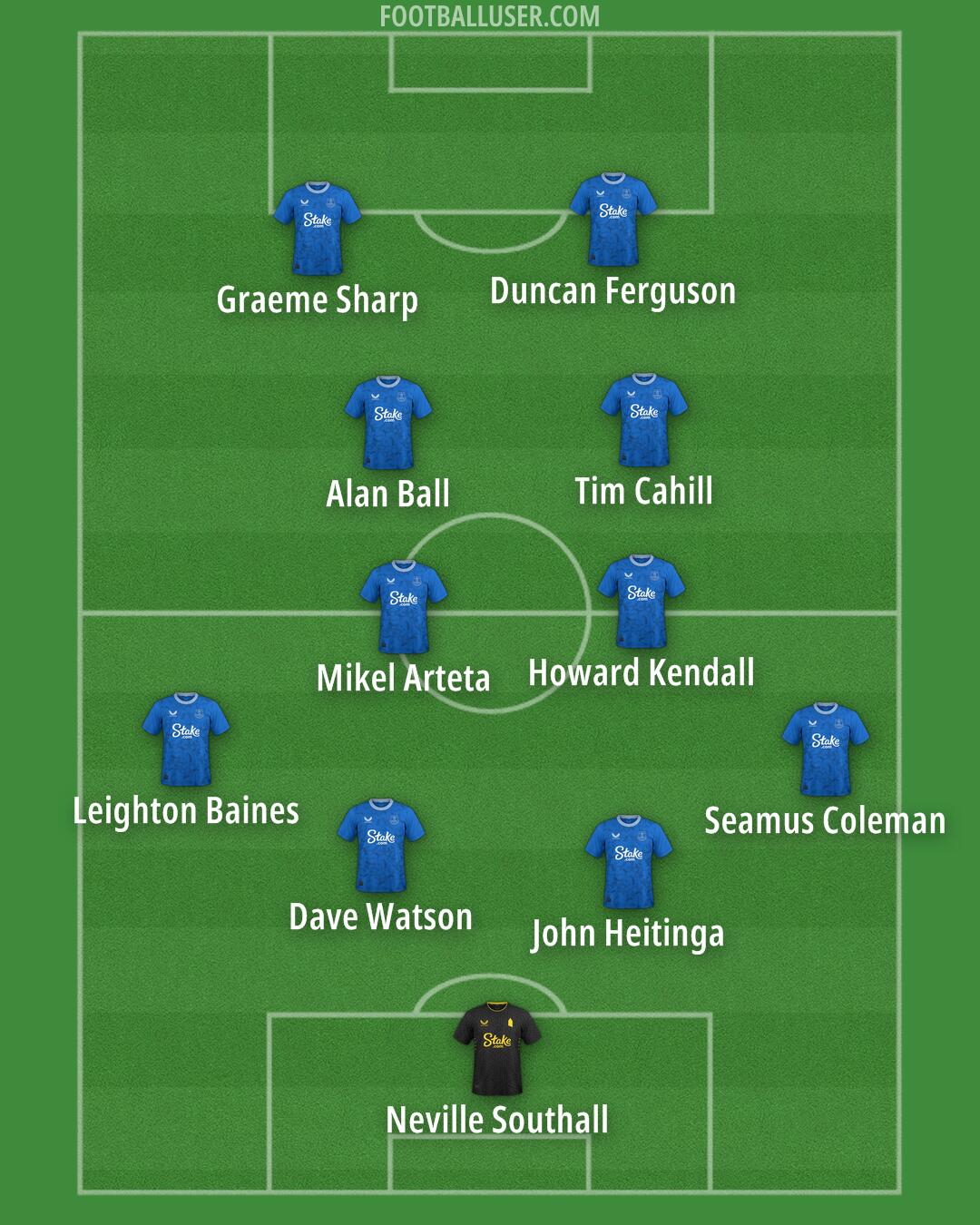
Neville Southall · Howard Kendall · Tim Cahill · Mikel Arteta · Dave Watson · John Heitinga · Seamus Coleman · Leighton Baines · Duncan Ferguson · Alan Ball · Graeme SharpEverton plays with a direct 4-4-2. This lineup focuses on a high press and quick transitions to catch opponents off guard. Players look to win the second ball and move the play forward rapidly to exploit gaps.
Neville Southall stands between the posts to command the area. Seamus Coleman occupies the right back position while Leighton Baines takes the left. Coleman provides width and pushes forward, while Baines delivers precise crosses. In the middle, Dave Watson and John Heitinga form a central pairing to defend zonally. Watson provides aerial strength to win the header, and Heitinga covers space behind him. The unit holds a compact line to deny the turn to attackers.
A double pivot in midfield anchors the center. Mikel Arteta plays as a deep-lying playmaker, using his passing range to recycle possession and find teammates. Howard Kendall sits alongside him to shield the defence and intercept passes. On the flanks, Alan Ball and Tim Cahill provide energy in a flat four. Ball presses aggressively to win the ball high up the pitch. Cahill works to arrive late into the box to score. These midfielders connect the defensive line to the front two.
The attack relies on two forwards in a partnership. Duncan Ferguson acts as a target man, using his aerial strength to hold up the ball and win headers. Graeme Sharp plays alongside him, looking to find the feet of the striker or run in behind. Play is built by playing short from the back or going direct to Ferguson. Wide players seek to whip it in toward the near post or far post. These movements create chances for the strikers to attack the far post.
One major advantage for Everton is the aerial dominance in both boxes. Pairing Dave Watson with Duncan Ferguson makes it difficult for opponents to win the second ball. Another strength is the work rate in the middle. Alan Ball and Tim Cahill ensure the team can press in pairs to force a long ball from the opposition. Such energy creates space for the team to counter at pace.
This 4-4-2 is built to dominate physically and win transitions. It is best suited for matches against technical sides that struggle with direct play and physical pressure.