
Italy National Football Team Formation
 June 25, 2025


Starting Lineup
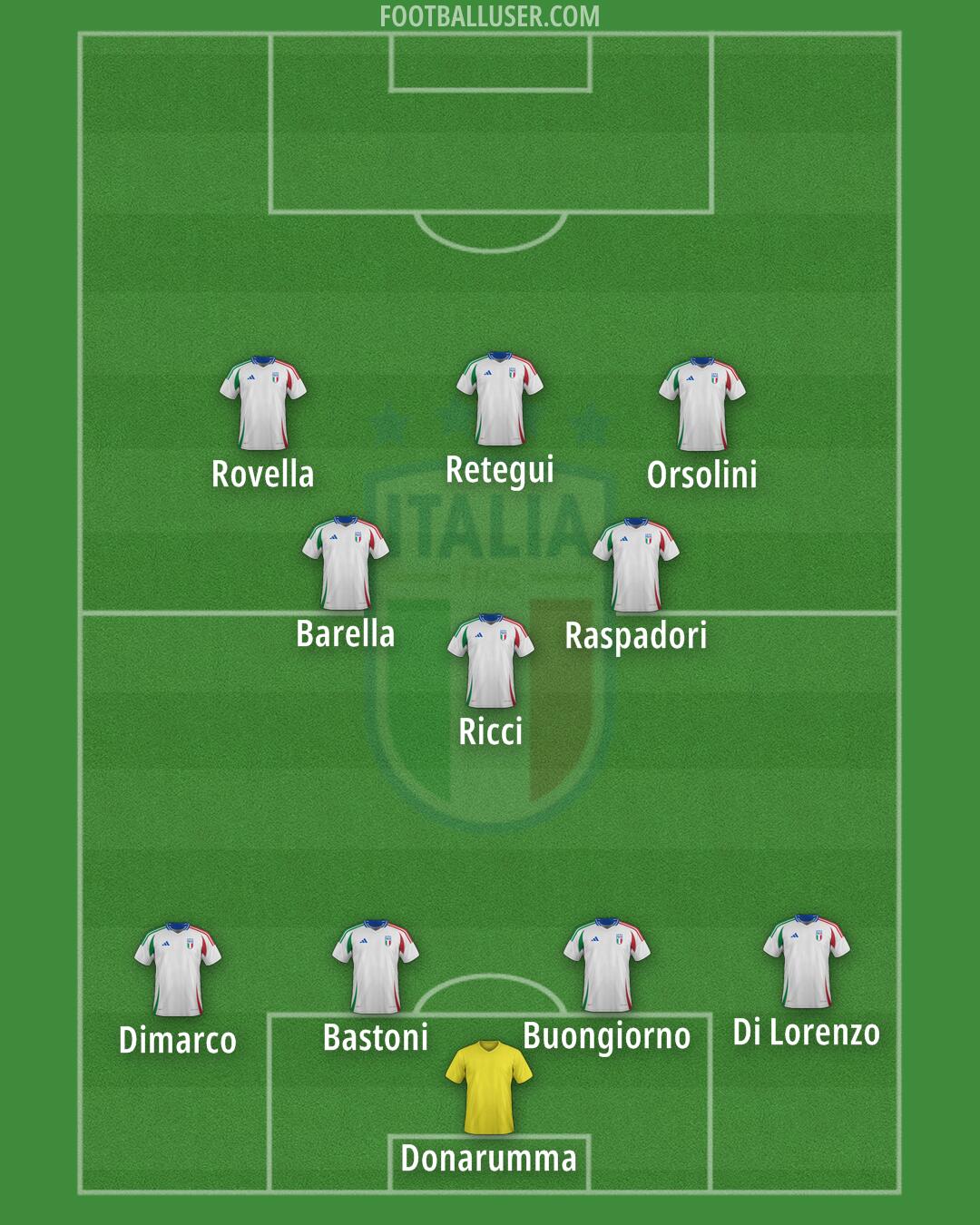
Donarumma · Bastoni · Buongiorno · Dimarco · Di Lorenzo · Ricci · Barella · Raspadori · Orsolini · Rovella · ReteguiItaly focuses on a high press and rapid transitions through a 4-3-3 formation. This lineup aims to win the ball high up the pitch and quickly move it forward to exploit spaces in the opposition defensive line. The goal is to stay compact while using verticality to punish teams that play a high line.
Donnarumma stands between the posts to command the area and sweep behind the back line. The defense operates as a flat back four with Bastoni and Buongiorno acting as the central pairing. Bastoni is a ball playing defender who looks to progress the ball with his passing range, while Buongiorno provides aerial strength and covers space when teammates push up. Di Lorenzo acts as an attacking full back on the right, while Dimarco provides width and constant delivery from the left flank. The unit works together to squeeze the space and keep the distance between the lines small.
The midfield functions as a three-man midfield with a single pivot providing a screen. Ricci sits in front of the defense to shield the back four and pick up runners. Beside him, Barella and Raspadori operate as the two interior players. Barella is known for his high pressing intensity and ability to drive forward with the ball, connecting the defensive unit to the attack. Raspadori helps to recycle possession and makes late runs into the box to create numbers in the final third. This group works to press in a mid-block and win the second ball to maintain pressure.
Up front, Italy uses three attackers to stretch the defense. Retegui acts as the lone striker and serves as a physical presence to hold up the ball and pin the last defender. Orsolini plays as an inverted winger on the right, looking to cut inside and create shooting opportunities, while Rovella stays wide on the left to provide width and deliver crosses. The forwards press from the front to force a long ball from the opposition. They look to combine in tight spaces and move quickly through transitions to catch the defense out of position.
This formation offers several tactical advantages for Italy. The team can create wide overloads when Dimarco and Rovella push forward together. They also benefit from numerical superiority in the middle of the pitch when the midfielders squeeze the space. The ability to win it back high up the pitch allows them to transition into attack before the opposition can get organized.
This 4-3-3 formation is built for a team that wants to control the tempo through pressing and verticality. It is best suited for games against opponents that struggle to play out from the back or leave large gaps behind their defensive line.