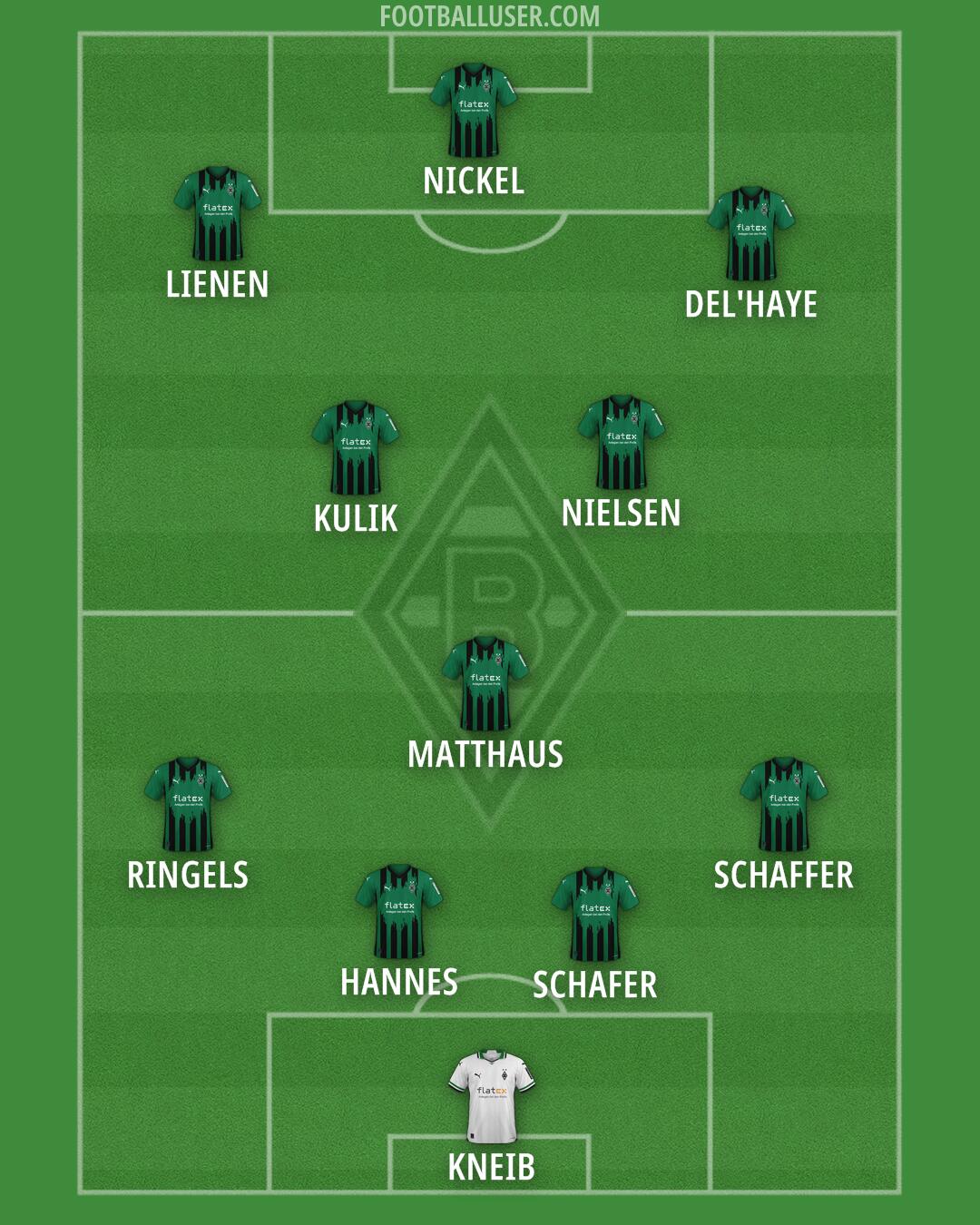

Borussia M'gladbach Football Formation
 June 25, 2025
 Pretorian


Starting Lineup
SCHAFFER · SCHAFER · HANNES · RINGELS · MATTHAUS · KULIK · NIELSEN · DEL'HAYE · NICKEL · LIENEN · KNEIBBorussia M'gladbach relies on a high press and quick transition to catch opponents off guard. The team utilizes a 5-2-3 formation to control space and defend deep when needed. This lineup is built to win the ball high up the pitch and immediately strike the opponent on the break.
Kneib stays between the posts to anchor the defensive unit. A back line of five features Matthaus acting as the central figure to hold the line. Schafer and Hannes play as wide centre backs to cover the channels and provide extra cover when the wing backs push high. Schaffer and Ringels act as attacking wing backs to provide width and overlap the wingers. This unit can shift into a mid block to squeeze the space between the lines.
The midfield operates as a double pivot with Kulik and Nielsen working together. Both players must cover large amounts of ground to shield the defence and win the second ball. Nielsen works to connect the defensive and attacking lines by receiving the ball from the centre backs. Meanwhile, Kulik can drive forward with the ball to create an extra man in the middle. They must stay compact to prevent the opponent from playing through the lines.
In the final third, the attacking unit uses three players to stretch the defence. Nickel leads the line as a pressing centre forward to force a long ball from the opposition. Lienen and Del'haye play as wide attackers who want to cut inside to create central presence. The team looks to hit in behind on the transition by using the runs of Lienen and Del'haye. Nickel stays central to hold up the ball and lay it off to arriving runners.
One major advantage for Gladbach is the ability to create wide overloads from overlapping full backs. Schaffer and Ringels can push high to pin the last defender and allow the wingers to move into half spaces. Another strength is the compactness when defending in a low block. This makes it very hard for opponents to find gaps. The speed of transition from a defensive five to an attacking three allows for quick counters.
This formation provides a strong defensive base while maintaining a dangerous presence in attack. It is best suited for matches against teams that hold high possession and leave space behind their defensive line.