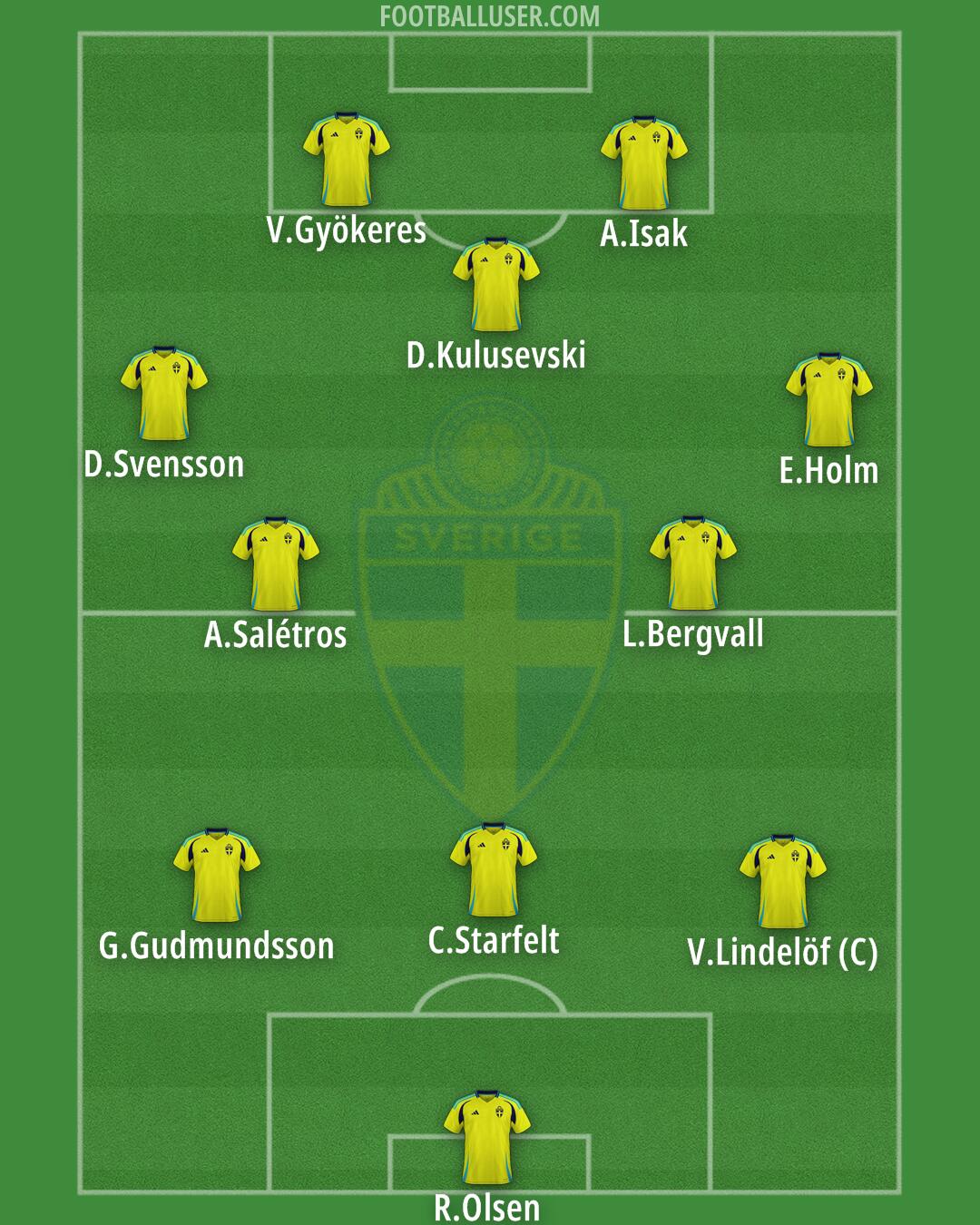

Sweden National Football Team Formation
 June 26, 2025
 bosan
bosan


Starting Lineup
R.Olsen · C.Starfelt · G.Gudmundsson · V.Lindelöf (C) · L.Bergvall · A.Salétros · D.Svensson · E.Holm · D.Kulusevski · V.Gyökeres · A.IsakSweden intends to control games through a high press and direct attacking movements in a 3-5-2 formation. This lineup is built to win the ball high up the pitch and use the speed of the forwards to punish teams on the transition. By using a three man defense and a crowded midfield, the team aims to squeeze the space in the middle and force the opposition into mistakes.
R.Olsen guards the goal as the last line of defense. The back three consists of G.Gudmundsson, C.Starfelt, and the captain V.Lindelöf, who provides leadership and aerial strength. V.Lindelöf and G.Gudmundsson act as the wide centre backs to cover the channels, while C.Starfelt holds the middle of the line. The defensive unit works to hold a high line to keep the team compact and prevent the opposition from playing out from the back.
The midfield is a central engine designed to dominate the center of the pitch. A double pivot featuring A.Salétros and L.Bergvall works to shield the defense and recycle possession. In front of them, E.Holm and D.Svensson operate in the half spaces to connect the defensive and attacking lines. D.Kulusevski plays as an attacking ten behind the strikers, using his dribbling style to carry the ball forward and create chances. This midfield group is tasked to press aggressively to win the ball back high up the pitch.
Sweden utilizes two forwards in a partnership to lead the attack. V.Gyökeres and A.Isak operate as a strike duo that can play both centrally and run in behind the defense. V.Gyökeres provides a physical presence to hold up the ball, while A.Isak uses his pace to attack the space behind the last defender. They press the opposition back line heavily to force long balls and then look to break quickly. The attack relies on link up play between the lines to find ways to split the defence with a through ball.
This formation offers Sweden significant tactical advantages in terms of central control. The heavy presence of players like E.Holm and D.Svensson allows for numerical superiority in midfield, making it hard for opponents to play through the center. Additionally, the team can create wide overloads when the midfielders push higher, leaving the opposition defenders isolated. The ability to transition from a mid block to a direct attack makes this lineup very dangerous.
The 3-5-2 formation for Sweden relies on a high press and a strong central presence to dictate the tempo. It is a setup best suited for games against teams that struggle to play through a crowded midfield or teams that leave space behind their defenders.