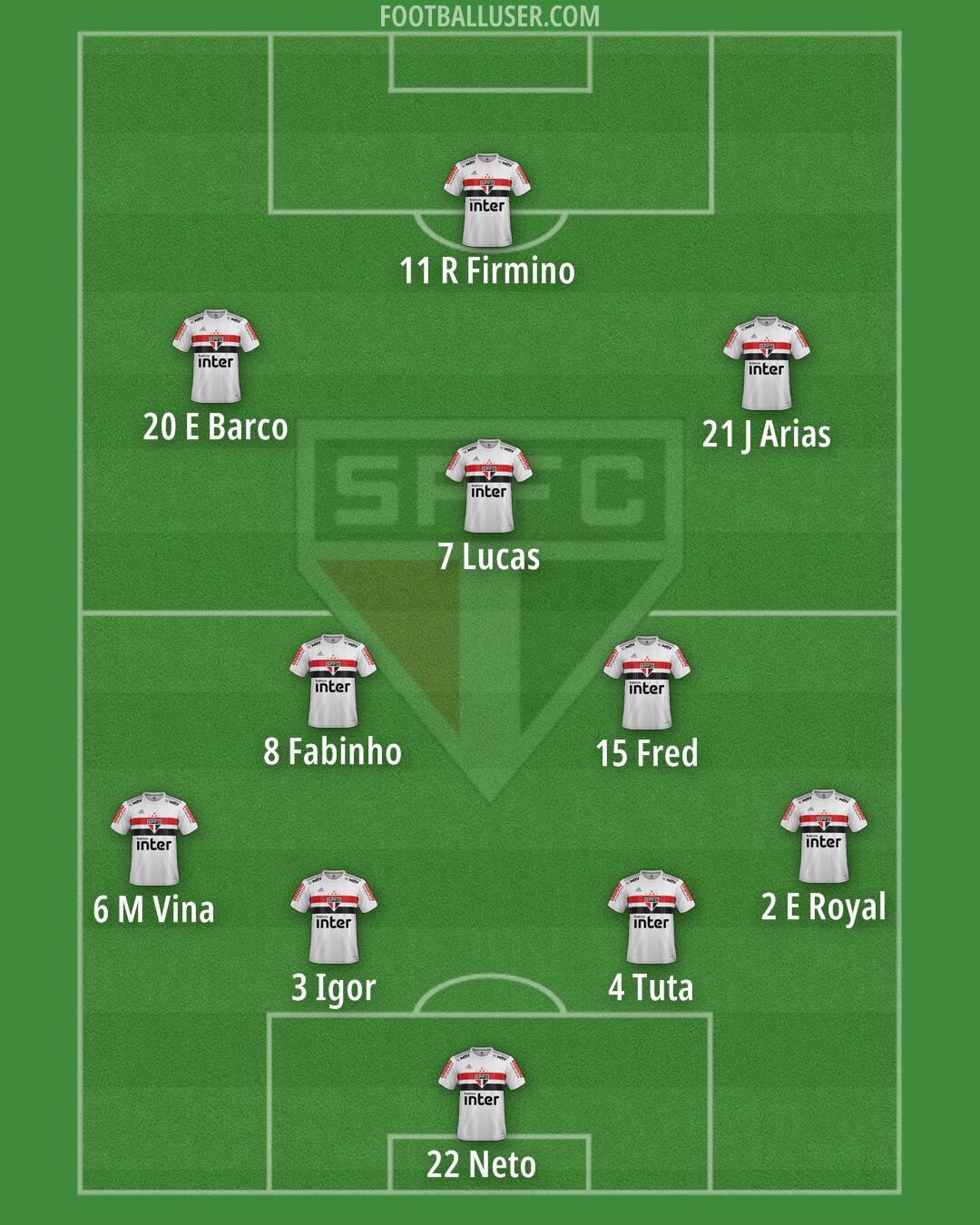

São Paulo Football Formation
 June 30, 2025
 RPLemos


Starting Lineup
22 Neto2 E Royal
3 Igor
4 Tuta
6 M Vina
8 Fabinho
20 E Barco
7 Lucas
15 Fred
11 R Firmino
21 J Arias
A heavy focus on high pressing and quick ball recovery defines the tactical identity of São Paulo in a 4-3-3. This lineup is built to win the ball high up the pitch and use quick transitions to catch the opposition out of position. By using a vertical style, the team looks to move the ball from the defensive line to the attacking trio with minimal touches.
Neto guards the goal as the last line of defense. The back four sits in a high line to keep the team compact. Tuta acts as the right centre back, using his aerial strength to defend crosses, while Igor provides cover as the left centre back. E Royal plays as an attacking full back on the right to provide width, whereas M Vina stays a bit more cautious on the left to help cover the space when the team loses the ball. The defensive unit works to squeeze the space between the lines and push the opposition back.
The midfield operates as a three man midfield with a carrier and two engines. Fabinho plays as a deep lying playmaker, dropping between the centre backs to receive the ball and start the build up. Fred works alongside him to drive forward with the ball and press aggressively in the middle of the park. Lucas plays as an attacking ten behind the striker, finding pockets of space to create chances and arrive late into the box. This group connects the defense to the attack by recycling possession and breaking the lines.
São Paulo employs three attackers across the front to stretch the defense. R Firmino leads the line as a pressing centre forward, often dropping deep to link up play between the lines. On the wings, J Arias and E Barco act as inverted wingers who cut inside to create overloads in the half spaces. These movements allow the full backs to overlap the winger and deliver crosses. The front three press the opposition back line to force a long ball, allowing the midfield to win the second ball.
One major advantage of this formation is the ability to press high in coordinated waves, which puts immense pressure on the opponent. The team also finds success through wide overloads, as the combination of the wingers and full backs creates mismatches on the flanks. This setup allows São Paulo to dominate territory by keeping the ball in the attacking third.
This 4-3-3 is a high intensity formation designed to dominate games through proactive defending and rapid attacking transitions. It is best suited for matches against teams that struggle to play out from the back under pressure.