Chelsea Football Formation
 June 30, 2025


Starting Lineup
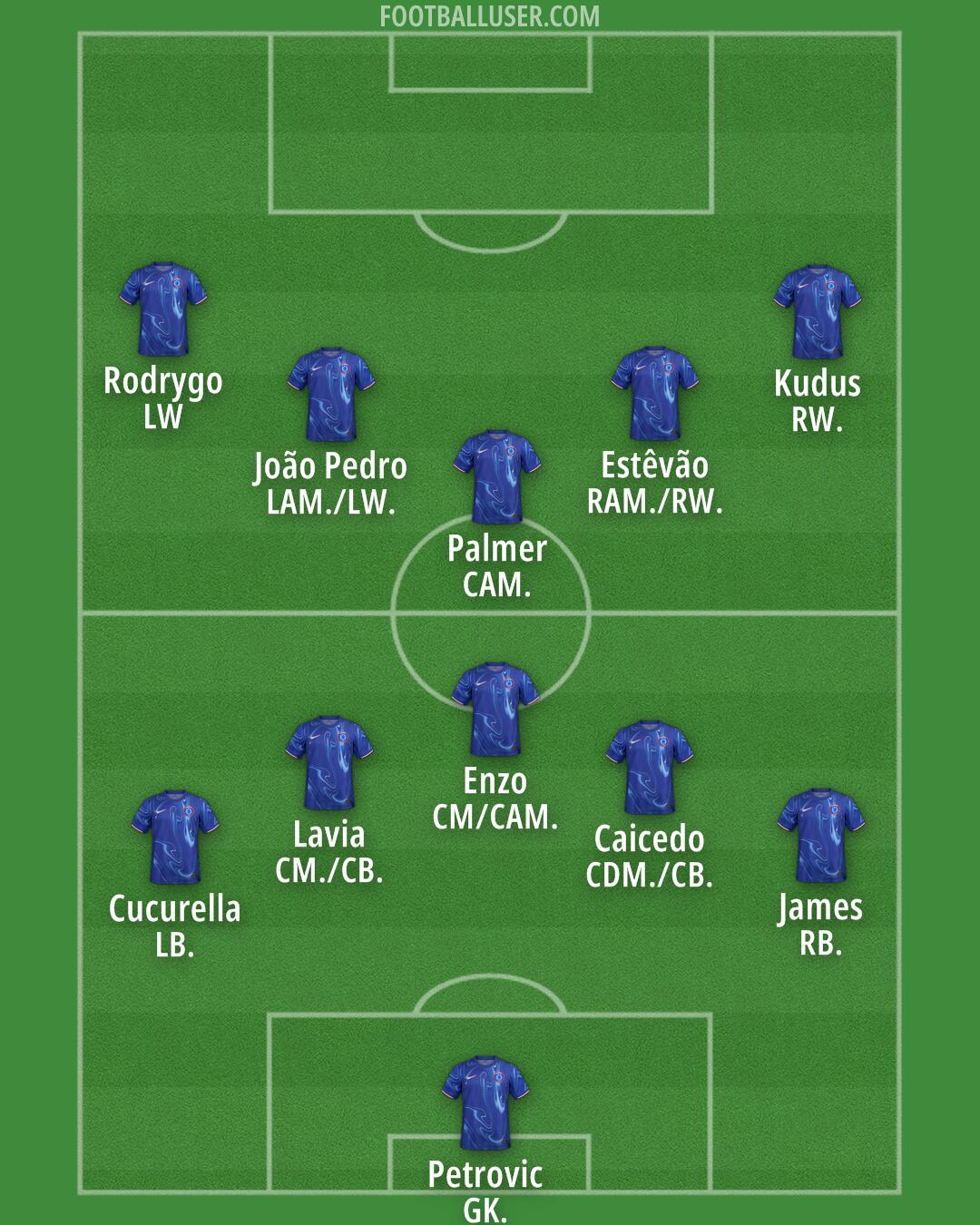
Rodrygo (LW) · João Pedro (LAM./LW.) · Palmer (CAM.) · Enzo (CM/CAM.) · Lavia (CM./CB.) · Caicedo (CDM./CB.) · Cucurella (LB.) · James (RB.) · Estêvão (RAM./RW.) · Kudus (RW.) · Petrovic (GK.)Chelsea focuses on a compact defensive block and quick transitions using a 5-3-2 formation. This lineup is built to play a direct style that exploits space behind the opposition. The team aims to absorb pressure and then use the speed of the forwards to break quickly.
Petrovic guards the goal while the back line operates as a coordinated unit. The formation uses a back three with Enzo sitting centrally to sweep behind the line and organize the defense. Lavia plays as the left centre-back to cover the space, while Caicedo acts as the right centre-back to win the second ball. Cucurella and James act as attacking wing backs to provide width. James uses his physicality and crossing to support the right flank, while Cucurella pushes high to stretch the defence.
A three-man midfield sits in front of the defenders to control the center of the pitch. Palmer plays as a single pivot to shield the defence and recycle possession. He uses his passing range to find teammates and play through the lines. João Pedro and Estêvão act as the two central midfielders to connect the defensive and attacking lines. João Pedro looks to receive on the half-turn, while Estêvão tries to carry the ball forward into the final third.
The attack features two forwards in a partnership to threaten the opposition. Rodrygo and Kudus lead the line, looking to make runs in behind the defenders. Rodrygo uses his dribbling and pace to isolate wide players in one on one situations. Kudus acts as a pressing centre-forward to force a long ball from the opponent. The width is provided by the wing backs, who overlap the wide areas to deliver crosses. The team looks to hit in behind on the transition to catch the opposition out of position.
Chelsea finds success through its compactness when defending in a low block. The formation provides numerical superiority in the central areas to deny the turn of opposing attackers. The speed of transition is a major advantage, allowing the team to move from a defensive stance to an attacking one in seconds. This allows the wing backs to spread wide and create overloads on the flanks.
This 5-3-2 formation is a defensively solid way to manage games through control and counter attacks. It is best suited for facing opponents that play with a high line and leave space behind their defenders.