
Feyenoord Football Formation
 July 1, 2025


Starting Lineup
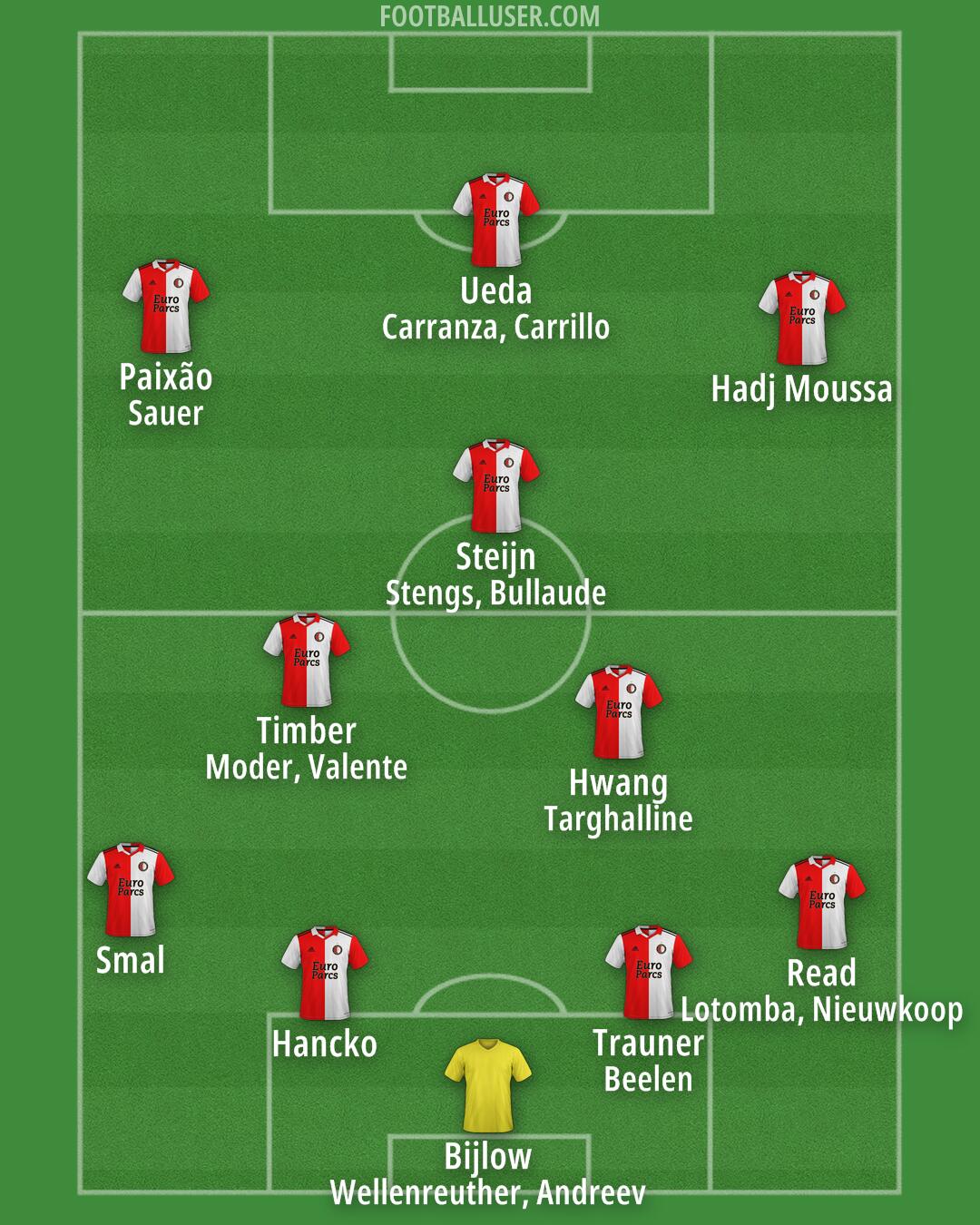
Paixão (Sauer) · Ueda (Carranza, Carrillo) · Hadj Moussa · Steijn (Stengs, Bullaude) · Timber (Moder, Valente) · Hwang (Targhalline) · Smal · Hancko · Trauner (Beelen) · Read (Lotomba, Nieuwkoop) · Bijlow (Wellenreuther, Andreev)Feyenoord look to control matches through high pressing and verticality in a 4-3-3. This formation allows the team to pin the opposition back and hunt for the ball high up the pitch. The goal is to use constant movement to stretch the defence and create quick scoring chances in transition.
Bijlow acts as the last line of defence, ready to sweep behind the back line if needed. The defensive unit functions as a flat back four where Read operates as a right back to provide width. Smal moves up the left flank to support the attack, while Hancko and Trauner form the central pair. Hancko serves as a ball playing defender to start attacks, while Trauner uses his aerial strength to defend crosses and win the second ball. This back four must stay compact to prevent passes through the middle.
The midfield works in a three man midfield with a carrier to move the ball through the thirds. Timber acts as a carrier, driving forward with the ball to break the line. Hwang provides stability to shield the defence and win possession in the middle. Steijn operates as an attacking ten behind the striker, looking to arrive late into the box or play through the lines with precise passing. This unit connects the defensive line to the front three by recycling possession and switching play.
Feyenoord use three attackers across the front to keep the opposition under pressure. Ueda plays as a pressing centre-forward, working to harass defenders and hold up the ball. Paixão and Hadj Moussa operate as inverted wingers who cut inside to create central overloads. These attackers push the opposition back line deep, creating space for midfielders to run into. The team relies on combinations in tight spaces and quick cutbacks from the byline to find Ueda.
This lineup offers several tactical advantages, including the ability to press high in coordinated waves. By using inverted wingers, Feyenoord create wide overloads when the full backs push up. The presence of Timber allows the team to progress through the thirds quickly during a transition. This setup also provides compactness when defending a lead by shifting into a mid-block.
The 4-3-3 formation provides Feyenoord with a balanced way to dominate both sides of the ball. This system is best suited for games against teams that try to play out from the back against a high press.