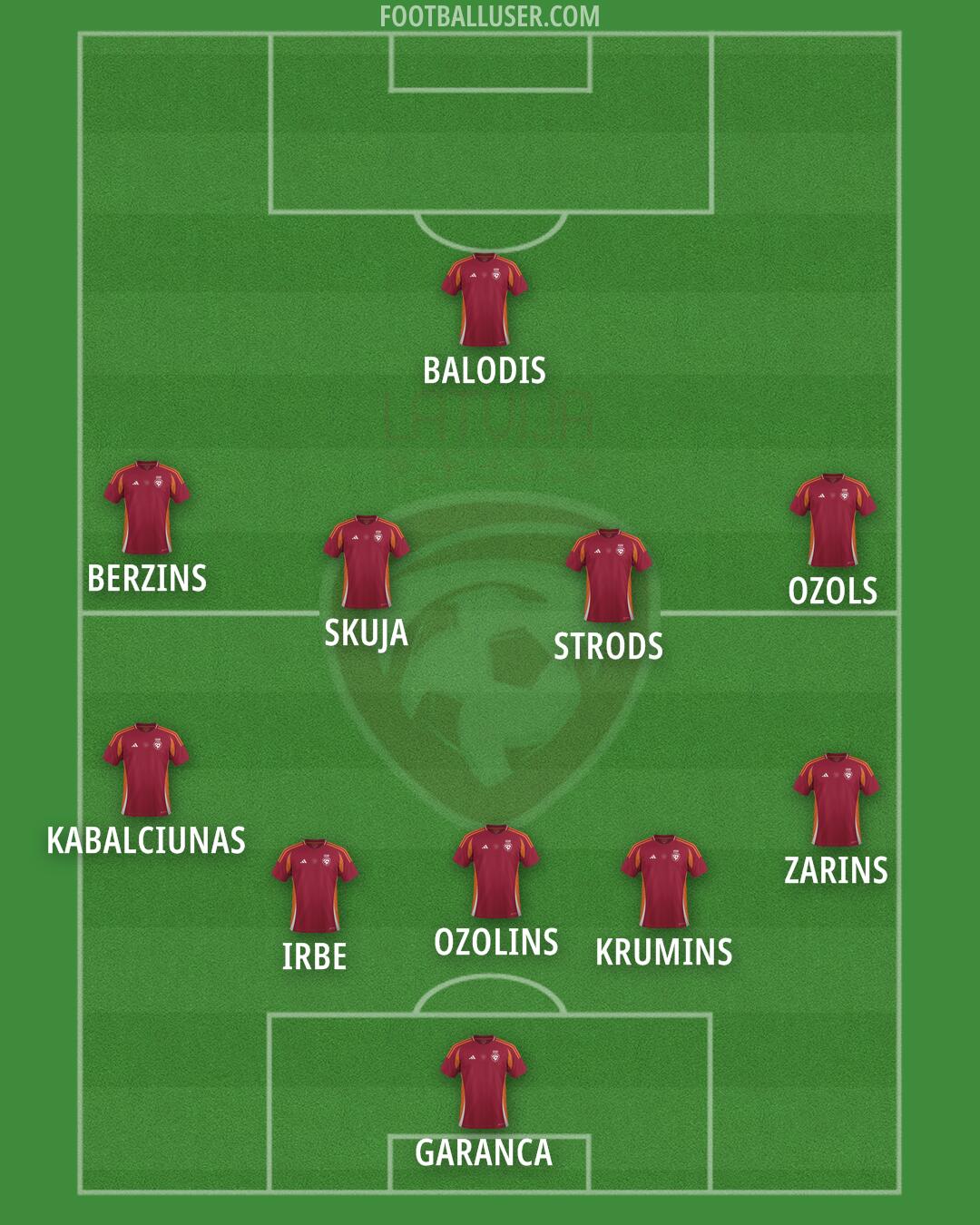

Latvia National Football Team Formation
 July 1, 2025
 PELUCOSAURIO


Starting Lineup
GARANCA · KABALCIUNAS · IRBE · OZOLINS · KRUMINS · ZARINS · BALODIS · SKUJA · STRODS · OZOLS · BERZINSLatvia relies on a defensively solid identity to stay in matches, utilizing a 5-4-1 formation. This lineup is built to absorb pressure and strike quickly when the opposition leaves space behind. By sitting deep, the team aims to frustrate attackers and wait for the right moment to play through the lines during a transition.
GARANCA stands between the posts to lead the defensive unit from the back. The back five consists of a central trio made up of OZOLINS, IRBE, and KRUMINS who stay compact to protect the middle. IRBE and KRUMINS act as the side centre-backs to cover the channels, while OZOLINS holds the line in the center. On the flanks, ZARINS and KABALCIUNAS act as wing backs who can push up to support the midfield but must track back quickly to form a narrow defensive block. The whole unit works to deny the turn to attackers and force them into wide areas.
In front of the back line, a flat four midfield works to squeeze the space. STRODS and SKUJA occupy the central roles, acting as the engine to shield the defence and win the second ball. Keeping a tight gap between them prevents opponents from playing through the middle. The wider midfielders, OZOLS and BERZINS, work to provide width and help the wing backs. This midfield group works to press in a mid-block, trying to intercept passes before they reach the final third. Connecting the defensive unit to the lone attacker requires recycling possession and looking for quick passes.
The attacking burden falls on BALODIS, who operates as a lone striker. He must hold up the ball to allow the midfield and wing backs to move up the pitch. BALODIS is tasked to pin the last defender and make runs in behind when the team wins the ball back. He also presses the opposition back line to help the team win the ball high up the pitch. Transitions are key, often with ZARINS or KABALCIUNAS carrying the ball forward to join the break. Creating space involves the movement of OZOLS and BERZINS to find the feet of the striker.
The main advantage for Latvia is the extreme compactness when defending in a low block. It is very difficult for opponents to find gaps between the five defenders and the four midfielders. Another strength is the ability to hit in behind on the transition, using the speed of the wing backs and the striker to catch the opposition off balance. This formation also allows the team to double up on wide players, making it hard for the opponent to isolate any single defender.
This 5-4-1 formation makes Latvia a very difficult side to break down through the middle. It is a formation best suited for facing teams that dominate possession and play with high defensive lines.