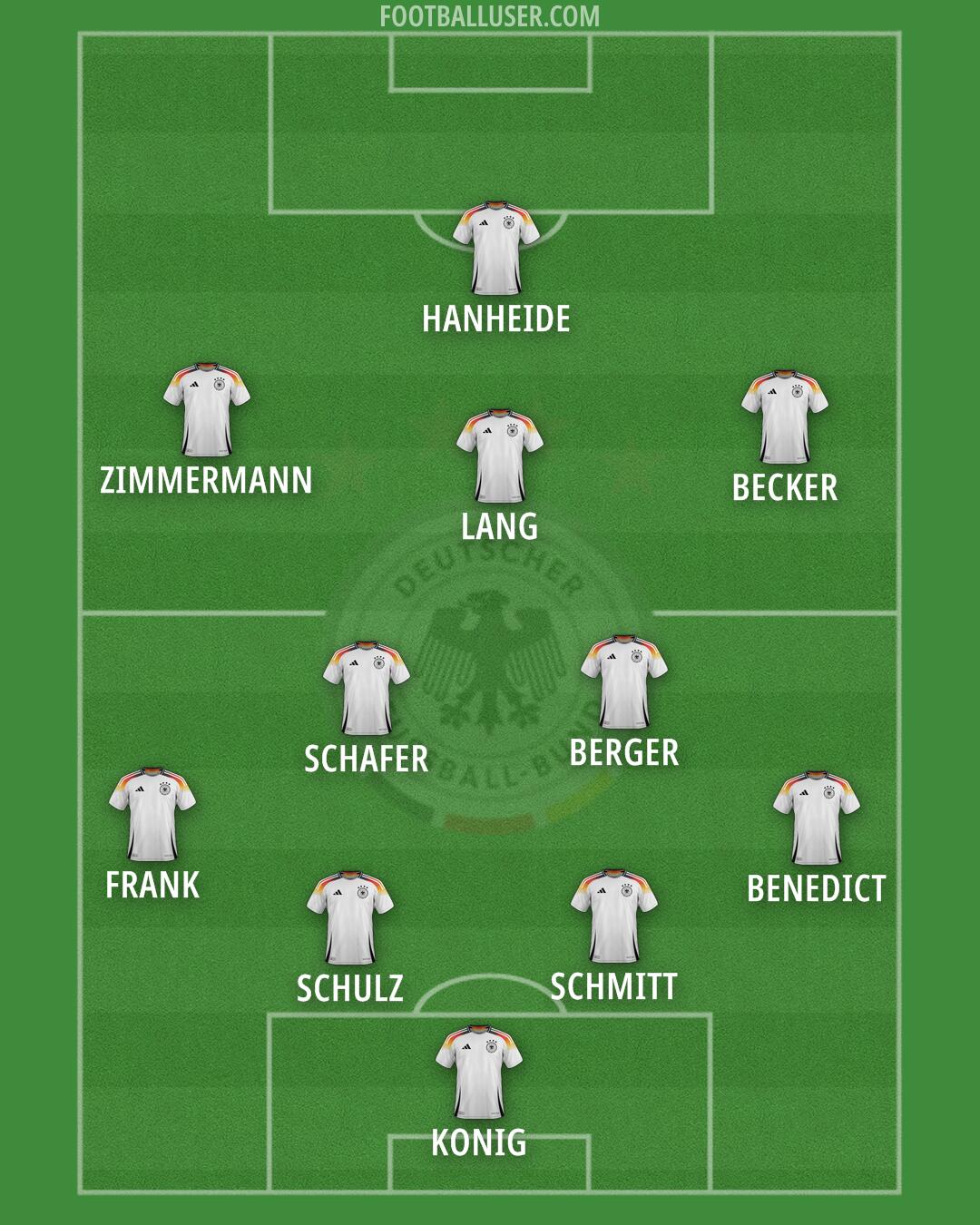

Germany National Football Team Formation
 July 1, 2025
 PELUCOSAURIO


Starting Lineup
KONIG · SCHULZ · FRANK · SCHMITT · BENEDICT · SCHAFER · LANG · BERGER · ZIMMERMANN · HANHEIDE · BECKERGermany relies on heavy attacking intent to overwhelm opponents. This 4-2-4 formation is built to play a high press to win the ball back quickly in the final third. The team looks to pin the opposition deep and use the wide areas to stretch the defence.
KONIG stands between the posts to command the area. A flat back four serves as the foundation, with BENEDICT playing as the right back and FRANK acting as the left back. SCHULZ and SCHMITT occupy the central defender roles to protect the middle. These two must hold the line and stay compact to prevent runners from finding space behind. BENEDICT and FRANK are expected to push up to support the attack while ensuring they cover the space left behind when the team loses possession.
The midfield operates as a double pivot to provide balance. SCHAFER and BERGER work together to control the center of the pitch. SCHAFER often drops deep to collect the ball from the defenders, while BERGER acts as a carrier to move the play forward. Their main job is to shield the defence and recycle possession when the attack stalls. By occupying the central spaces, they attempt to intercept passes and prevent the opposition from playing through the lines.
A powerful front line drives the attacking intent for Germany. ZIMMERMANN plays on the left wing and BECKER operates on the right wing, both looking to cut inside or get to the byline to whip it in. In the center, LANG and HANHEIDE act as two forwards in a partnership. They work to find space between the defenders and combine in tight spaces to create chances. The wingers stretch the width of the pitch, which allows LANG and HANHEIDE to make runs in behind or arrive late into the box to finish crosses.
This lineup offers significant tactical advantages through its attacking numbers. The team can create wide overloads when the full backs overlap the wingers. Having four players high up the pitch allows for the ability to press high in coordinated waves, making it difficult for the opponent to build from the back. The speed of transition is a major factor, as the team can move from a defensive block to a direct attack very quickly.
The 4-2-4 formation makes Germany a constant threat in the final third through relentless pressure. This system is best suited for matches where the team needs to chase a goal or face an opponent that struggles to play out from the back.