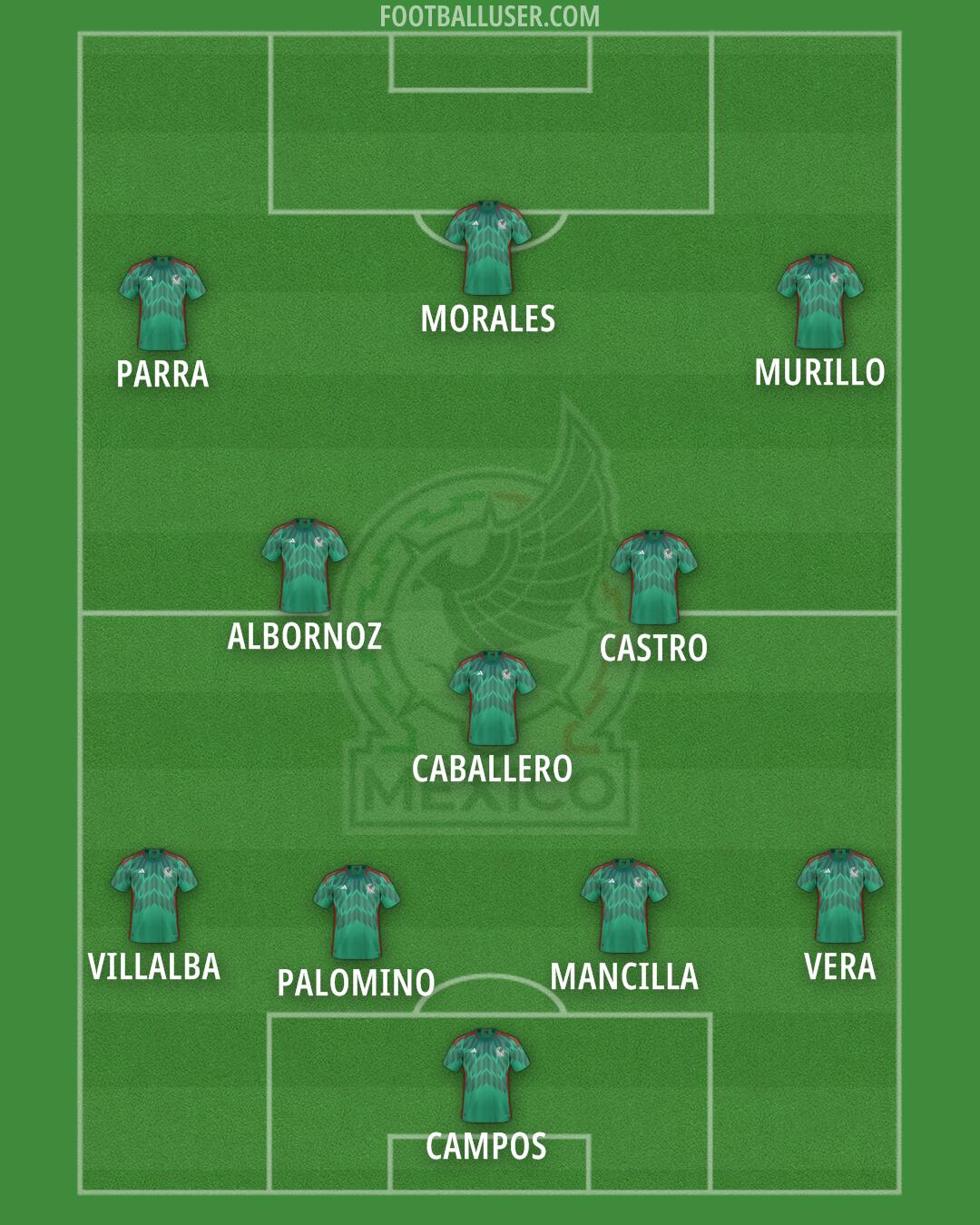

Mexico National Football Team Formation
 July 2, 2025
 PELUCOSAURIO


Starting Lineup
CAMPOS · VERA · MANCILLA · PALOMINO · VILLALBA · MURILLO · MORALES · PARRA · ALBORNOZ · CABALLERO · CASTROMexico focuses on winning the ball back high up the pitch through a heavy press in a 4-3-3. This lineup is built to play a direct game that looks to punish teams in transition by using wide runners. The team seeks to control the tempo through quick ball movement and aggressive verticality.
CAMPOS stays between the posts to manage the defensive line. The back four operates as a zonal line where VERA and VILLALBA act as full backs to provide width. MANCILLA and PALOMINO form the central pairing, with MANCILLA looking to cover the space behind the attacking full backs while PALOMINO stays more central to win headers. The unit must stay compact to prevent the opposition from playing through the lines.
A three-man midfield controls the center of the pitch. CABALLERO plays as a single pivot to shield the defence and recycle possession. On either side, ALBORNOZ and CASTRO work as inverted eights to connect the defensive and attacking lines. ALBORNOZ looks to press aggressively to win the ball high, while CASTRO drives forward with the ball to carry it into the final third. This midfield trio works to compress the midfield when the team does not have the ball.
The attacking unit uses three attackers to stretch the defence. MORALES acts as the pressing centre-forward to pin the last defender and win the second ball. PARRA and MURILLO play as wide wingers who hug the touchline to create width. These wingers look to isolate a one-on-one wide or cut inside to find the feet of the striker. The attack is built to create runs in behind and deliver crosses from the byline.
Mexico offers several tactical advantages with this formation. The team can create wide overloads when VERA and VILLALBA push up to overlap the winger. They also possess the ability to press high in coordinated waves, using the front three to trigger a press. This forces the opponent to play long balls, which the central defenders can then intercept.
This 4-3-3 formation relies on high intensity and quick transitions to overwhelm the opponent. It is best suited for matches against teams that struggle to play out from the back under pressure.