Custom Team Football Formation
 July 2, 2025
 Nacho1605


Starting Lineup
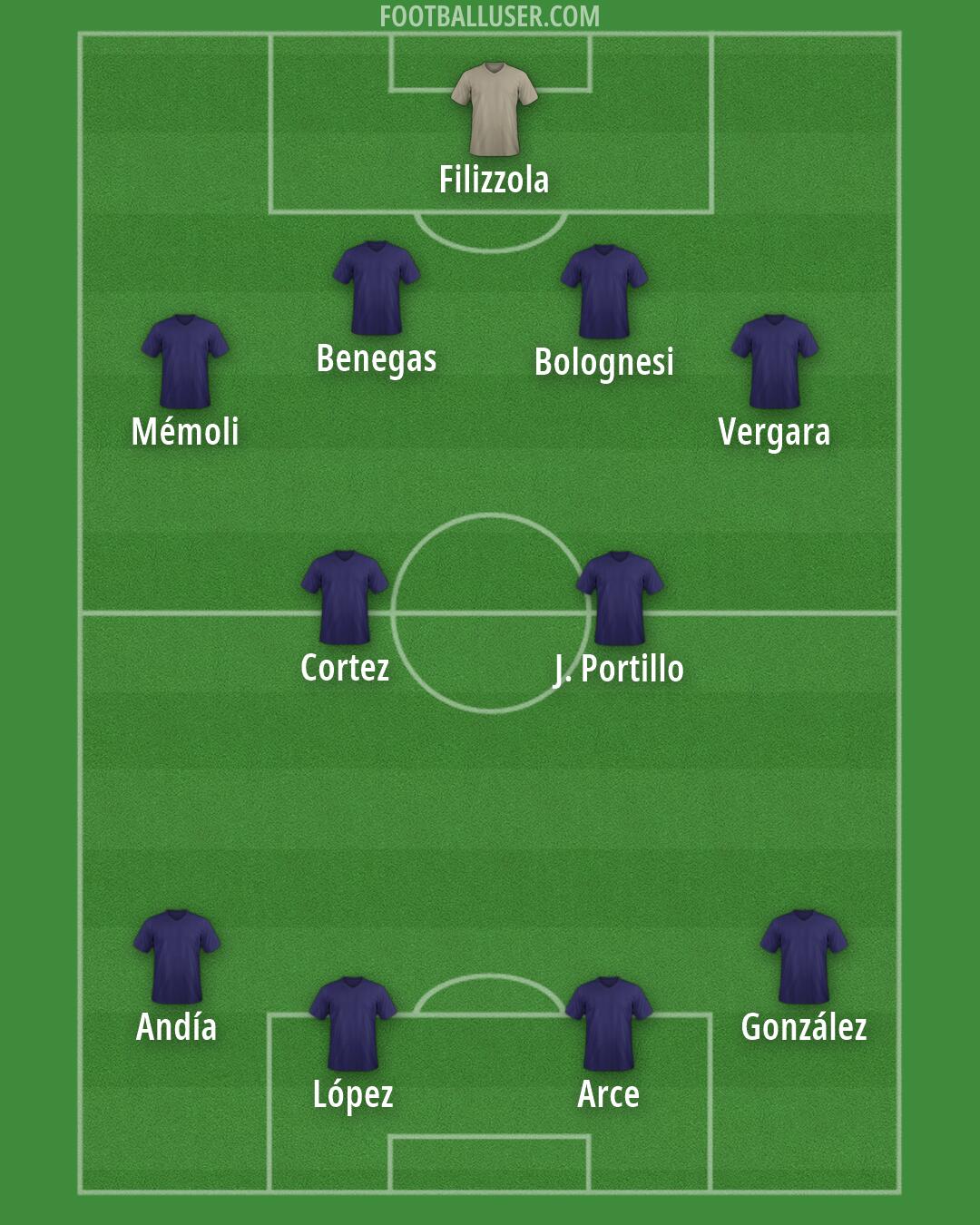
Filizzola · Mémoli · Benegas · Bolognesi · Vergara · Cortez · J. Portillo · Andía · López · Arce · GonzálezA heavy focus on direct verticality and overwhelming numbers in the final third defines this lineup, which operates in a 4-2-4 formation. This system aims to punish opponents by hitting them in behind and using wide players to stretch the pitch. The goal is to create rapid transitions that move the ball from the defensive unit to the front four as quickly as possible.
Filizzola acts as the last line of defense in goal. The defensive unit sits as a flat back four with Mémoli at right back and Vergara at left back. Both wide defenders are expected to push up to support the attack when the team has the ball. In the middle, Benegas and Bolognesi form the central pairing, where Benegas operates as a right-sided centre back and Bolognesi as the left-sided centre back. They must hold the line and stay compact to avoid being caught by long balls.
The midfield consists of a double pivot to provide a base in front of the back four. Cortez and J. Portillo work together to control the center of the pitch. Cortez acts as a carrier to drive the ball forward, while J. Portillo works to protect the defensive line and recycle possession. These two midfielders serve as the vital link, connecting the defenders to the attacking quartet and helping to win the second ball when the ball is cleared by the opposition.
With four players across the front, the attacking structure is designed to pin the last defender. López and Arce operate as a partnership of two centre forwards, often working to find space between the opposing centre backs. On the wings, Andía and González act as wide wingers who hug the touchline to spread the defense wide. This allows the forwards to exploit the gaps created by the wingers, making the team very dangerous when they can play through the lines or use cutbacks from the byline.
One major tactical strength of this formation is the ability to create wide overloads when the full backs join the wingers. Another advantage is the sheer number of players in the box, which makes it difficult for the opposition to mark every runner. The speed of transition allows the team to move from a defensive block to an attacking state in seconds, often catching the opponent out of position.
This high-risk, high-reward formation is built for teams that want to dominate the final third through direct play. It is best suited for games against opponents who sit in a deep low block and can be stretched by wide movements.