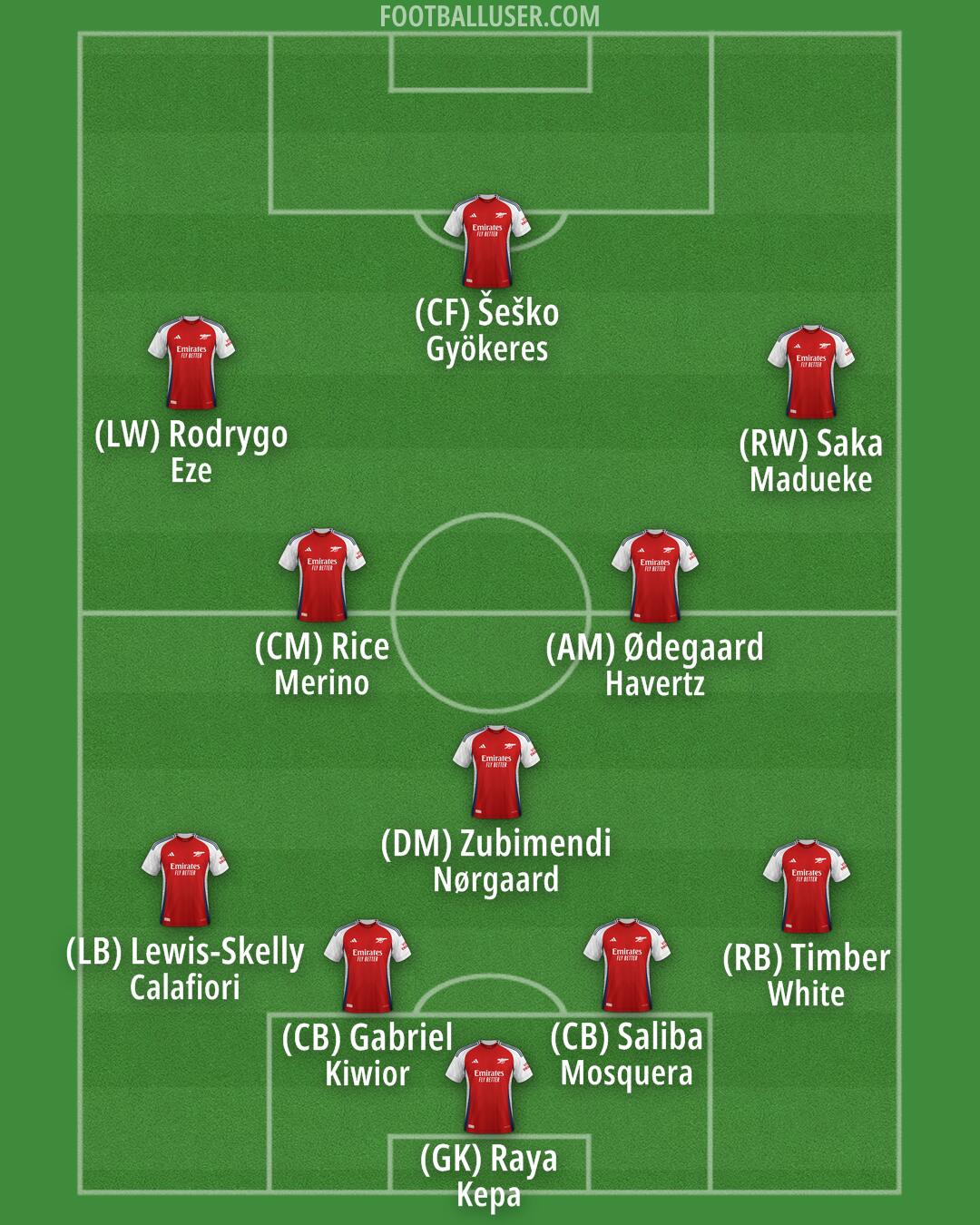
Arsenal Football Formation
 July 6, 2025


Starting Lineup
(CF) Šeško (Gyökeres) · (RW) Saka (Madueke) · (LW) Rodrygo (Eze) · (CM) Rice (Merino) · (AM) Ødegaard (Havertz) · (RB) Timber (White) · (CB) Saliba (Mosquera) · (CB) Gabriel (Kiwior) · (LB) Lewis-Skelly (Calafiori) · (GK) Raya (Kepa) · (DM) Zubimendi (Nørgaard)Arsenal focuses on controlling games through high pressing and rapid transitions, utilizing a 5-2-3 formation. This lineup is built to squeeze the pitch and dominate the ball in the attacking third. The Gunners aim to use their defensive stability to launch direct attacks when they win the ball high up the pitch.
David Raya operates between the posts to start play from the back. The defensive unit functions as a back five with Zubimendi sitting as the central man in the defensive line. Gabriel and Saliba play as the left and right centre backs, where they use their aerial strength and physical presence to clear the lines. Timber acts as a right wing back to provide width, while Lewis-Skelly plays as the left wing back to push forward. This unit can drop into a low block or step up to catch opponents offside.
The midfield consists of a two-man engine room. Declan Rice plays as the left midfielder to shield the defense and win the second ball, while Martin Ødegaard operates as the right midfielder to create from deep and connect the lines. Rice often works to intercept passes and protect the back five, whereas Ødegaard looks to play through the lines to find the front three. This pairing relies on heavy work rates to cover the ground between the defensive and attacking units.
Arsenal employs three attackers to stretch the opposition. Šeško acts as the lone striker and target man to hold up the ball and pin the last defender. On the wings, Saka and Rodrygo act as inverted wingers who cut inside to attack the near post or create space for overlapping runs. Saka is known for his dribbling style and ability to isolate defenders one on one. These forwards press from the front to force a long ball from the opposition.
This formation offers significant tactical advantages. Arsenal creates wide overloads when Timber and Lewis-Skelly push up to support the wingers. The side also gains numerical superiority in the final third during transitions. The compactness when defending makes it very difficult for opponents to find space between the lines.
The 5-2-3 lineup provides a robust platform for teams that want to marry defensive solidity with aggressive wing play. It is best suited for matches against opponents that struggle to deal with high pressure and rapid width.