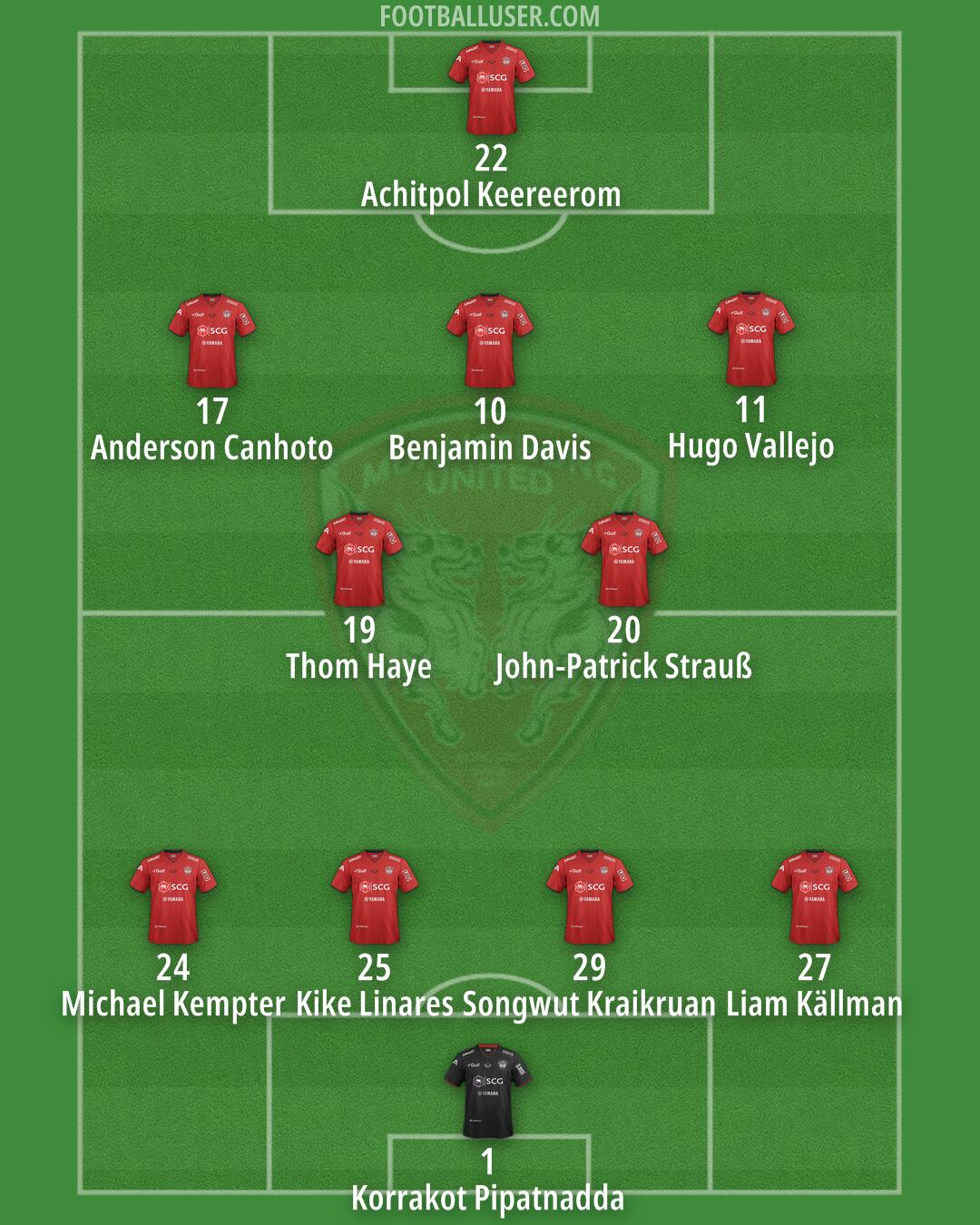

Muangthong Utd Football Formation
 July 12, 2025


Starting Lineup
1 (Korrakot Pipatnadda)10 (Benjamin Davis)
27 (Liam Källman)
24 (Michael Kempter)
29 (Songwut Kraikruan)
25 (Kike Linares)
20 (John-Patrick Strauß)
19 (Thom Haye)
17 (Anderson Canhoto)
11 (Hugo Vallejo)
22 (Achitpol Keereerom)
Muangthong Utd looks to control the middle of the pitch through a heavy concentration of players in a 4-5-1. This formation is built to play a mid-block game where the team can clog the central areas and force the opposition to the wings. By packing the midfield, the lineup aims to win the second ball and maintain defensive solidity when the opponent tries to move through the center.
The defensive unit begins with 1 between the posts. A flat back four forms the foundation of the defense. 29 and 25 act as the central defenders, where they must mark the opposition strikers and clear the lines when pressure arrives. To the sides, 27 and 24 act as full backs. They must track back to cover the wide areas and prevent crosses, while also being ready to step up when the team pushes the line higher. The unit works together to maintain a compact formation when the opposition has the ball.
In the center, Muangthong Utd employs a five man midfield to dominate the central zones. 20 and 19 operate as a double pivot to shield the defense and disrupt play. Ahead of them, 10, 17, and 11 occupy the central and half spaces to connect the defensive and attacking lines. The role of 10 is to create from deep and recycle possession, while 17 and 11 act as carriers to drive forward with the ball. This group works to squeeze the space between the lines and press in a mid-block to win the ball back.
The attack relies on a lone striker, 22, who must hold up the ball to bring others into play. Because the midfield is so crowded, the attack is built through quick transitions rather than sustained possession. 22 works to pin the last defender and create space for 17 and 11 to arrive late into the box. The wide areas are often targeted by 27 and 24 overlapping the midfielders to provide width. When the team wins the ball, they look to hit in behind on the transition to catch the defense off guard.
One major advantage of this formation is the numerical superiority in midfield, which makes it very hard for opponents to play through the middle. The presence of 20, 19, 10, 17, and 11 allows for a very compact block that is difficult to break down. Another strength is the ability to win the second ball in the middle of the pitch. This allows the team to switch play quickly or start a fast break once the ball is recovered.
This 4-5-1 formation is a solid choice for teams looking to sit deep and strike on the break. It is best suited for matches against ball dominant sides where controlling the central zones is a priority.