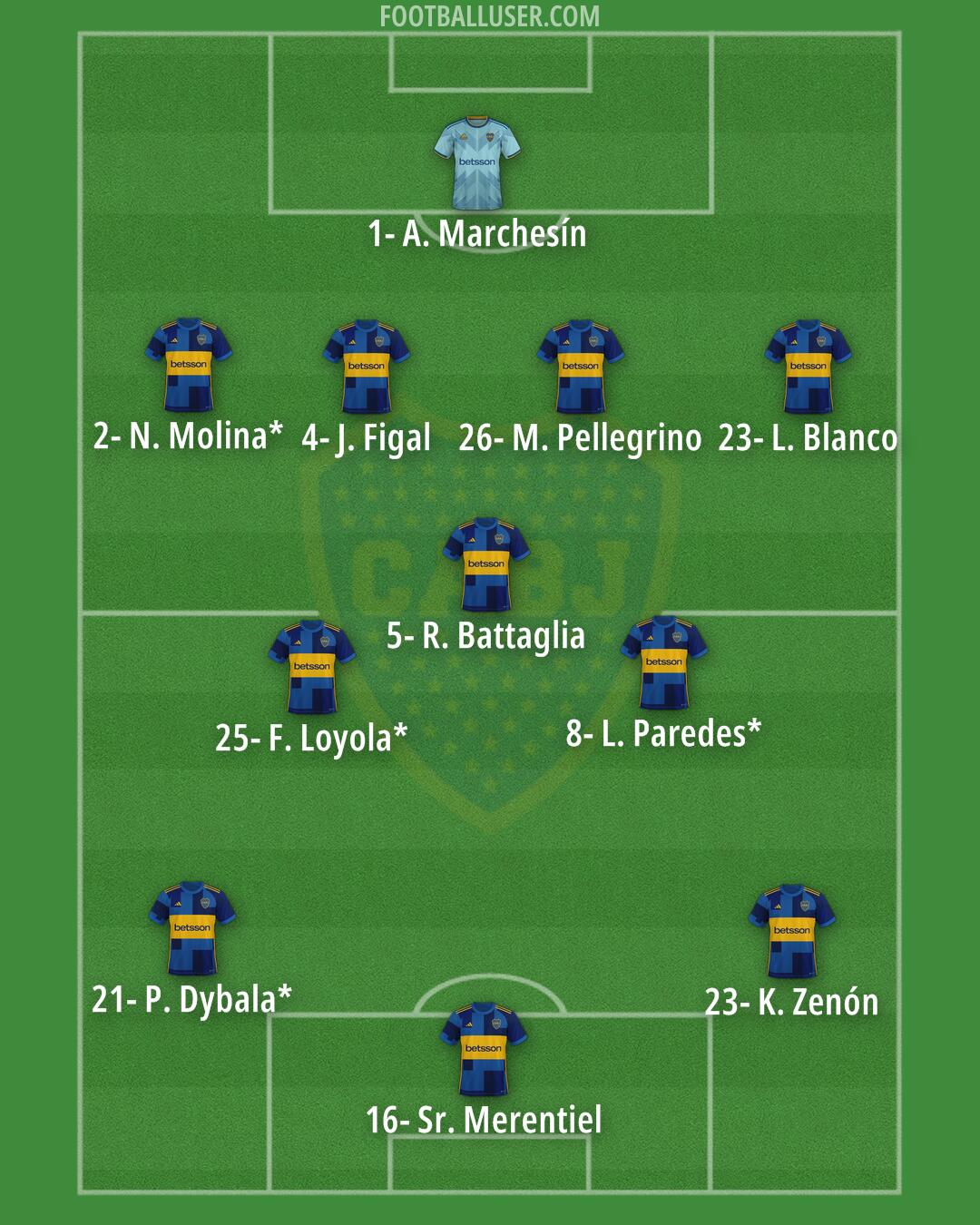

Boca Football Formation
 July 12, 2025


Starting Lineup
1- A. Marchesín2- N. Molina*
4- J. Figal
26- M. Pellegrino
23- L. Blanco
5- R. Battaglia
25- F. Loyola*
8- L. Paredes*
21- P. Dybala*
16- Sr. Merentiel
23- K. Zenón
Boca aims to dominate through heavy possession and a high press using a 4-3-3 formation. This lineup is built to control the ball in the middle third and use technical quality to break down low blocks. The team seeks to squeeze the space in the opponent half to win it back high up the pitch and launch quick attacks.
A. Marchesín starts in goal to command the area and play short from the back. The defensive unit operates as a flat back four. J. Figal and M. Pellegrino act as the central pairing, with Figal serving as a ball playing defender to help build play. L. Blanco acts as an attacking left back to provide width, while N. Molina provides balance on the right. The defenders must hold the line and stay compact to deny the turn to any incoming strikers.
The midfield consists of a single pivot and two advanced eight roles. R. Battaglia sits in front of the back four to shield the defence and recycle possession. Beside him, L. Paredes and F. Loyola operate as inverted eights who connect the defensive and attacking lines. Paredes uses his passing range to find teammates deep in the final third, while Loyola looks to carry the ball forward and press aggressively to win the ball high. This three-man midfield is the engine that allows Boca to progress through the thirds.
Up front, the team utilizes three attackers to stretch the defence. K. Zenón plays as an inverted winger on the left, looking to cut inside and create chances. On the opposite flank, P. Dybala operates as an inverted winger who also looks to find the feet of the striker or make runs in behind. Sr. Merentiel acts as the central presence, using his movement to pin the last defender and hold up the ball. This front line works to create combinations through quick passing and movement in tight spaces.
One major tactical advantage is the numerical superiority in midfield which allows the team to control the tempo of the game. The ability to press in pairs in the final third creates many turnovers in dangerous areas. Additionally, the movement of the wingers allows the full backs to overlap and create wide overloads, forcing the opposition to shift side and leave gaps in the middle.
This 4-3-3 formation relies on technical players to maintain control and high intensity. It is best suited for matches against teams that sit deep and defend in a mid-block.