Newcastle Football Formation
 July 13, 2025


Starting Lineup
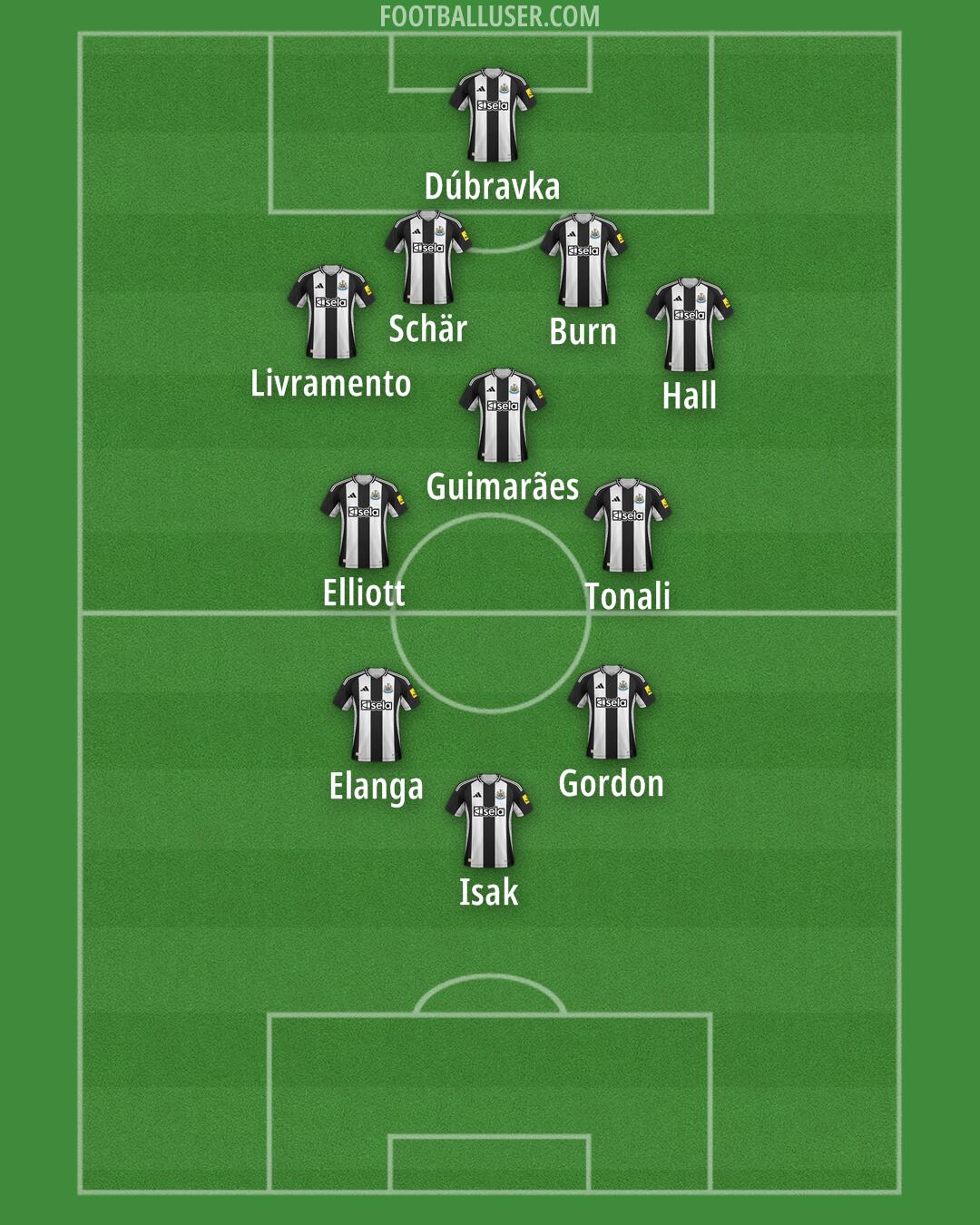
Isak · Elanga · Gordon · Dúbravka · Burn · Livramento · Tonali · Guimarães · Hall · Schär · ElliottNewcastle seeks to control the tempo through a high press and quick transitions, operating within a 4-5-1 formation. This lineup is built to squeeze the space in the middle of the pitch and win the ball back high up the pitch. The team relies on a compact defensive unit to force errors before launching direct attacks.
Isak sits between the posts as the goalkeeper. The back line functions as a flat back four where Tonality plays as the right back to provide width. Elliott acts as the left back, while Elanga and Gordon operate as the two central defenders. Elanga and Gordon are tasked to defend zonally and hold the line against runners. They must stay coordinated to win the second ball and ensure they do not get caught out when the team pushes up.
The midfield consists of a single pivot and four supporting players to create a dense block. Guimarães operates as the single pivot to shield the defence and recycle possession. Schär and Burn act as the two central midfielders, with Schär looking to carry the ball forward and Burn to win the second ball in central areas. Hall and Livramento operate on the flanks as wide midfielders, tasked to track back and cover the full backs when the team loses possession. Guimarães is the key player to deny the pivot of the opposition and break the line with vertical passes.
Dúbravka acts as a lone striker to lead the line. He must hold up the ball to allow the wide midfielders, Hall and Livramento, to join the attack. The attacking plan involves the forwards press from the front to force a long ball from the opposition. Newcastle looks to use the wide midfielders to stretch the defence, creating space for Schär or Burn to arrive late into the box. When the team wins the ball, they look to hit in behind on the transition with quick passes to Dúbravka.
One major advantage for Newcastle is the ability to press high in coordinated waves, using the front five to squeeze the opposition. The midfield density provides compactness when defending, making it very difficult for opponents to play through the lines. Another strength is the speed of transition, as the team can move from a defensive block to an attacking phase very quickly once Guimarães recovers the ball.
This 4-5-1 formation provides a reliable way to congest the central areas and frustrate opponents. It is best suited for games against teams that rely heavily on possession in the middle of the pitch.