Rangers Football Formation
 July 21, 2025


Starting Lineup
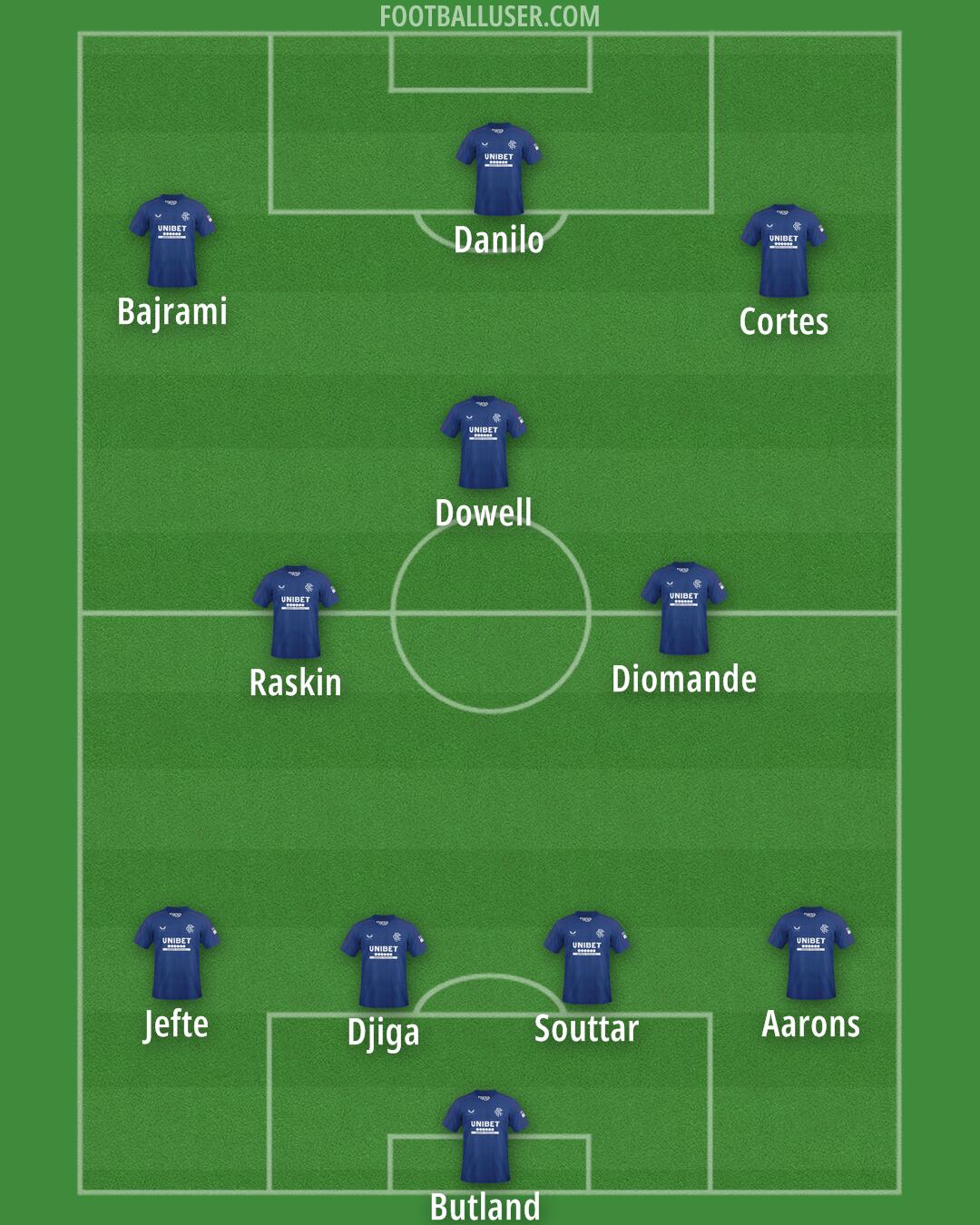
Butland · Aarons · Souttar · Djiga · Jefte · Raskin · Dowell · Diomande · Bajrami · Cortes · DaniloRangers look to control matches through high intensity and directness in a 4-3-3. This formation is built to win the ball back high up the pitch and quickly transition into attacking phases. The lineup focuses on verticality, looking to move the ball from the back to the front line as fast as possible to catch the opposition out of position.
Jack Butland sits in goal to command the area and organize the defensive unit. The back line operates as a flat back four, with Aarons and Jefte playing as full backs to provide width. Souttar acts as a dominant presence in the air to win headers, while Djiga covers the space behind and can step up to intercept passes. This defensive unit works to hold a high line, squeezing the space between the defenders and the midfield to make the pitch as small as possible.
The midfield functions as a three-man midfield with a carrier and a creative link. Diomande works to shield the defence and win second balls, allowing Raskin to drive forward with the ball into the half spaces. Dowell operates as an attacking ten behind the striker, looking to find pockets of space and connect the midfield to the attack. This trio works to compress the midfield, ensuring that when possession is lost, they can immediately trigger a press to win it back.
Rangers employ three attackers across the front to stretch the defence. Danilo acts as a pressing centre-forward who can hold up the ball and link play, while Bajrami and Cortes work as inverted wingers who cut inside to create goalscoring chances. Bajrami looks to pull wide to stretch the defence before driving into central areas. The front line is designed to make runs in behind and use combinations in tight spaces to break the line of the opposition defence.
One major advantage for Rangers is the ability to press high in coordinated waves, forcing the opposition into mistakes. The formation also provides wide overloads when Aarons and Jefte push forward to support the wingers. Another strength is the speed of transition, as the midfield can quickly switch play to the wide areas once the ball is recovered.
This 4-3-3 setup is ideal for a team that wants to dominate through physical presence and rapid forward movements. It is best suited for games against opponents who struggle to play out from the back under heavy pressure.