Brentford Football Formation
 July 23, 2025


Starting Lineup
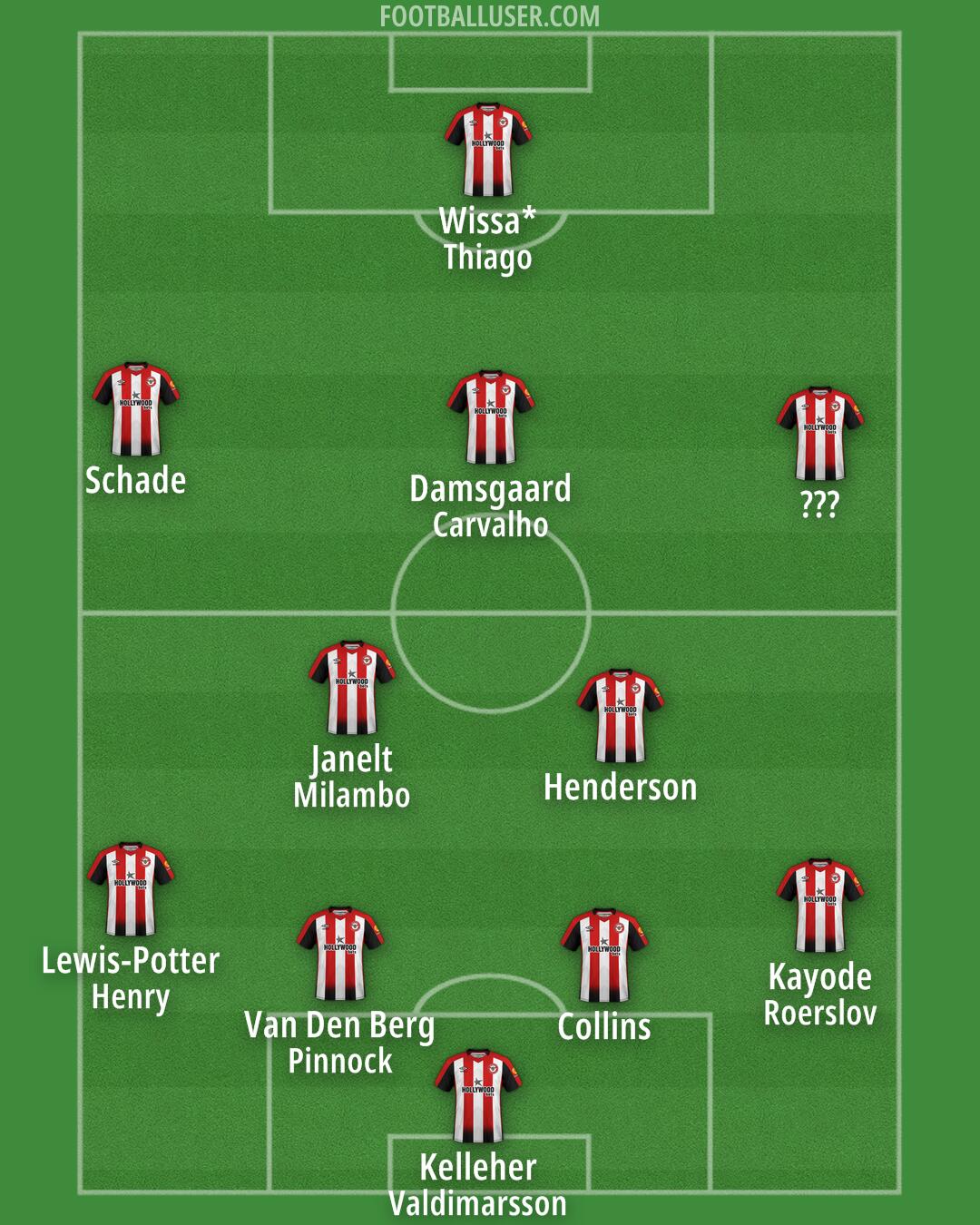
Kelleher (Valdimarsson) · Collins · Van Den Berg (Pinnock) · Kayode (Roerslov) · Lewis-Potter (Henry) · Damsgaard (Carvalho) · Schade · Wissa* (Thiago) · Henderson · Janelt (Milambo) · ???Brentford play with a high press and focus on quick transitions. The team uses a 4-5-1 formation to remain compact and hard to break down in the middle third. This lineup is built to sit in a mid-block and wait for the opposition to lose the ball before they look to hit them in behind.
Kelleher operates between the posts to organize the defensive line. The back line functions as a flat back four where Kayode and Lewis-Potter act as full backs to cover the wide areas. Collins and Van Den Berg form the central pair to defend the box. Collins is dominant in the air while Van Den Berg focuses on covering and intercepting passes to prevent through balls. The defensive unit stays narrow to deny the turn and force the opposition into wide areas.
In the middle of the pitch, Brentford employ a double pivot consisting of Henderson and Janelt. These two shield the defence and work to win the second ball. Damsgaard and Schade operate in the half-spaces to connect the defensive and attacking lines. The player ??? occupies the central position to help recycle possession and maintain the midfield lineup. This group works to press aggressively to win the ball high up the pitch and trigger a press to squeeze the space.
The attack relies on Wissa playing as a lone striker. Wissa acts as a pressing centre-forward to disrupt the opposition back line and force a long ball. When the team wins the ball, they look to break quickly with combinations in transition. The wide players Schade and Damsgaard push forward to support Wissa, creating runs in behind and looking to deliver early crosses. This movement is designed to isolate wide players in one on one situations or find the feet of the striker in the box.
One major advantage for Brentford is the compactness when defending. The five midfielders and four defenders create a very tight block that is difficult to play through. The team also benefits from numerical superiority in midfield when they transition into attack. This allows them to control the tempo and move the ball through the thirds to find space.
This 4-5-1 formation provides a solid base for a team that wants to strike on the counter. It is best suited for matches against teams that dominate possession and leave space behind their defensive line.