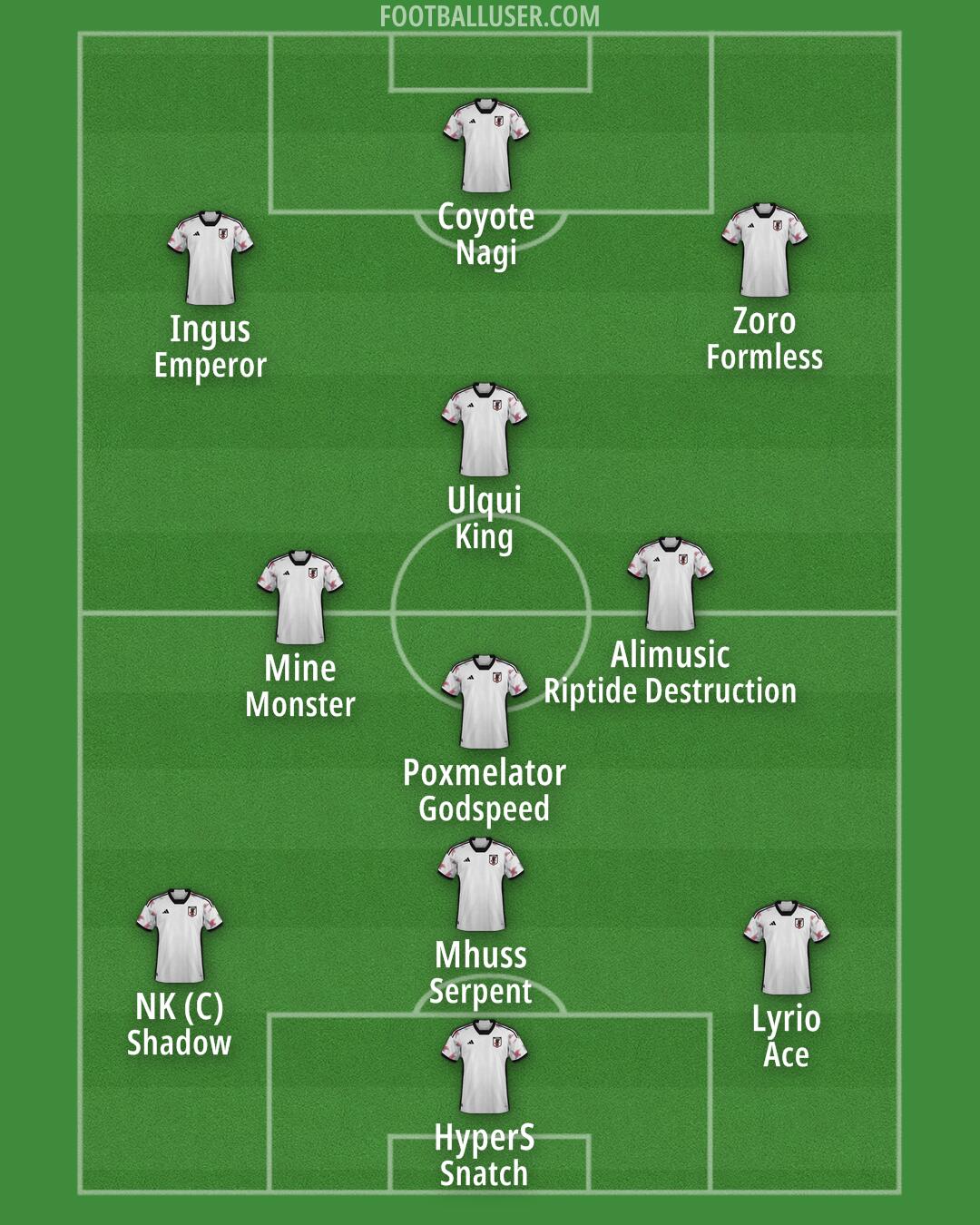

Japan National Football Team Formation
 July 24, 2025
 NK_Leonardoburst


Starting Lineup
NK (C) (Shadow) · Mhuss (Serpent) · HyperS (Snatch) · Lyrio (Ace) · Zoro (Formless) · Ulqui (King) · Ingus (Emperor) · Coyote (Nagi) · Alimusic (Riptide Destruction) · Poxmelator (Godspeed) · Mine (Monster)Japan intends to play with high aggression and a heavy emphasis on winning the ball back high up the pitch in a 2-4-4 formation. This lineup is built to overwhelm opponents in the final third by crowding the attacking zones and forcing errors through constant pressure. The team relies on a direct style to catch the opposition off guard before they can settle into a rhythm.
Coyote stays between the posts to act as the last line of defense. The defensive unit consists of a narrow back two with Zoro and Ingus acting as central defenders. These two must stay compact to protect the middle of the pitch while being ready to step up to catch attackers offside. Because there are no full backs, Zoro and Ingus have to be dominant in the air and quick to cover the space behind them if the opposition breaks quickly.
In front of the defense, the midfield works to control the center and provide a platform for the attack. Ulqui plays as a single pivot to shield the two defenders and pick up runners in the middle. Alimusic and Mine operate as two central midfielders who carry the ball forward and help recycle possession. Poxmelator acts as an attacking ten behind the strikers to connect the lines and find the feet of the attackers. This midfield group must press hard to deny the pivot of the opposition and force a long ball.
The attacking line is designed to pin the last defender and stretch the defense wide. NK, the captain, operates as an inverted winger on the right to cut inside and create chances, while Lyrio stays wide on the left to provide width. In the center, Mhuss and HyperS act as two forwards in a partnership to occupy the center backs. They work to run in behind the defense and create combinations in tight spaces, often looking to receive the ball in the pockets of space between the opposition midfield and defense.
Japan gains a massive advantage through numerical superiority in the attacking third. By pushing four players high, they can create wide overloads and force the opponent into a deep block. This formation also allows for a high press in coordinated waves, making it very difficult for the opposition to play out from the back. The speed of transition is a major threat when the midfield wins the ball and immediately hits in behind on the transition.
This formation is built for a high risk and high reward style of football. It is best suited for games where Japan needs to break down a defensive opponent through sheer attacking volume.