
Piast Football Formation
 July 24, 2025


Starting Lineup
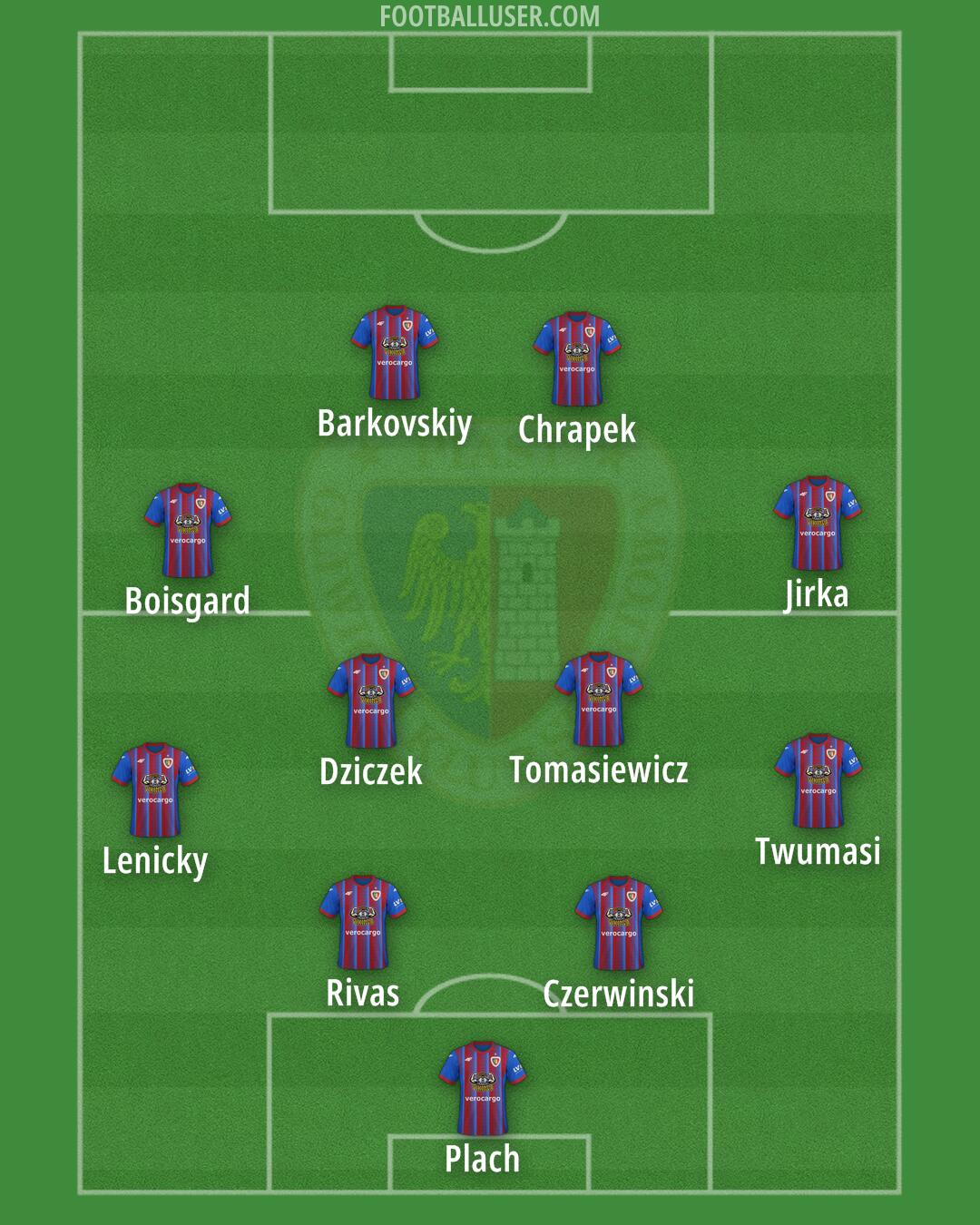
Plach · Rivas · Czerwinski · Twumasi · Lenicky · Dziczek · Tomasiewicz · Jirka · Chrapek · Boisgard · BarkovskiyPiast prioritizes verticality and direct attacking play through a 2-4-4 formation. This lineup is built to punish teams in transition by flooding the final third with numbers. The team aims to bypass the midfield quickly to find the forwards as soon as possession is won.
Plach stays between the posts to command his area. The back line consists of a narrow pair of central defenders in Czerwinski and Rivas. They play a high line to squeeze the space, acting as a two man block that relies on speed to cover the pitch. Czerwinski and Rivas must remain compact to avoid being split by through balls. The defensive unit functions by pushing up to support the midfield and maintaining a high line to keep the team compact.
A central midfield pairing of Dziczek and Tomasiewicz handles the ball in the middle of the pitch. Dziczek and Tomasiewicz act as the engines, working to win the second ball and drive the play forward. They connect the two central defenders to the front four. To provide width, Lenicky and Twumasi operate on the flanks. Lenicky and Twumasi work to push high up the pitch to create passing lanes and support the attack.
The attacking unit uses four players to stretch the opposition defence. Chrapek and Barkovskiy work as a two man striking partnership in the center. Chrapek and Barkovskiy look to find space between the defenders and hold up the ball. Boisgard and Jirka act as wide attackers, with Boisgard operating on the left and Jirka on the right. Boisgard and Jirka often cut inside to create central threats, while also looking to deliver crosses into the box. This front line is designed to create runs in behind and isolate defenders in one on one situations.
Piast offers significant advantages through numerical superiority in the attacking third. By committing four players forward, they create constant pressure on the opposition back line. The formation also allows for quick transitions, as the distance between the midfield and the forwards is minimal. This setup makes it hard for opponents to defend against rapid vertical passes.
This 2-4-4 formation creates a high octane attacking threat that relies on rapid forward movement. It is best suited for games where the team needs to break down a sitting defence or catch an opponent on the break.