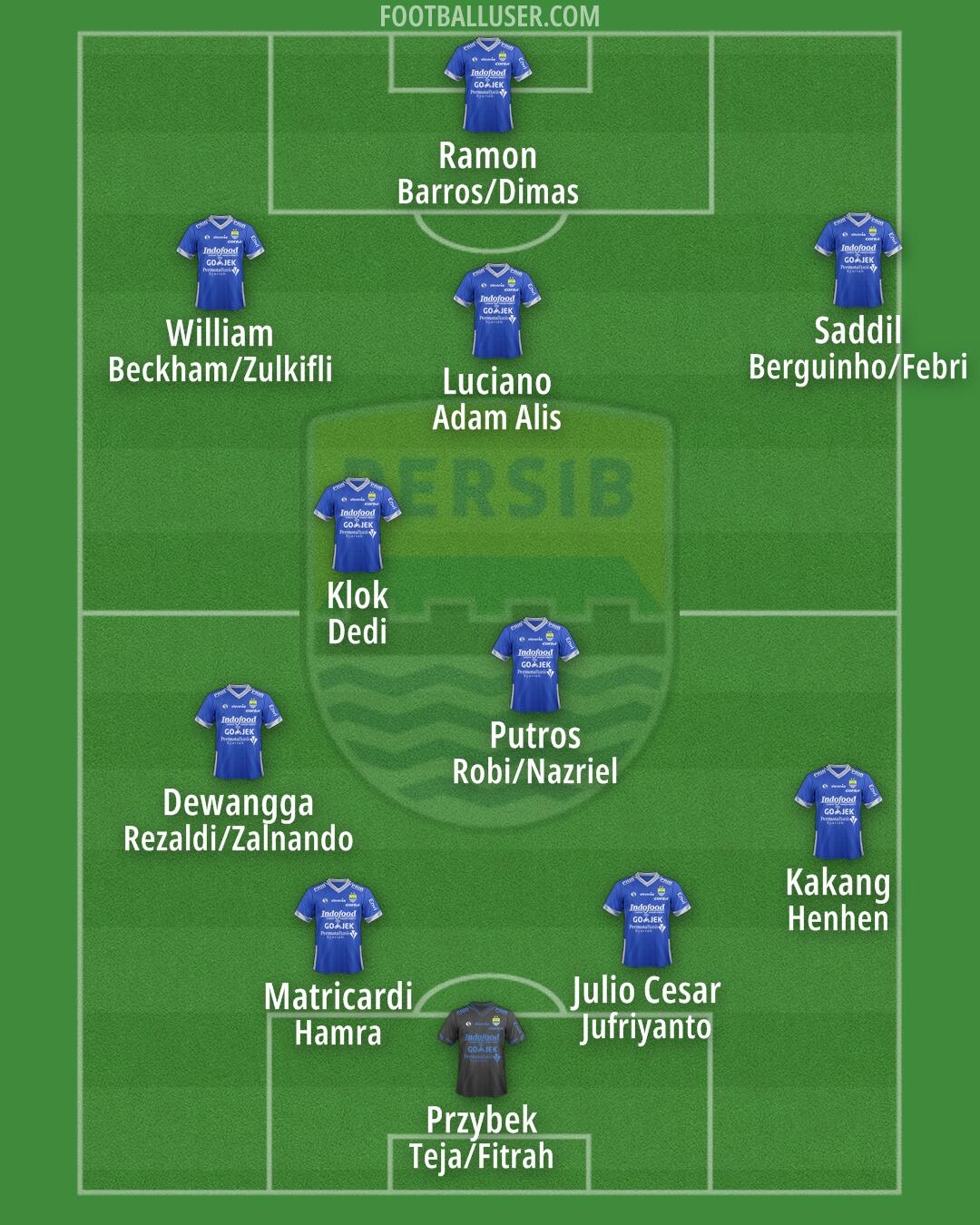

Persib Football Formation
 July 27, 2025


Starting Lineup
Przybek (Teja/Fitrah) · Kakang (Henhen) · Julio Cesar (Jufriyanto) · Matricardi (Hamra) · Dewangga (Rezaldi/Zalnando) · Putros (Robi/Nazriel) · Luciano (Adam Alis) · William (Beckham/Zulkifli) · Ramon (Barros/Dimas) · Klok (Dedi) · Saddil (Berguinho/Febri)Persib relies on a heavy verticality to catch opponents off guard, utilizing a 2-4-4 formation. This lineup is built to attack with numbers and exploit quick transitions. The team looks to move the ball forward with speed, seeking to overwhelm the opposition in the final third through rapid direct play.
Przybek stays between the posts to organize the defense. The back line consists of a narrow duo with Matricardi and Julio Cesar acting as the central defenders. They operate as a pair to cover the central channels, often needing to defend large areas of space. Matricardi and Julio Cesar must communicate well to win the second ball and clear the lines when the team is under pressure. Because there are only two at the back, they often have to step up to intercept passes or drop deep to cover the space left by the advancing midfield.
The midfield is organized as a four man unit to provide a platform for the attack. Kakang sits as a single pivot to shield the defense and win possession. Alongside him, Dewangga and Putros act as the central engines, with Dewangga looking to drive forward with the ball while Putros helps to recycle possession. Klok plays as an attacking ten behind the forwards, looking to find space between the lines and arrive late into the box. This group works to connect the defensive unit with the front four, ensuring the ball moves quickly from the back to the attack.
Persib employs a front four designed to stretch the defense. Luciano and Ramon operate as a central partnership, with Luciano acting as a target man to hold up the ball and Ramon looking to make runs in behind. On the flanks, William and Saddil act as wide wingers who stay near the touchline to provide width. They look to isolate one on one situations against full backs or whip it in to the central strikers. The attack relies on quick combinations and movement to pull defenders out of position, creating gaps for the midfielders to exploit.
A primary advantage of this Persib lineup is the ability to create numerical superiority in the attacking third. By pushing many players forward, they can create wide overloads and force the opposition to defend deep. The team also benefits from a high level of speed in transition, allowing them to hit opponents in behind before they can get organized. This aggressive posture makes them very dangerous when winning the ball high up the pitch.
This formation is designed for high risk attacking football that prioritizes speed and pressure. It is best suited for games where the team needs to break down a low block through sheer numbers in the box.