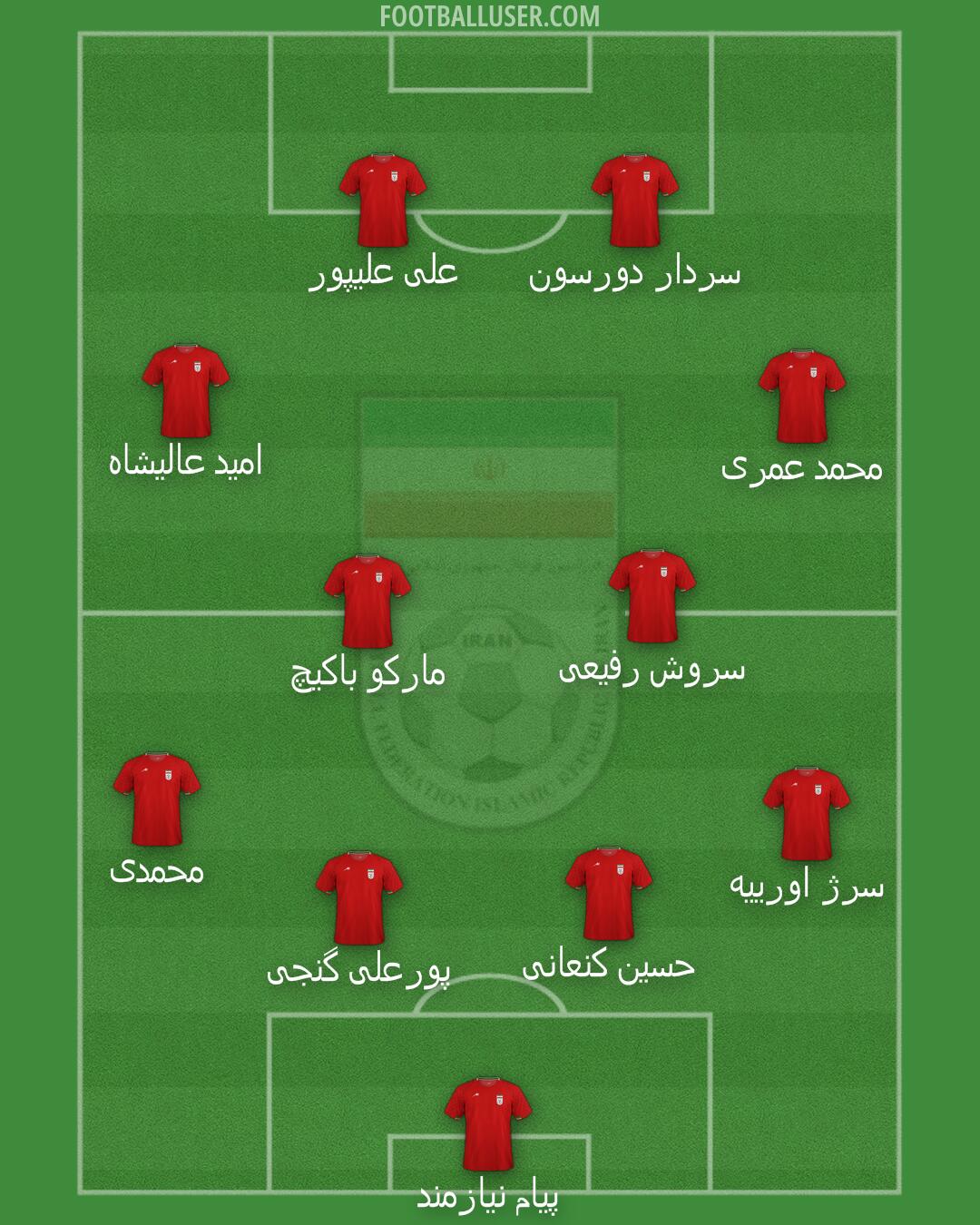

Iran National Football Team Formation
 August 2, 2025


Starting Lineup
سردار دورسون · علی علیپور · امید عالیشاه · سروش رفیعی · مارکو باکیچ · محمد عمری · پورعلی گنجی · محمدی · پیام نیازمند · حسین کنعانی · سرژ اورییهIran favors a direct and aggressive style of football through a 4-2-4 formation. This lineup is built to attack with heavy numbers and press the opposition back line high up the pitch. By spreading the players across the field, the team seeks to create mismatches in the final third and exploit space during transitions.
In goal, پیام نیازمند acts as the last line of defense for Iran. The back line functions as a flat back four, where محمدی operates as the left back and سرژ اورییه plays as the right back to provide width. The central defenders, پورعلی گنجی and حسین کنعانی, hold the line and defend zonally to manage the space behind them. They must be ready to step up to play the offside trap or drop back to cover runs in behind.
The midfield operates as a double pivot to provide some protection for the defense. مارکو باکیچ and سروش رفیعی occupy the central areas, tasked with winning the second ball and recycling possession. One midfielder must shield the defense while the other looks to drive forward and connect the defensive unit to the attacking quartet. Their main job is to protect the gaps left by the aggressive full backs and ensure the team is not caught out on the break.
The attack is incredibly front-heavy with three attackers positioned high up the pitch. سردار دورسون and علی علیپور work as a partnership in the center, acting as two forwards to pin the opposition defenders. On the flanks, محمد عمری and امید عالیشاه act as wide wingers who stretch the defense and look to cut inside or deliver crosses. This formation creates constant pressure on the opponent and looks to hit in behind on the transition with quick combinations.
A major tactical advantage of this 4-2-4 lineup is the ability to create wide overloads when the full backs push up to join the wingers. Iran can also use its numbers to press high in coordinated waves, making it difficult for opponents to build out from the back. This setup forces the opposition to defend deep, which opens up more room for the forwards to operate.
This formation relies on heavy attacking pressure and rapid forward movement to overwhelm the opponent. It is best suited for games where the team needs to score goals quickly or against opponents who struggle to handle high pressure.