
Valencia Football Formation
 August 4, 2025
 oiarbidexabi


Starting Lineup
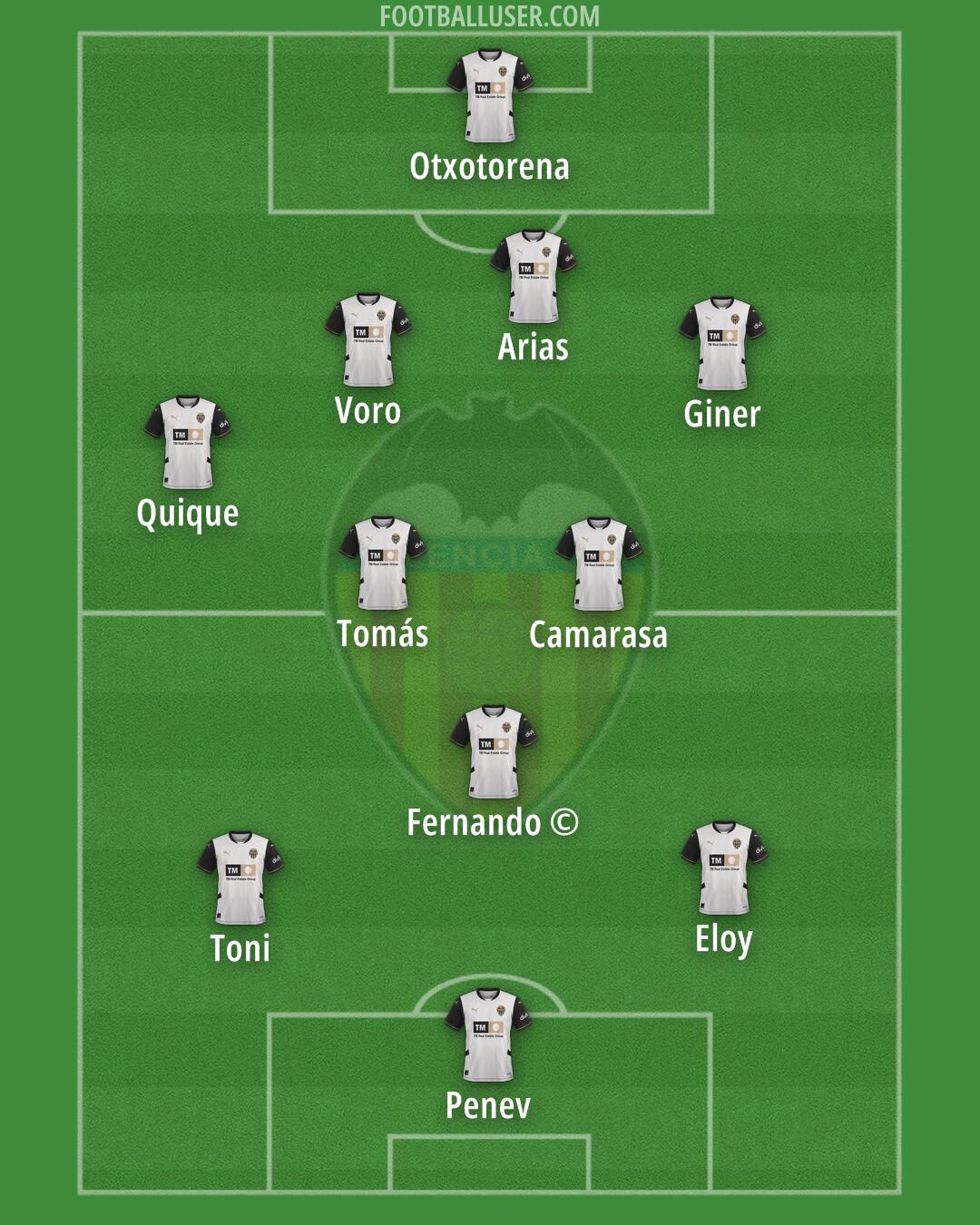
Otxotorena · Giner · Arias · Quique · Voro · Tomás · Fernando © · Penev · Camarasa · Eloy · ToniValencia looks to control the game through directness and high intensity in a 4-3-3. This formation is built to play a high press and transition quickly once the ball is recovered. The goal for Valencia is to use the width of the pitch to stretch the opposition and create spaces for central penetrative runs.
Otxotorena plays between the posts to organize the defensive line. A flat back four provides the foundation, with Giner and Quique acting as full backs to provide width. Giner pushes up to overlap the winger, while Quique holds a more conservative position to manage the wide areas. In the center, Arias and Voro defend as central defenders, with Arias often looking to step into midfield when the team plays out from the back. Voro stays deeper to cover and win headers during set pieces.
The midfield operates as a three-man midfield with a carrier and a creative hub. Fernando (C) acts as the attacking ten, operating in the pocket to link the midfield and attack. He is the captain and the main engine for progressing the ball through the lines. Camarasa plays as a central midfielder who looks to receive on the half-turn and switch play to the flanks. Tomás sits slightly deeper to shield the defense and win the second ball, ensuring the team stays compact when the opposition tries to play through the middle.
Up front, the team uses three attackers to pin the opposition back line. Penev operates as a pressing centre-forward, constantly working to disrupt the opponent's build up. Eloy and Toni occupy the wide positions as inverted wingers, cutting inside to create goal scoring chances. This movement creates space for Giner and Quique to push higher. The forwards focus on link-up play to allow Fernando (C) to arrive late into the box.
One major tactical advantage is the ability to press high in coordinated waves, using Penev, Eloy, and Toni to force a long ball from the defenders. The team also benefits from wide overloads when the full backs overlap the wingers. This creates numerical superiority in the final third, making it difficult for the opposition to defend the half spaces.
This 4-3-3 formation prioritizes high pressing and quick verticality. It is best suited for matches against teams that struggle to play out from the back under intense pressure.