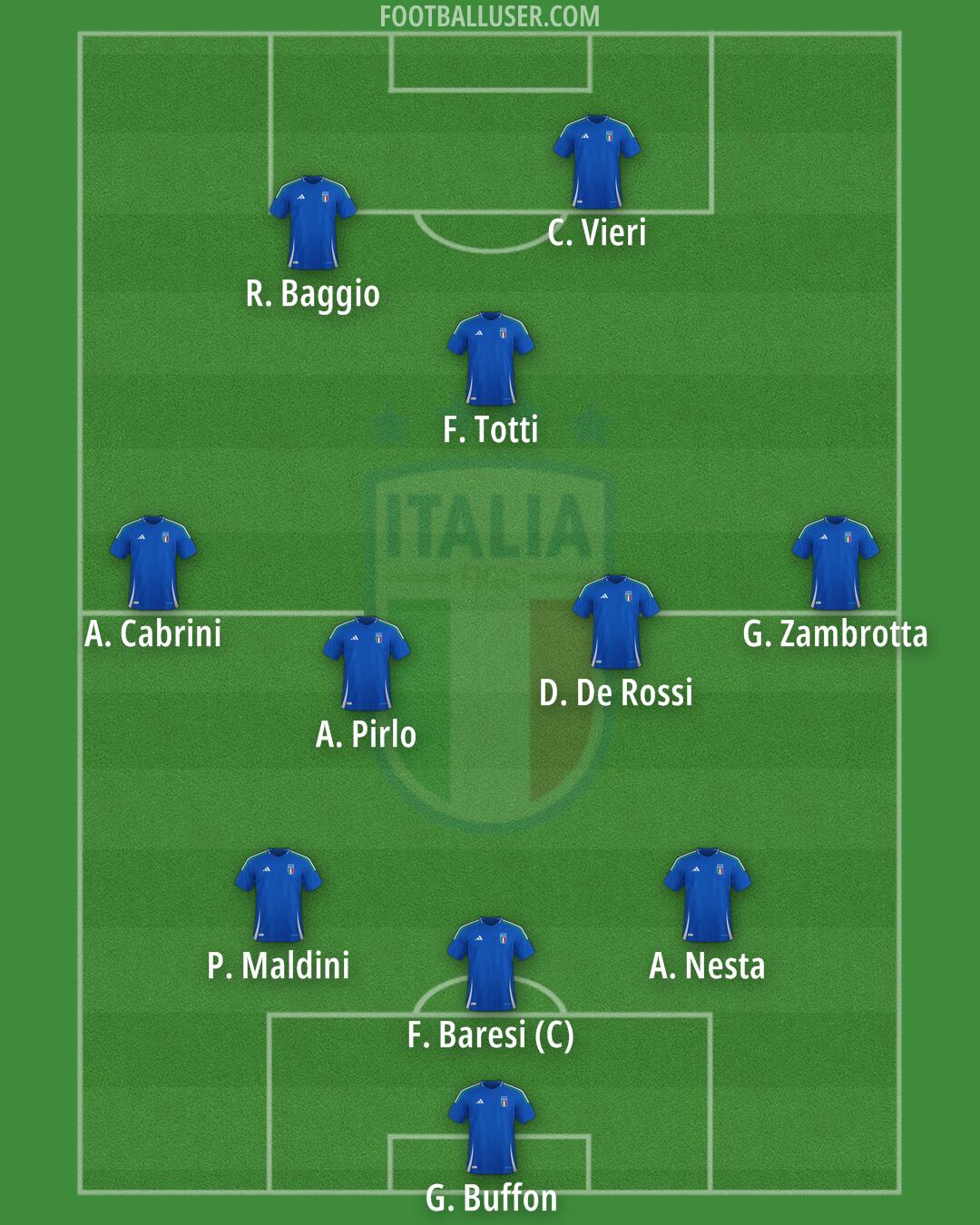

Italy National Football Team Formation
 August 8, 2025


Starting Lineup
G. Buffon · A. Nesta · P. Maldini · A. Pirlo · G. Zambrotta · D. De Rossi · F. Totti · R. Baggio · C. Vieri · A. Cabrini · F. Baresi (C)Italy focuses on a strong defensive base and efficient transitions, utilizing a 3-5-2 formation. This lineup is built to control the tempo through technical players while maintaining a heavy presence in the middle of the pitch. The tactical identity centers on being hard to break down and hitting opponents with direct passing when the ball is won.
G. Buffon guards the goal as the last line of defense. In front of him, Italy employs a back three that acts as a wall. F. Baresi (C) leads the defense as the central figure, organizing the line and reading the game to intercept passes. He is joined by A. Nesta on the right and P. Maldini on the left. Both Nesta and Maldini are capable of covering wide areas, acting as wide centre-backs who can slide out to face attackers. This unit stays compact to deny space between the lines, with Baresi often stepping up to meet the ball.
The midfield is a busy engine room designed to control the game. A. Pirlo sits in a deep-lying playmaker role, dropping deep to collect the ball and spray long passes to switch play. Beside him, D. De Rossi acts as the primary shield for the back three, using his grit to tackle and win the second ball. A. Cabrini and G. Zambrotta operate as wing backs, providing the necessary width by pushing high to overlap the midfield. F. Totti plays in the hole as an attacking ten, looking to find pockets of space to connect the midfield to the forwards.
The attack relies on a potent partnership of two forwards. C. Vieri acts as the target man, using his physical presence to hold up the ball and fight for headers. R. Baggio plays as a second striker, dropping into the space between the midfield and defense to create chances or arrive late into the box. The team builds the attack by moving the ball through the center or using the width provided by the wing backs to whip it in from the flanks. This combination of strength and creativity forces the opposition back line to stay deep.
Italy creates significant tactical advantages through its midfield control and defensive depth. The presence of A. Pirlo allows the team to dictate the rhythm, while the work rate of D. De Rossi ensures stability. A major strength is the ability to create wide overloads when Cabrini and Zambrotta push forward, stretching the defence and creating gaps for Totti and Baggio to exploit.
This 3-5-2 formation is built for teams that want to dominate central areas and maintain a solid defensive block. It is best suited for matches against opponents who play with narrow midfields and struggle to handle quick transitions.