Arsenal Football Formation
 August 10, 2025


Starting Lineup
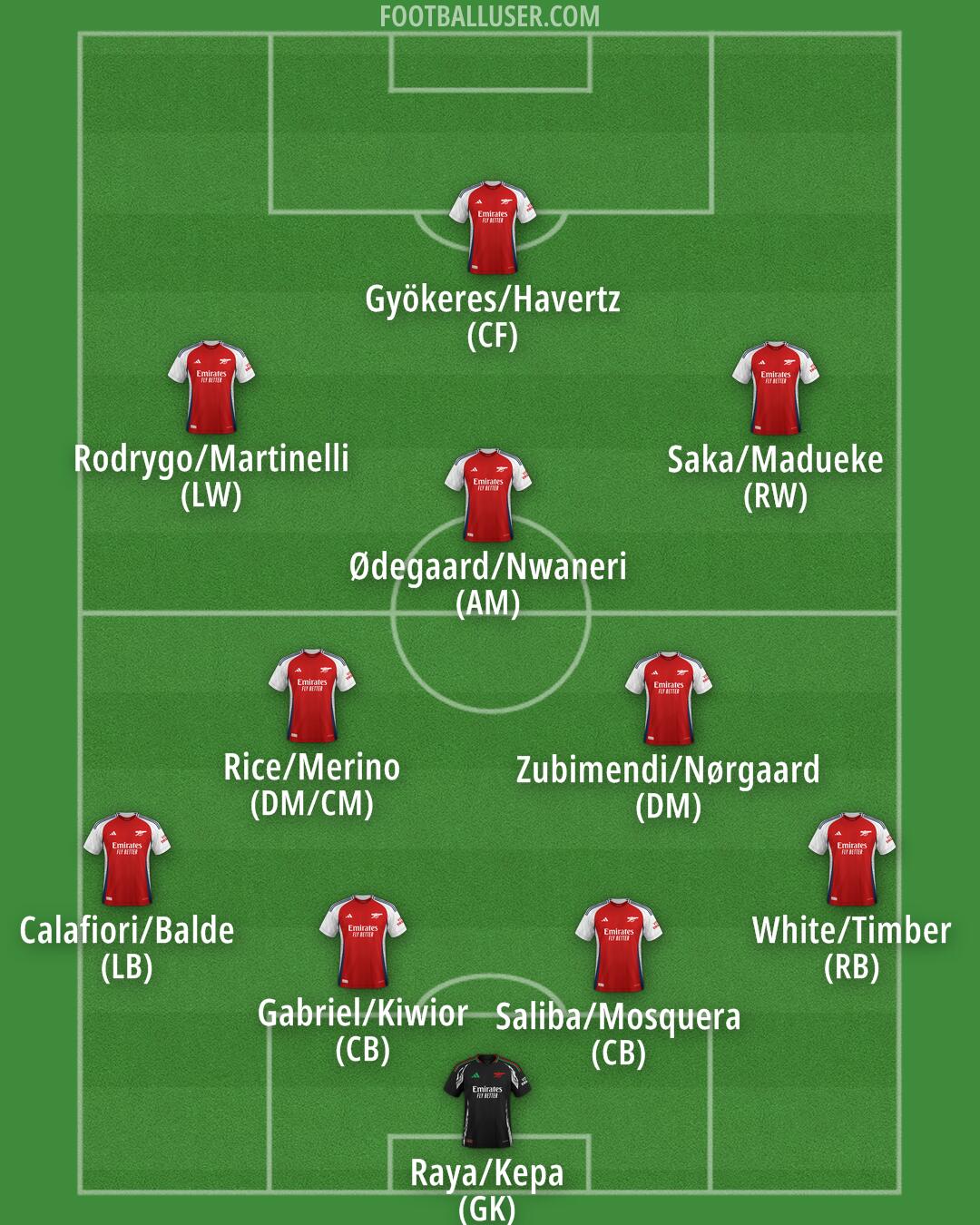
Raya/Kepa (GK) · Calafiori/Balde (LB) · Gabriel/Kiwior (CB) · Saliba/Mosquera (CB) · White/Timber (RB) · Zubimendi/Nørgaard (DM) · Rice/Merino (DM/CM) · Ødegaard/Nwaneri (AM) · Rodrygo/Martinelli (LW) · Gyökeres/Havertz (CF) · Saka/Madueke (RW)Arsenal focuses on high pressing and dominant possession within a 4-3-3 formation. This lineup aims to control the game by squeezing the space in the opposition half and winning the ball back high up the pitch. The Gunners look to play through the lines and create constant pressure to force mistakes from the back.
David Raya acts as the goalkeeper to start the play from the back. The back line consists of a flat back four featuring Ben White at right back and Riccardo Calafiori at left back. William Saliba and Gabriel serve as the central defenders to defend zonally and hold the line. Saliba uses his recovery pace to cover the space behind while Gabriel is dominant in the air during set pieces. This defensive unit works to stay compact and push up to keep the distance between the lines small.
The midfield operates with a three-man midfield including a deep-lying playmaker and two more advanced players. Martin Rice works to shield the defence and break the line with his ball carrying. Martin Zubimendi sits in the pivot to recycle possession and protect the center. Martin Ødegaard plays as the attacking ten behind the striker to find the feet of the forwards. This group connects the defence and attack by shifting the ball quickly to the flanks.
The attack uses three attackers across the front to stretch the defence. Bukayo Saka plays as an inverted winger on the right to cut inside and create chances. Rodrygo operates on the left wing to provide width and threat. Viktor Gyökeres acts as the pressing centre-forward to lead the line and hold up the ball. The front three look to create runs in behind and use combinations in tight spaces to get to the byline.
Arsenal gains a significant advantage through numerical superiority in the midfield when the full backs push high. The ability to press high in coordinated waves allows the team to win the second ball frequently. This setup also provides speed of transition to exploit gaps as soon as the ball is recovered.
This 4-3-3 formation is built for teams that want to dictate the tempo of the match through high intensity. It is best suited for games against opponents that play a low block and struggle with quick passing.