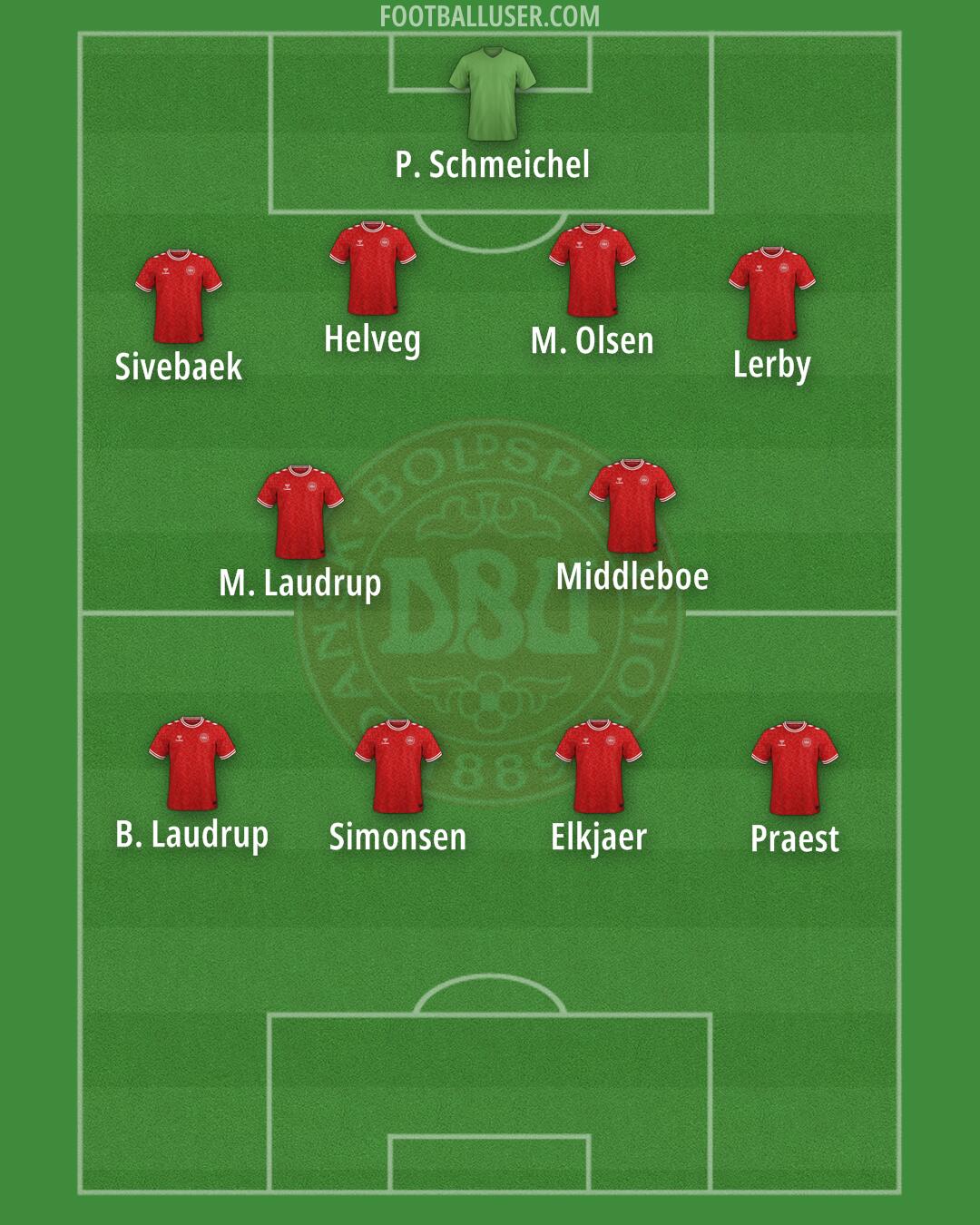

Denmark National Football Team Formation
 August 11, 2025


Starting Lineup
P. Schmeichel · Helveg · M. Olsen · Sivebaek · Lerby · M. Laudrup · Middleboe · B. Laudrup · Simonsen · Elkjaer · PraestDenmark focuses on an attacking identity, often looking to catch opponents out through direct play and quick verticality. This 4-2-4 formation is built to overwhelm the opposition through high numbers in the final third. The Red Devils look to win the ball and push forward quickly to exploit gaps in the opponent line and create scoring chances.
P. Schmeichel sits between the posts to organize the defense and direct his teammates. The defensive unit functions as a flat back four with Sivebaek at right back and Lerby at left back. Helveg and M. Olsen act as the central defenders, where Helveg works to cover the space and M. Olsen aims to win the header. The full backs push up to support the transition, but they must also track back to handle runners in the wide channels.
The midfield consists of a two-man unit with Middleboe and M. Laudrup. Middleboe plays to shield the defense and win the second ball in the center. M. Laudrup uses his passing range to connect the defensive line to the attack and find teammates in advanced positions. These two must work hard to cover the ground between the lines, often dropping deep to receive from the center backs before they try to play through the lines to the forwards.
In the attacking phase, Denmark uses four players across the front. B. Laudrup operates on the right wing, often cutting inside to find space with his dribbling and vision. Praest provides width on the left side to stretch the defense. Simonsen and Elkjaer work as a central strike partnership, looking to pin the last defender and make runs in behind. This formation creates constant pressure, as the forwards press the opposition back line to force a long ball.
The main strength of this formation is the ability to press high in coordinated waves. With four players in the front line, Denmark can squeeze the space and win the ball high up the pitch. Another advantage is the speed of transition, allowing the team to hit in behind on the transition using the pace of the wide players. This creates wide overloads when the full backs overlap the winger to deliver a cross.
This 4-2-4 formation is a high-intensity way to play that prioritizes attacking volume. It is best suited for situations where the team needs to break down a low block through sheer numbers and constant pressure.